
24-hour funding is defined as the process where a business receives capital within a single business day, eliminating the multi-day settlement delays that trap working capital and stall growth. For small business owners, this speed is not a convenience. It is a structural advantage that changes how you plan, spend, and scale. Understanding why 24 hour funding changes businesses requires looking past the marketing claims and into the mechanics of payment rails, batch cutoffs, and real cost of capital. Fordhamcapital has funded over $120M for businesses that needed capital fast, and the pattern is consistent: speed, when matched with the right terms, produces measurable results.
Settlement delays are the silent tax on every business that accepts card or ACH payments. Standard card processing runs on a two-to-three business day settlement cycle. That gap between the sale and the deposit is not just an inconvenience. It is trapped capital sitting in transit while your bills, payroll, and supplier invoices come due.
The numbers are concrete. Businesses processing $1 million per month with a standard two-day settlement delay have roughly $65,000 perpetually locked in transit. At a 10% cost of capital, that trapped cash costs approximately $6,500 annually per $1 million in monthly volume. For a small business operating on thin margins, that figure is not abstract. It is the difference between making payroll comfortably and reaching for a credit line.

Settlement delays also create forecasting problems. When deposits arrive in unpredictable batches, cash flow projections become guesswork. Reconciling payments across multiple settlement windows adds administrative hours that most small teams cannot afford. The operational drag compounds the financial cost.
Pro Tip: Track your average days-to-deposit across all payment methods. The gap between your sale date and deposit date is your true settlement lag, and it directly determines how much working capital you need to keep liquid at all times.
Not all fast funding is the same. The term “same-day funding” covers a wide range of actual delivery speeds, and the difference matters.
Three main payment rails move money between processors and bank accounts: ACH (Automated Clearing House), RTP (Real-Time Payments), and FedNow. Standard ACH runs in batches and typically settles in one to two business days. Same-day ACH is faster but still batch-based. RTP and FedNow operate 24 hours a day, 7 days a week, 365 days a year, enabling true instantaneous settlement. The catch is that adoption varies widely among banks and processors. Your processor must use RTP or FedNow, and your bank must participate, for true 24-hour settlement to occur.
Batch cutoffs are where same-day funding claims often fall apart. Many processors set cutoff times as early as 10:00 AM. Any sales processed after that cutoff roll into the next funding cycle. For a restaurant, retailer, or service business that does its heaviest volume in the afternoon and evening, a 10:00 AM cutoff means most of the day’s revenue does not qualify for same-day deposit. Cutoffs as early as 10 a.m. can push peak-period sales into the next day’s funding round, which undercuts the speed advantage entirely.
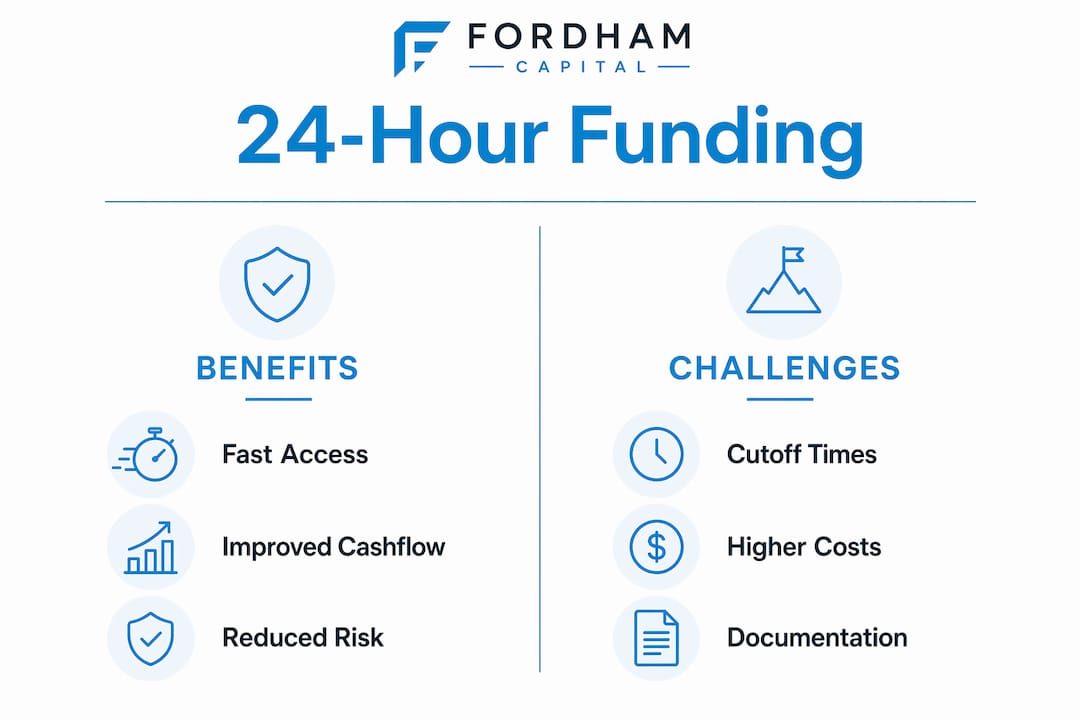
Next-day funding often closes its batch later, sometimes around 10:00 PM, capturing a full day of sales in one predictable deposit. That predictable deposit rhythm benefits steady operations more than a same-day option with an early cutoff.
Pro Tip: Ask your processor for the exact batch cutoff time before signing any agreement. A same-day product with a 10:00 AM cutoff may deliver less practical speed than a next-day product with a 10:00 PM cutoff.
The benefits of fast funding go beyond simply getting money sooner. They reshape how a business operates day to day.
The securities industry offers a useful benchmark. The shift from T+2 to T+1 settlement reduced margin volatility by 41% in that sector. The principle applies directly to small business payment processing: shorter settlement windows mean less exposure and more stable operations.
For businesses looking to put faster capital to work, types of fast business funding range from merchant cash advances to short-term loans, each with different speed and cost profiles worth understanding before you commit.
Swift financing matters, but it comes with trade-offs that every business owner should evaluate before prioritizing speed above all else.
For businesses evaluating their options, speeding up loan approval starts with understanding what your lender needs and how your bank processes incoming funds. Structuring the application correctly cuts days off the timeline before the funding speed of the product even comes into play.
Understanding how to speed up your loan approval process also means knowing which documents to prepare in advance, which lenders use automated underwriting, and how your banking relationship affects deposit timing.
Same-day funding delivers real financial advantages for small businesses, but only when the product’s actual delivery speed, cost structure, and repayment terms align with how the business operates.
| Point | Details |
|---|---|
| Trapped capital has a measurable cost | Businesses processing $1M monthly lose roughly $6,500 annually to settlement delay at a 10% cost of capital. |
| Batch cutoffs limit real-world speed | A 10:00 AM cutoff means afternoon and evening sales often miss same-day funding despite the product’s name. |
| Faster funds reduce credit dependence | Quicker settlement shrinks the gap businesses must cover with revolving credit, cutting direct borrowing costs. |
| Repayment terms matter as much as speed | Fast funding with poor repayment structure creates cash flow strain rather than relieving it. |
| Measure revenue impact, not just deposit time | The value of rapid funding shows up in reinvestment cycles, supplier terms, and reduced interest costs. |
The conversation around rapid funding almost always focuses on speed. Lenders market it. Business owners ask for it. But the businesses I’ve seen get the most from 24-hour access to capital are not the ones who chased the fastest product. They are the ones who matched funding speed to a specific operational need.
A retailer restocking a fast-moving product benefits enormously from same-day settlement. A service business with 30-day client invoices does not. The mistake I see repeatedly is treating fast funding as a universal upgrade rather than a tool with a specific job. When the job is wrong, the tool creates problems.
The other factor most business owners overlook is processor selection. Your lender’s approval speed means nothing if your bank does not participate in RTP or FedNow. I have watched businesses sign fast-funding agreements and then wait three days for deposits because their bank processed on a standard ACH schedule. Verify the full chain: processor, payment rail, and receiving bank, before you commit to any fast-funding product.
Speed is real. The benefits are real. But the businesses that capture those benefits consistently are the ones who read the terms, understand the cutoffs, and measure the outcome in dollars, not hours.
— Rob
Fordhamcapital built its process around one reality: small businesses cannot wait weeks for a funding decision.
The application takes one page. Approvals come within 24 hours. Fordhamcapital connects businesses to a wide network of banks and lenders, which means the funding terms are matched to your situation rather than a one-size-fits-all product. With an A+ BBB rating and over $120M funded, Fordhamcapital has helped clients generate more than $500M in revenue. If your business needs capital to restock, hire, or scale, apply now and get a decision within one business day without a credit impact from the inquiry.
24-hour funding is a financing arrangement where a business receives approved capital within one business day. It applies to both payment settlement products and direct business loans with fast approval processes.
Not always. Batch cutoffs as early as 10:00 AM mean afternoon and evening sales often settle the next business day. True same-day delivery requires a processor using RTP or FedNow and a participating bank.
Faster access to funds reduces the capital trapped in settlement transit, lowers reliance on credit lines, and allows businesses to reinvest in inventory or operations without waiting days for deposits to clear.
Yes. Faster funding products typically carry higher processing fees or interest rates than standard settlement options. Businesses should calculate the total cost against the cash flow benefit before choosing a faster product.
Verify the batch cutoff time, confirm your bank participates in the relevant payment rail, and review the repayment terms carefully. Speed without suitable repayment structure can create financial strain rather than relieve it.
At Fordham Capital, we've made the application process straightforward and reassuring. Dive in and explore your financial options with confidence, knowing there's no impact on your credit score and no obligations. We review your details and offer customized solutions based on what you're looking for.