SOFR is a market rate built from overnight Treasury-backed borrowing, published every business day. The prime rate is a bank-posted rate that moves only when banks decide to change it, usually after the Federal Reserve moves. For a small business, the practical difference is this: prime-based loans change in visible steps, while SOFR-based loans can shift more often. What really sets your cost is the margin the lender adds on top of either one. If you want to compare real offers across banks and alternative lenders rather than decode benchmarks alone, Fordham Capital lets you do that with a one-page application.
SOFR measures what it costs to borrow cash overnight when the loan is secured by U.S. Treasury securities. The New York Fed describes it as a broad measure of the cost of borrowing cash overnight collateralized by Treasury securities. It is calculated as a volume-weighted median of transaction-level data from several parts of the Treasury repo market, and it is published each business day at about 8:00 a.m. ET.
In plain terms: SOFR comes from real trades between large financial institutions, not from a survey or a bank’s opinion. It reflects conditions in the short-term funding market, which is why it can jump around month-end or tax dates when cash gets tight.
One timing detail matters for loan contracts. According to the New York Fed’s User’s Guide to SOFR, SOFR is published the business day after the overnight transaction it describes, once the data are received and vetted. The same guide explains that averages of SOFR over an accrual period can smooth out day-to-day swings. That is why many SOFR loans use an average or a term version rather than a single day’s print.
The prime rate is the base rate banks use for many loans to their best-qualified customers and as a reference for other lending. Who sets it surprises many borrowers. The Federal Reserve’s FAQ says prime is determined by individual banks, and that the Board reports the rate posted by a majority of the 25 largest banks in its H.15 Selected Interest Rates release.
The Fed also says it does not directly set prime, although many banks base their prime rates partly on the FOMC’s federal funds target. So prime usually moves in step after a Fed rate decision, and it stays put between decisions. The same FAQ names small-business loans and credit-card loans as examples of products where banks use prime as a reference or base rate.
| SOFR | Prime rate | |
|---|---|---|
| Who publishes it | Federal Reserve Bank of New York | Set by each bank; the Fed reports the majority rate among the 25 largest banks |
| What it is based on | Overnight Treasury repo transactions | Banks’ own decisions, usually following the Fed’s federal funds target |
| How often it changes | Every business day | Only when banks change it, typically after Fed meetings |
| What it feels like on a loan | Can move more often, especially with a daily or term structure | Moves in clear, announced steps |
| Typical use | Larger and newer floating-rate commercial loans, many replacing LIBOR | Lines of credit, SBA-style pricing, many community-bank loans |
The table shows why neither is automatically better. Prime is easier to follow. SOFR is more tied to money-market conditions. Neither one is your rate.
A floating-rate business loan is quoted as a benchmark plus a margin, also called a spread. “Prime plus 2.5%” or “SOFR plus 4%” are typical shapes. The benchmark changes with the market. The margin is the lender’s price for your risk, the loan’s size and term, and its own costs, and it usually stays fixed unless the contract says otherwise.
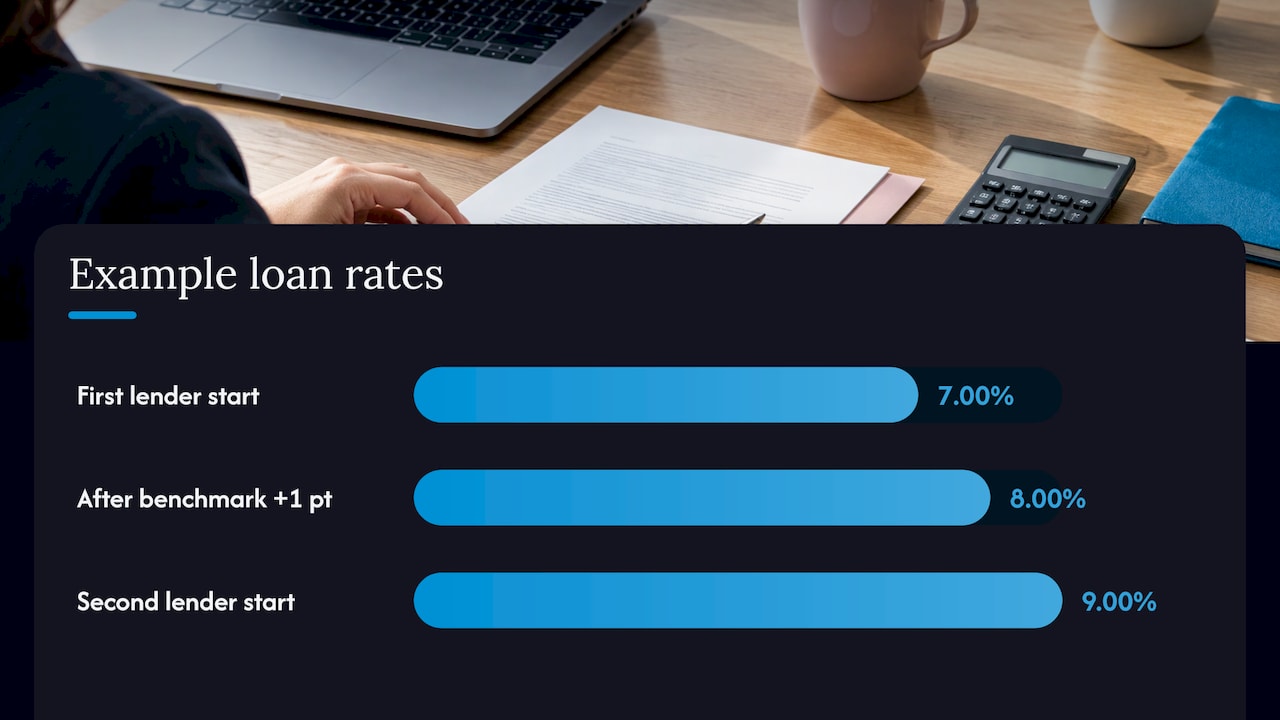
A worked example, using made-up round numbers to show the arithmetic only: suppose a benchmark reads 4.00% and the lender adds 3.00%. Your rate is 7.00%. If the benchmark rises one percentage point, you pay 8.00% on the same margin. On a $100,000 balance, that is $1,000 more in annual interest. A different lender quoting the same benchmark with a 5.00% margin would charge 9.00% from the start, which is $2,000 more a year than the first lender at the same balance. The margin gap matters as much as any move in the benchmark.
Three questions will tell you most of what you need from any floating-rate quote:
Fees count too. A low rate with a large origination fee can cost more than a higher rate with none. Our guide to business loan origination fees shows what small businesses typically pay, and APR vs. interest rate explains which number to compare when fees are involved.
SBA-backed loans are commonly priced as a base rate plus a capped spread, and the base rate choices have changed in recent years. If you are weighing an SBA loan, our pieces on SBA loan interest rates and SBA rates after the March 1 base rate rule walk through how the pricing works for your loan size.
Many working capital products from alternative lenders are not priced off SOFR or prime at all. They use a fixed factor, a fixed monthly rate, or a fixed fee, so the cost is known on day one. Our explainer on how lenders price unsecured business loans covers those structures. If a quote shows no benchmark, that is not a red flag. It means the pricing is fixed and you compare it on total cost.
If you read older loan agreements or articles, you will see LIBOR. U.S. dollar LIBOR was a panel-bank benchmark used to set floating, adjustable, or variable rates on loans and other financial products, as the SEC’s Investor.gov bulletin describes it. The bulletin states that one-week and two-month USD LIBOR ended at the close of 2021 and that the remaining settings were scheduled to end after June 30, 2023.
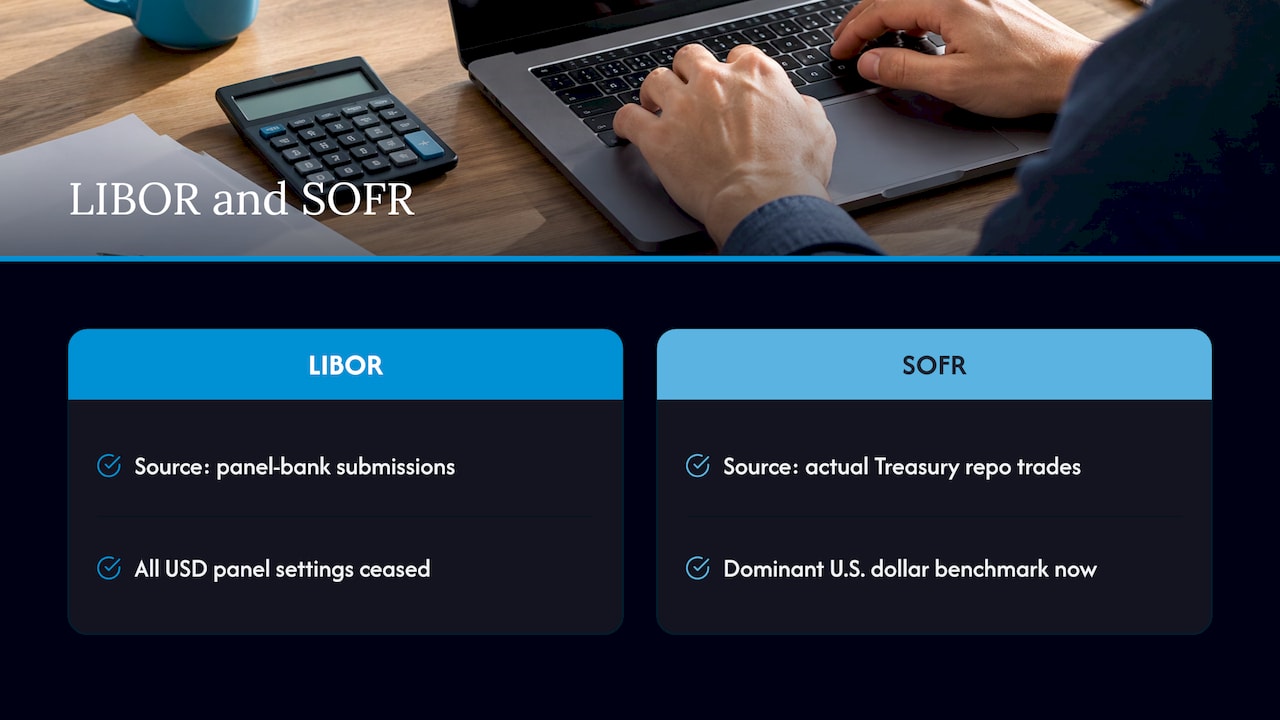
The key difference is the source of the number. LIBOR relied on submissions from a panel of banks. SOFR comes from actual transactions in the Treasury repo market. The New York Fed’s ARRC transition page describes SOFR as the dominant U.S. dollar benchmark now that all USD LIBOR panel settings have ceased.
If you have an older loan that referenced LIBOR, it did not simply disappear. The Federal Reserve’s final rule implementing the LIBOR transition law covers U.S.-law contracts that referenced certain USD LIBOR settings and had no clear replacement. For most such contracts it specifies overnight SOFR plus a statutory spread adjustment, or CME Term SOFR plus the applicable adjustment for term references, subject to the rule’s categories. Check your own note or ask your lender which replacement applies to you.
There is no single mandated replacement for new loans. The interagency statement from the U.S. banking agencies says they do not endorse one specific replacement rate and that a bank may choose a rate suited to its funding model and customer needs. That is why you will see SOFR at one lender and prime at another.
Both rates move, so any figure quoted in an article is a snapshot. SOFR is published daily by the New York Fed on its SOFR data page. Prime appears in the Federal Reserve’s H.15 release, and the Fed’s prime rate FAQ explains the series. Use those live pages, not a figure from a blog post, when you check a quote.
The right test for your own loan is simple. Take the benchmark named in your offer, look it up on the official page for the date in your contract, and confirm that your lender’s stated rate equals the benchmark plus the margin on the quote. Then ask when the next reset happens.
A word on expectations: you will see headlines about where the Fed may take rates next. Treat them as commentary, not a plan. Your budget should work if the benchmark rises by a point, which is why the worked example above is a useful habit for any floating-rate loan.
There is no universal winner. Use these rules of thumb:
For most owners the benchmark is the smaller decision. Speed, approval odds, fees and the margin drive the outcome. Our guide on when speed beats the lowest offer shows how to weigh a slightly higher cost against a missed opportunity, such as inventory you can buy now at a discount or a contract that needs staffing this month.
Fordham Capital is a marketplace, not a direct lender. We connect small and medium-sized businesses with a network of banks and alternative lenders through a one-page application, with approvals possible within 24 hours and no impact on your credit score from applying. No collateral is required.
That matters for this topic because the offers you see will not all be priced the same way. On our site, the published pricing for an SBA loan is 8% per year, and a line of credit is 1-3% per month. Working capital has no published price. One application brings you offers priced in different ways, so you can compare them on total cost instead of chasing a single benchmark yourself.
If you are ready to see what is available for your business, you can start on the Fordham Capital site with the one-page application.
Business owners often ask us whether they should hold out for a SOFR loan or a prime loan. Usually that is the wrong question. The benchmark is a moving input. The margin, the fees and how fast the money arrives are what you live with.
We built Fordham Capital for owners who are overlooked by conventional banks or who cannot wait weeks for an answer. A one-page application, a wide network of banks and lenders, and advisor support let you see real offers quickly, with no collateral and no credit score impact from applying. When you can compare several offers side by side, the benchmark stops being a mystery and becomes one line on a quote.
Our advice: ask what the rate is built from, ask what it costs in total, and decide with the numbers in front of you. We will help you get those numbers.
Rob
Prime has generally sat well above SOFR, because prime is a retail-style base rate for lending to customers while SOFR is an overnight rate between large institutions. The gap changes over time, so check both on the official pages. What matters is the all-in rate after the lender adds its margin to whichever benchmark it uses.
Individual banks set their own prime rates. The Federal Reserve says it does not directly set prime, but many banks base theirs partly on the FOMC’s federal funds target. The Fed’s H.15 release reports the rate posted by a majority of the 25 largest banks.
SOFR is now the dominant U.S. dollar benchmark after USD LIBOR panel settings ended on June 30, 2023. Existing contracts without a clear fallback were moved to SOFR-based rates under a Federal Reserve rule. New loans may use SOFR, prime or another rate the bank considers suitable.
Yes, it is published each business day. Many loans smooth this by using an average of SOFR over a period or a term version, so your payment does not change daily. Your loan agreement states which version applies and when it resets.
Yes. Many working capital products use fixed pricing, such as a set monthly rate or fee, so the cost is known up front. Fordham Capital’s network includes banks and alternative lenders, so offers can be structured differently.
At Fordham Capital, we've made the application process straightforward and reassuring. Dive in and explore your financial options with confidence, knowing there's no impact on your credit score and no obligations. We review your details and offer customized solutions based on what you're looking for.