The short answer: the SBA 7(a) is the flexible, general-purpose loan, and the SBA 504 is the long-term loan for major fixed assets such as a building or heavy equipment. If you need working capital, an acquisition or a mix of uses, you are looking at 7(a). If you are buying property or machinery that will last a decade or more, 504 is built for that. Fordham Capital connects small and medium-sized businesses to a network of banks and lenders through a one-page application, so you can find out which program your project fits without filling out forms lender by lender.
Both programs are run by the U.S. Small Business Administration (SBA), but the SBA does not lend the money itself. Banks and other approved lenders make the loans, and the SBA guarantees part of them. That guarantee is what lets lenders say yes to businesses that a conventional loan might not fit.
Where the two programs differ is the job they do:
Think of 7(a) as a toolbox and 504 as a single heavy-duty tool. Plenty of owners use one or the other, and some use both over the life of the company as it grows.
The 7(a) covers a broad range of purposes: working capital, buying equipment, buying or improving real estate, refinancing certain debt and acquiring another business. Because lenders structure each loan around the borrower’s situation, the same program can fund a restaurant’s inventory and a dental practice’s purchase of another practice. For a detailed breakdown of what the money can and cannot touch, see our guide to what you can and can’t do with SBA loan proceeds.
The SBA’s 504 page permits eligible building or land purchases, construction or renovation, and long-term machinery or equipment with at least 10 years of remaining useful life. Certain debt consolidation and qualified-debt refinancing are also allowed under the conditions in 13 CFR 120.882(e) and (g), per the same page.
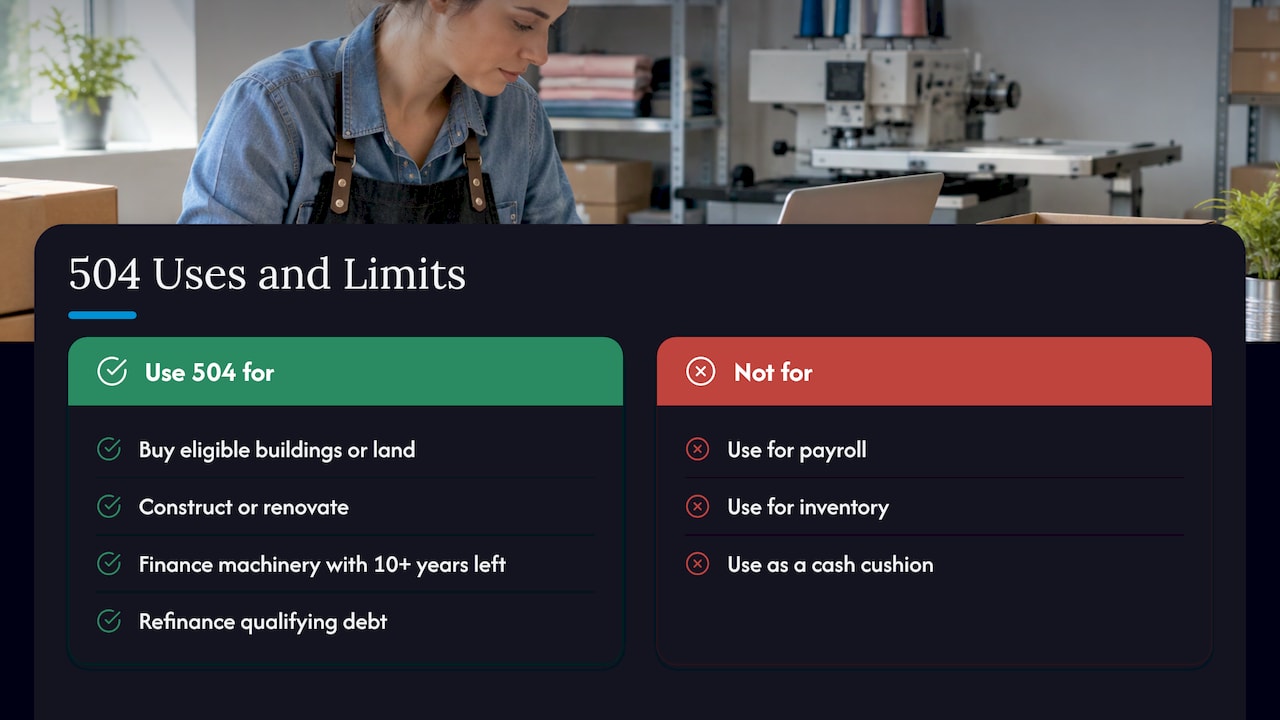
What 504 does not do is just as important for planning. It is not a payroll loan, an inventory loan or a cash cushion. If your need is day-to-day cash flow, that is territory for 7(a), a line of credit or working capital financing.
| Feature | SBA 7(a) | SBA 504 |
|---|---|---|
| Role | Primary, general-purpose SBA loan | Long-term financing for major fixed assets |
| Maximum loan amount | $5 million | $5.5 million |
| Typical use | Working capital, acquisitions, equipment, real estate | Owner-occupied property, construction, long-life equipment |
| Rate type | Fixed or variable; variable payments may change when rates reset | Fixed-rate financing |
| Repayment | Generally monthly principal and interest from business cash flow | Long-term, fixed-rate |
| Best fit | Mixed or flexible needs | A single large asset purchase |
On 7(a), the SBA explains that fixed-rate payments stay the same while variable-rate payments may change when rates reset. That matters for budgeting: a variable-rate loan can cost more or less next year than it does this year.
The 504 is typically delivered as two pieces: a loan from a bank plus a second loan through a nonprofit certified development company. Your total cost is a blend of both, which is why lenders quote 504 deals as a package and not as a single rate.
Fees are where owners get surprised, so it helps to see the actual rule. Under 13 CFR 120.220 in the eCFR (accessed November 22, 2026), the SBA guaranty fee on a 7(a) loan is a percentage of the guaranteed portion, not of the full loan:
For loans with maturities of 12 months or less, the same regulation sets a lower lender-paid fee of 0.25% of the guaranteed portion, and it governs when a lender may pass the fee to a borrower.
A worked example: on a $500,000 loan, the fee bracket is 3% of the guaranteed portion. If the guaranteed portion were $375,000, the fee would be $11,250. The guaranteed share varies by loan, so ask the lender for the exact figure in writing. Our guide on the FY2026 SBA guaranty fee and Form 159 walks through how to read it on your closing documents, and our overview of origination fees and what small businesses pay covers the other charges to expect.
Interest rates move with the market and, for variable loans, with the index the loan is tied to, so any rate you see quoted is a snapshot. For how the SBA’s base rate rule works, see U.S. SBA rates in 2026.

The two programs share a common foundation. The SBA’s 7(a) page says a business must operate for profit in the United States, be small under SBA size rules, be an eligible operating business, be unable to get the desired credit on reasonable terms elsewhere, and be creditworthy with reasonable repayment ability.
For 504, the SBA requires an operating, for-profit U.S. small business that is not in an ineligible category. Other standards include qualified management expertise, a feasible business plan, good character and the ability to repay.
Small does not mean tiny. SBA SOP 50 10 version 8.1 provides an alternative size standard: tangible net worth of no more than $20 million and average net income after federal income taxes, excluding carry-over losses, of no more than $6.5 million for the two full fiscal years before application. That sits alongside the industry-specific size standards, so a business that misses one test can sometimes pass the other.
The same SOP, which takes effect October 1, 2026, says the applicant must meet core 7(a) or 504 eligibility requirements throughout application, closing and disbursement. In practice, your eligibility is not a one-time check at the start. Keep your financials, ownership documents and business status in order until the funds are disbursed. For a full checklist, see do you meet SBA loan requirements.
Start with what the money will buy, then work outward.
A few examples:
Every loan comes with structure. Planning for it up front keeps surprises out of the closing table.
If you are comparing the SBA route with other kinds of funding, our pages on SBA versus conventional loans and SBA Express versus 7(a) cover those side by side.
The hardest part of choosing between 7(a) and 504 is that the answer depends on the lender as much as the program. Fordham Capital is an online platform that connects small and medium-sized businesses with a network of banks and alternative lenders. We are an intermediary, not a direct lender, so the application is built around finding the right match for you.
Here is what that looks like on our side:
Our site lists SBA loans at 8% per year and lines of credit at 1-3% per month. Working capital has no published price. Terms depend on the lender and your business, so treat these as the published starting point. We hold an A+ BBB rating and have funded over $120M, helping clients generate more than $500M in revenue.
If you already know you need an SBA loan, or you are still deciding between 7(a), 504 and another option, start your application at Fordham Capital.
Owners tend to ask us which SBA program is “better.” That is the wrong question. The right question is what the money is for and how fast you need it.
When the need is a mix of working capital, equipment and growth, a flexible loan keeps everything under one roof. When the need is a single big asset, a long-term fixed-rate structure protects your cash flow for years. The mistake we want you to avoid is forcing a project into the wrong program because it was the first one you heard about.
That is why we built Fordham Capital around a single one-page application and a wide network of banks and lenders. You tell us about the business once, we put your request in front of the lenders that fit, and an advisor helps you compare what comes back. Many of the businesses we serve are the ones conventional banks overlook, and speed matters to them as much as price.
Whichever route you choose, line up your documents early, read the fee disclosures line by line, and keep your eligibility clean until the day the funds arrive.
Rob
Yes. They are separate programs with separate purposes, and a growing business can use each at a different stage. A company might use a 7(a) to buy a competitor, then a 504 years later to purchase its own building. Each loan is underwritten on its own merits.
There is no single answer, because the cost depends on the lender, the rate type, the fees and the size of the loan. The 7(a) guaranty fee is set by 13 CFR 120.220 as a percentage of the guaranteed portion, so compare the total cost of each offer in writing before you sign.
No. It also covers long-term machinery and equipment with at least 10 years of remaining useful life, along with construction and renovation. It is not meant for working capital or inventory.
The SBA uses industry size standards, and SOP 50 10 version 8.1 also provides an alternative test based on tangible net worth and average net income. Check both, since passing either can be enough. Our SBA loan requirements guide explains the test step by step.
At Fordham Capital, we've made the application process straightforward and reassuring. Dive in and explore your financial options with confidence, knowing there's no impact on your credit score and no obligations. We review your details and offer customized solutions based on what you're looking for.