
A 0% APR card fits best when you can pay the full balance before the promotional period ends. A loan fits best when the expense is large, the payoff will take longer than the promotion, or you want one fixed payment you can plan around. The rest of this guide shows how to tell which side of that line your business is on.
The two products solve different problems, even though both put money in your hands.
A business credit card is a revolving line. You get a limit, spend against it, repay, and spend again. A business loan is typically non-revolving: you receive a lump sum and repay it in fixed installments, according to Xero’s guide to cards versus loans. Some cards add a 0% introductory promotion, and that promotion is what makes the comparison interesting.
Here is the side-by-side view.
| Factor | 0% intro APR business card | Business loan |
|---|---|---|
| How money arrives | Spend as needed up to a limit | One lump sum |
| Repayment | Flexible minimums, balance can carry | Fixed installments on a schedule |
| Cost during the first months | No interest during the promotion | Interest from day one |
| Cost after the promotion | Standard purchase APR applies to what remains | Same rate for the loan term (if fixed) |
| Best for | Short-term, repayable purchases | Larger or longer-term needs |
| Reusable | Yes, as you repay | No, you reapply for more |
The table hides one trap: a card is cheap only while the promotion lasts. A loan is priced the same way from the first payment to the last.
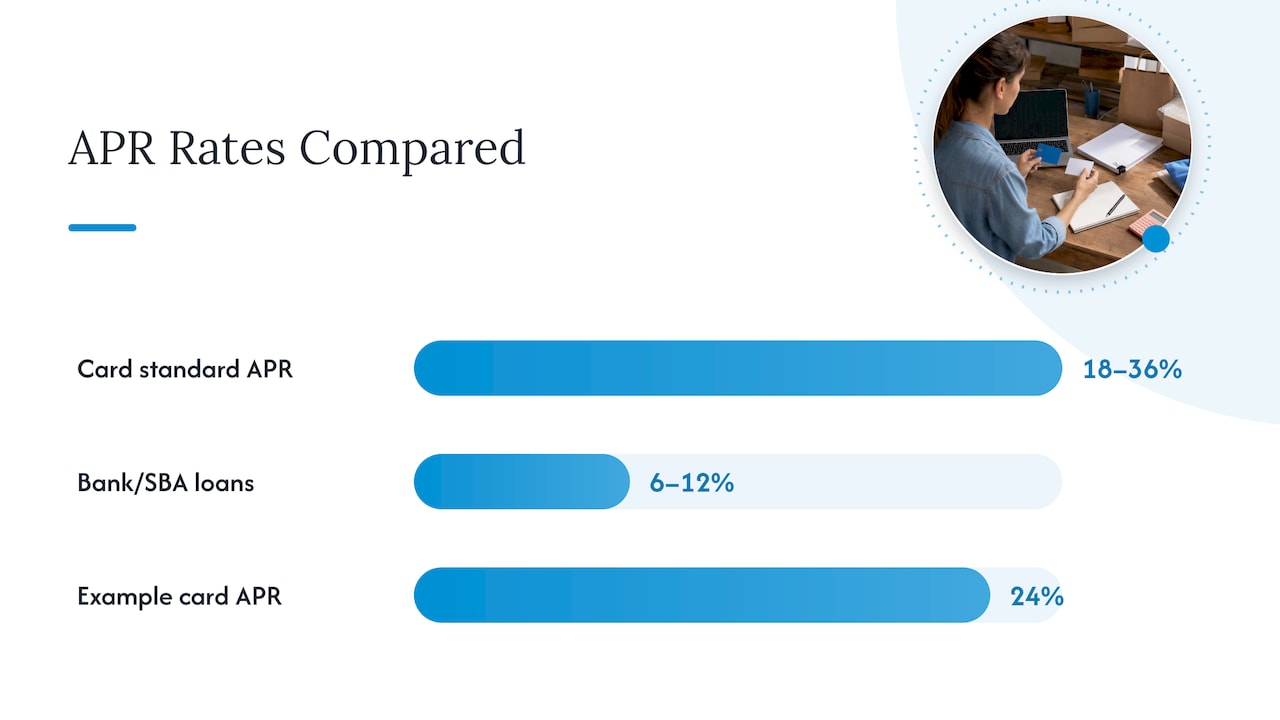
Standard purchase APRs on business credit cards generally run from 18% to 36% in 2026, depending on the issuer and the borrower’s profile. Bank and SBA loan rates often fall between 6% and 12%.
That gap is why the payoff plan decides everything. Take a $20,000 equipment purchase:
The lesson is not that one product wins. It is that the card wins when your payoff date comes before the promotion’s end date, and the loan wins when it does not.
Two details are worth checking on any card offer. First, how long the promotion lasts and whether it covers purchases, balance transfers or both. Second, whether interest is waived or merely deferred, because the terms of the card agreement decide what happens to the balance. Read the issuer’s rate and fee table before you apply. For a deeper look at how the stated rate and the APR differ, see our explainer on APR versus interest rate.
A card is the stronger tool in a narrow, useful set of cases:
A few habits make a promotional card work well:
A loan earns its place when the numbers do not fit inside a promotion window.
SBA loans are the long-term end of that range. The SBA says 7(a) loans go up to $5 million, with rates negotiated between borrower and lender within SBA maximums, and terms of 10 years or less unless the loan finances real estate or long-lived equipment. For a closer look at which SBA program suits which purchase, read this breakdown of SBA 7(a) and 504 loans.
The SBA also notes that a line of credit charges interest only while the money is in use, which makes it an efficient way to manage working capital. That puts a business line of credit in a useful middle position: it revolves like a card but is built for business cash flow.
A card gives immediate access to funds once approved, though you may wait for the physical card to arrive. Loans can take days to weeks.
That difference shrinks when the application is simple and goes to several lenders at once. If time is the deciding factor, these guides cover what slows approvals and how to avoid it:
If the purchase cannot wait and a card is not enough, a non-bank lender can be the faster path. We explain why in why businesses choose non-bank lenders for fast funding.
The approval picture differs by product.
New businesses often have no business credit history. You can begin building one by registering the company and opening business financial accounts. Until a history exists, lenders and card issuers commonly look at the owner’s personal credit as well, and many ask owners to back the account personally.
Before you sign anything, check three items in the agreement:
We cover what lenders weigh in business loan approval factors. On the loan side, the difference between recourse and nonrecourse structures is explained well in this piece on recourse versus nonrecourse loans, and it is worth understanding before you sign a personal guarantee on any product.
The risk looks different for each product, so plan for it before you borrow.
With a card, the main danger is the end of the promotion. Any balance left moves to the standard rate, and that rate can be high. Missed payments can add fees and change your terms, depending on the card agreement. If you personally guaranteed the card, the issuer can look to you.
With a loan, the danger is the fixed installment. It is due whether the month was strong or weak. That is why you should size the payment against your slowest month, not your average one. If you expect trouble, contact the lender early. Lenders generally have more options before a payment is missed than after.
A simple stress test works for both:
If it does not fit, shrink the amount, lengthen the term, or choose a structure like a line of credit where you draw only what you need.
| Your situation | Likely better fit |
|---|---|
| $5,000 to $15,000 purchase, repaid within the promotion | 0% intro APR card |
| Ongoing small expenses cleared monthly | Card |
| Purchase over your card limit | Loan or line of credit |
| Payoff will take longer than the promotion | Loan |
| Uneven revenue, draws needed at different times | Line of credit |
| Fast approval needed, limited credit history | Marketplace application to several lenders |
We talk with owners every week who got a card offer, spent heavily during the promotion, and then found the balance would not clear in time. None of them did anything careless. The card was simply the wrong shape for the expense.
Our view is that the shape of the money should match the shape of the need. A short, repayable purchase can suit a promotional card. Growth spending that pays back over a year or more usually suits a loan or a line of credit, where the terms are visible from the start.
That is why we built Fordham Capital around a one-page application and a wide network of banks and alternative lenders. Our process is designed to avoid a credit score impact, so you can see your options without paying for the look. Many of the owners we serve are small and medium-sized businesses that conventional banks overlook, and we would rather show you several offers than send you to one.
If you are choosing between a card and a loan, price both over the full period you will actually need the money. Then pick the one with the clearest end date.
Rob
If your purchase needs more time than a promotion allows, Fordham Capital connects you with lenders through one short application. We are a marketplace, not a direct lender, so your offers come from banks and alternative lenders in our network. Our site lists SBA loans at 8% per year and lines of credit at 1-3% per month, and we also arrange working capital financing. Terms depend on the lender and your business.
You can start on the Fordham Capital homepage. If you want to understand pricing first, our guide to 2026 U.S. business loan interest rates explains when speed is worth more than the lowest quoted rate. To see how lender types stack up, read our comparison of fast-approval business lenders.
It is cheaper only if you repay the balance before the promotion ends. After that, the card’s standard purchase APR applies to what remains, and those rates commonly run 18% to 36%. A loan costs interest from the start, but the rate and payment stay predictable.
The remaining balance begins to accrue interest at the card’s regular rate. The exact treatment, including whether interest was deferred or waived, is set out in your card agreement. Divide the balance by the promotional months at the start so the payoff lands before the deadline.
A card can be used right after approval, though the physical card may take time to arrive. Loans can take days to weeks. A single application sent to multiple lenders can shorten the loan timeline.
Often yes, but with different requirements. A new company may have no business credit history, so lenders may look at the owner’s profile. Registering the business and opening business accounts starts building that history.
Both revolve, so the choice comes down to cost and limit. A line of credit, as the SBA notes, charges interest only while the money is in use. If your needs exceed a card limit or last longer than a promotion, a line of credit is worth pricing.
At Fordham Capital, we've made the application process straightforward and reassuring. Dive in and explore your financial options with confidence, knowing there's no impact on your credit score and no obligations. We review your details and offer customized solutions based on what you're looking for.