Business references, formally called trade references, are the single most direct window a lender gets into how your company actually pays its bills. When a supplier or vendor confirms your payment history, credit limit, and account standing in writing, that third-party verification carries weight that no financial statement can replicate on its own. For new or thin-credit businesses especially, trade references fill gaps left by automated credit reporting systems, since many vendors never report payment data to the major bureaus. The role of business references in lending comes down to one thing: giving lenders real, verifiable evidence of how you behave as a borrower before they commit capital.
Here is what lenders typically confirm through trade references:
Strong references can unlock higher credit limits, better interest terms, and faster approvals. Weak or absent ones can stall an application entirely, even when your financials look clean.
A trade reference is a formal statement from a vendor, supplier, or financial institution that has extended credit to your business. It is not a character endorsement. It is a structured account of your payment behavior, and it covers specific, verifiable data points.

Applicants generally provide several trade references when applying for business credit. Lenders then verify those references directly, usually by phone or email, using contact information they source independently rather than relying solely on what the applicant provides. That independent sourcing matters because it prevents applicants from routing calls to friendly contacts.
A complete trade reference typically includes:
Bank references work differently. A bank will usually confirm that an account exists and may indicate a general balance range, but banks limit disclosures compared to what a vendor will say. That makes vendor trade references the more informative source for lenders trying to understand day-to-day payment behavior.
Trade references differ from credit bureau data in one critical way: they are not automated. Credit bureaus like Dun & Bradstreet, Experian, and Equifax collect payment data that lenders and vendors report on a regular schedule. Trade references are direct conversations, narrower in scope but often more candid and detailed than anything a bureau report captures.
Lenders do not treat all references equally. A vendor who has extended credit to your business for three years carries considerably more weight than one who started six months ago, because a longer relationship provides more insight into how you handle credit across different business cycles. That depth of history is what separates a meaningful reference from a thin one.

When lenders evaluate references, they are looking for consistency, not perfection. Paying on time across multiple vendors, with different credit limits and payment terms, tells a coherent story. Paying one vendor promptly while stretching another by 45–90 days tells a different one, and lenders notice that pattern.
Key factors lenders weigh when evaluating trade references:
The interplay with bureau data from Dun & Bradstreet, Experian, and Equifax is worth understanding. The U.S. Small Business Administration recommends monitoring business credit reports from all three bureaus regularly. Bureau reports aggregate payment data broadly, but they miss private trade relationships entirely when vendors do not report. Trade references fill that gap with direct, specific information that no bureau algorithm captures.
Research from the accounting field adds another layer: when financial statements support loan approval, lenders give more weight to character and relationship data, including references. When accounting facts are negative, references rarely override the numbers. That means strong references matter most when your financials are already solid, acting as confirmation rather than rescue.
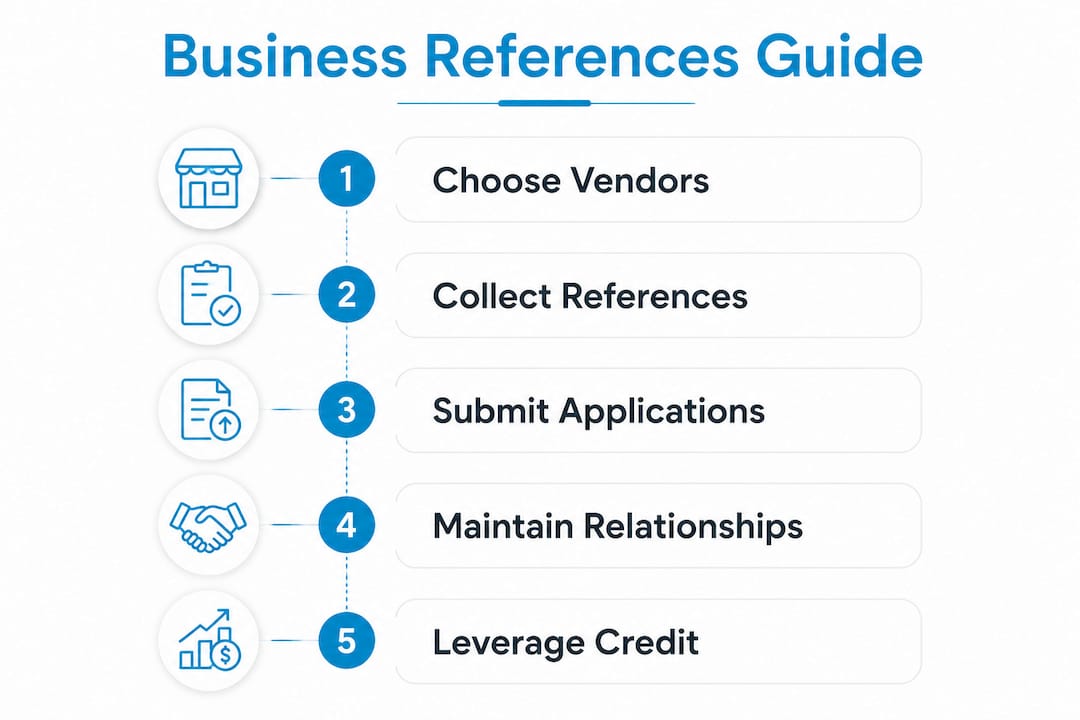
The first step is choosing the right vendors to build relationships with. Seek out suppliers who extend formal credit terms, net 30 or net 60, rather than requiring immediate payment. Proactively sharing positive trade references helps attract additional vendors and increases loan approval chances, so the earlier you start building these relationships, the better your position when you need financing.
When requesting a trade reference from a supplier, be direct and professional. Explain that you are applying for a credit line or loan and need a reference confirming your account history. Most vendors will comply, especially if you have paid consistently. Provide them with any forms the lender requires, and thank them for their time.
Steps to build and maintain strong trade references:
Pro Tip: Never submit only your most lenient vendors as references. Lenders look for discrepancies where a business pays some vendors on time but stretches others by 45–90 days. A list of references that all happen to be unusually forgiving raises a red flag, not confidence.
When you apply for a loan, do not wait to be asked. Submit your references proactively as part of your application package. Lenders who see organized, well-documented references alongside financial statements tend to move faster through the approval process. You can find more on preparing your loan application to make references work in your favor from day one.
Managing trade references is not a one-time task. Your credit profile is a living document, and the references that support it need regular attention.
Check your business credit reports from Dun & Bradstreet, Experian, and Equifax at least once a year. Verify that vendors who agreed to report your payment history are actually doing so, and that the data on file matches your records. Errors in bureau reports are more common than most business owners realize, and a single incorrect late payment notation can affect your credit score and your reference credibility simultaneously.
Techniques for getting the most from your trade references:
Lenders who see a business with consistent, long-standing vendor relationships and clean payment histories across all of them view that business as a lower credit risk. That perception translates directly into better loan terms and higher credit limits. Understanding the full picture of what lenders look for helps you position your references as part of a complete, credible application.
Trade references are one tool in a lender’s toolkit, not the whole toolkit. Understanding where they fit relative to other evaluation methods helps you know when they matter most.
| Evaluation method | What it shows | Key limitation |
|---|---|---|
| Business credit bureau reports (D&B, Experian, Equifax) | Aggregated payment history across reporting vendors | Misses vendors who do not report |
| Trade references | Direct, candid payment behavior from specific vendors | Applicant selects which references to submit |
| Financial statements | Revenue, expenses, cash flow, and debt | Can be outdated; does not show payment behavior |
| Bank references | Account existence and general balance range | Banks limit disclosures; less detail than vendor references |
| Personal credit score | Owner’s personal payment history | Relevant mainly for new businesses without business credit |
Bureau reports are broad but automated and may miss private trade relationships entirely. Trade references are narrower but often more candid. Financial statements tell you whether a business is profitable; references tell you whether it pays its bills on time. A lender using all three gets a far more complete picture than one relying on any single source.
For startups and businesses with thin credit files, trade references often carry the most weight because bureau data simply does not exist yet. For established businesses, references serve as confirmation and context for what the bureau reports already show.
Consider two businesses applying for a $150,000 line of credit. Both have similar revenue and clean financial statements.
Business A submits five trade references. Three show two or more years of on-time payment with net 30 terms and credit limits between $20,000 and $50,000. Two show relationships of 18 months with consistent payment within terms. The lender calls all five, gets consistent answers, and sees no discrepancies with the application.
Business B submits three references. One vendor confirms on-time payment but the relationship is only four months old. A second reference shows payments averaging 15 days beyond terms. The third vendor cannot be reached at the number provided. The lender now has questions the application does not answer.
Business A is likely to receive better terms, possibly a lower interest rate or a higher approved limit, because the references reduce the lender’s perceived risk. Business B may face additional documentation requests, a lower approved amount, or a denial. The financials were similar. The references were not.
This pattern plays out constantly in small business lending. A secured loan application, for instance, often requires lenders to build a complete credit dossier, and vendor references are a core component of that dossier for businesses without extensive bureau history.
Trade references have real limitations, and understanding them protects you from over-relying on them or misreading what a lender sees.
Applicant selection bias is the most fundamental problem. Because you choose which references to submit, lenders know the list is curated. A clean reference from three vendors does not prove you pay everyone on time. Lenders account for this by looking for discrepancies, short relationship lengths, or unusually low credit limits that suggest other vendors were not comfortable extending more.
Other common challenges include:
Refusing to provide references at all is treated as a red flag. Lenders may decline the application outright or impose stricter terms when a business cannot produce any trade references on request.
Credit managers approach trade references the way investigators approach witness statements: they look for consistency, corroboration, and anything that does not add up. The surface data matters less than the pattern it reveals.
According to NACM research, 27% of companies lose more than $1 million in revenue annually because they cannot obtain sufficient customer information, and 16% of credit departments identify insufficient credit investigations as the top cause of credit losses over the prior three years. Those numbers reflect what happens when references are skipped or treated as a formality.
Bank references add liquidity confirmation but rarely provide the behavioral detail that vendor references do. As the FDIC’s privacy framework makes clear, banks restrict disclosures to protect customer confidentiality, which means a bank reference tells a lender you have an account and roughly how much is in it, not whether you pay your suppliers on time.
Critical factors credit managers look beyond the surface data:
Fordhamcapital’s approach to business funding accounts for exactly this complexity. With access to a broad network of banks and lenders and a process built around fast, thorough evaluation, Fordhamcapital helps businesses present their full credit picture, including trade references, in a way that gives lenders the context they need to say yes. For businesses ready to put their references to work, applying through Fordhamcapital takes one page and can result in approval within 24 hours.
Strong, well-documented trade references are one of the most direct ways a small business can demonstrate creditworthiness to lenders, especially when bureau data is thin or incomplete.
| Point | Details |
|---|---|
| References fill bureau gaps | Many vendors never report to Dun & Bradstreet, Experian, or Equifax, making direct references the only record of those payment relationships. |
| Relationship length matters most | A vendor who has extended credit for three years provides more credible insight than one with only six months of history. |
| Lenders spot selective submissions | Submitting only lenient vendors raises suspicion; lenders look for discrepancies where businesses stretch some vendors by 45–90 days. |
| Insufficient references cost companies | 27% of companies lose more than $1 million annually due to inability to obtain sufficient customer information, and 16% of credit departments identify insufficient credit investigations as the top cause of credit losses over the prior three years. |
| Proactive submission accelerates approvals | Providing organized references with your application, before being asked, speeds up lender review and improves approval odds. |
At Fordham Capital, we've made the application process straightforward and reassuring. Dive in and explore your financial options with confidence, knowing there's no impact on your credit score and no obligations. We review your details and offer customized solutions based on what you're looking for.