
If you need to make payroll this week and you invoice other businesses, invoice factoring is usually fastest. If you want reusable access to cash you only tap when needed, a business line of credit is a better fit. Short-term payroll loans work for a single predictable gap, merchant cash advances suit businesses with steady card sales, but carry the highest cost, and payroll-bridge products built into payroll software split the fee into fixed installments.
TL;DR:
- Invoice factoring is ideal for businesses with slow-paying clients, offering funding within 24 to 72 hours at a fee of 1% to 3% per period, and depends heavily on customer credit.
- Business lines of credit provide flexible, reusable cash access, with funding times ranging from a few days to two weeks and interest paid only on the drawn amount.
- Short-term payroll loans are best for predictable, one-time gaps and are repaid in fixed installments over three to eighteen months, with speed varying from same day to a week.
- Merchant cash advances are the most expensive option, repaid as a percentage of daily sales using factor rates that can effectively triple the borrowed amount, especially over short repayment periods.
- Payroll-bridge products embedded in payroll platforms offer fixed fees and quick approvals without separate applications, but should be used to supplement operational improvements rather than recurring reliance.
Every option below solves the same problem, a gap between when payroll is due and when cash arrives, but the mechanics and cost shape differ enough that picking the wrong one gets expensive fast.
The mechanics behind each product determine whether it actually solves your timing problem or just delays a bigger one.
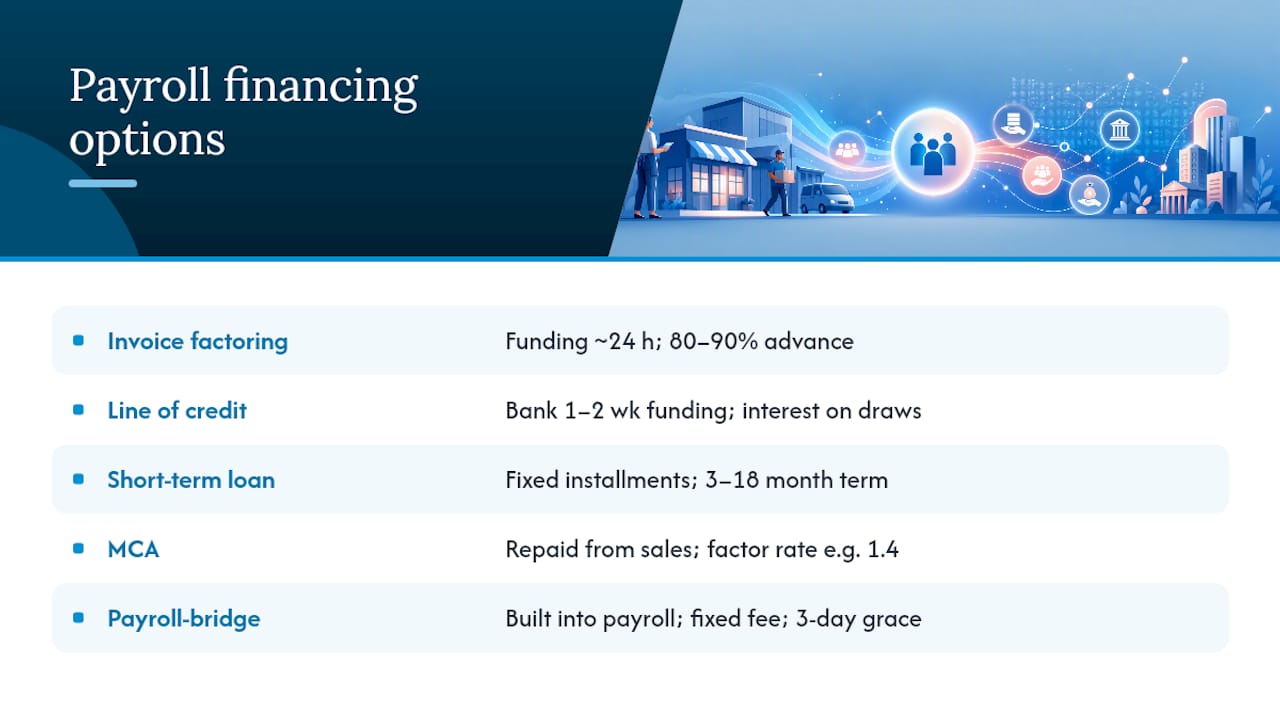
1. Invoice factoring. You submit approved commercial invoices to a factoring company, which advances a percentage of the invoice value, often up to 80% to 90%, and holds the remainder in reserve until your customer pays. IFXI reports funding can land within 24 hours for eligible accounts, with factoring fees typically running 1% to 3% of invoice value per period. Recourse factoring means you’re liable if your customer never pays; non-recourse shifts more of that risk to the factor, usually at a higher fee. Staffing firms, trucking companies, and government contractors use this heavily because their invoices are large, predictable, and owed by creditworthy customers. One underappreciated point: approval leans more on your customers’ credit than yours, which is why a business with weak business credit but blue-chip clients can still qualify.
2. Business line of credit. You get approved for a credit limit and draw against it only when needed, paying interest solely on the amount outstanding. Once you repay a draw, that capacity opens back up, which makes a line better suited to recurring payroll timing gaps than a one-time loan. Bank-issued lines require more documentation and can take one to two weeks to fund; online lenders move faster but often charge more. Expect to submit bank statements, tax returns, and a personal guarantee regardless of the lender type.
3. Short-term payroll loans. These are lump-sum loans repaid in fixed daily, weekly, or monthly installments over a set term, usually three to eighteen months. A “firewall loan,” a one-time infusion to cover a specific gap, like a delayed government contract payment, makes more sense here than a revolving product because you know the exact amount and timeline you need to cover.
4. Merchant cash advance. An MCA isn’t technically a loan. You sell a portion of future sales for an upfront lump sum, then repay through a fixed percentage taken from daily card transactions or a fixed daily debit. The cost is expressed as a factor rate (like 1.3 or 1.4) rather than an interest rate, which makes MCAs easy to misjudge. A 1.4 factor rate on a $50,000 advance means $70,000 owed, regardless of how quickly you repay it, and that total can translate to a triple-digit APR when repayment happens over a few months.
5. Payroll-bridge products. These are financing tools embedded directly in payroll platforms. Gusto’s version uses a fixed financing fee instead of variable interest, split across a set number of installments, and some versions include a three-calendar-day grace period that waives the fee entirely if you repay fast enough. The appeal here is speed and simplicity: no separate application, and the underwriting often doesn’t touch your personal credit.
Pro Tip: Before signing anything, ask the lender to state the total dollar cost of the financing in plain terms, not just the rate. A factor rate of 1.3 sounds small until you realize it’s 30% of the amount borrowed, often for a term shorter than four months.
The single biggest mistake business owners make when comparing payroll financing options is comparing a factor rate to an APR as if they’re the same measurement. They’re not. A factor rate is a flat multiplier applied once to the amount advanced. An APR annualizes the cost of borrowing over time, which lets you compare a 90-day MCA against a 12-month line of credit on equal footing. To convert roughly, take the total dollar cost, divide by the amount financed, then annualize based on the actual repayment period. A $10,000 MCA with a 1.35 factor rate repaid over four months costs $3,500, which annualizes to well over 100% APR even though “35%” sounds modest on paper.
Qualification patterns vary by product. Factoring relies heavily on your customers’ payment history rather than your own credit score, which is why the SBA’s guidance on employer payroll obligations is worth reviewing before you apply, since factors and lenders both request payroll and tax documentation as part of underwriting. Lines of credit and term loans typically require six months to two years in business and a minimum monthly revenue threshold. MCAs have the loosest credit requirements but the highest cost.
Match the product to your actual problem before you match it to the lowest advertised rate.
Ask every lender these questions directly: What’s the total dollar cost of this financing, not just the rate? Can you convert your factor rate into an equivalent APR? Is this recourse or non-recourse? Will you file a UCC lien, and on what assets? Is a personal guarantee required, and is it capped or open-ended? Is there a prepayment penalty? Can you guarantee the funding timeline in writing?
Have these documents ready before you apply: three to six months of bank statements, accounts receivable aging reports, recent payroll reports, the last two years of business tax filings, and corporate formation documents. For a deeper walkthrough of what lenders actually check during underwriting, see how business funding applications work for small businesses.
Pro Tip: If a lender won’t put the total fee structure in writing before you sign, walk away. Vague fee disclosure is the number one warning sign of a roll-up clause or renewal fee buried in the fine print.
Red flags worth avoiding entirely: an open-ended personal guarantee with no cap, mandatory automatic renewal clauses, and lenders who won’t commit to a funding date in writing.
Payroll funding is built for temporary timing mismatches, not permanent cash-flow gaps. Justworks warns that frequent reliance on payroll financing signals a structural problem, one that financing alone won’t fix, and that repeated borrowing tends to raise your long-term cost and risk rather than lower it.
Best practices that reduce how often you need financing at all:
| Risk signal | Better practice |
|---|---|
| Using factoring or an MCA every pay cycle | Build a payroll reserve or negotiate a revolving line instead |
| Stacking multiple short-term products at once | Consolidate into one line of credit with a clear repayment schedule |
| Accepting vague fee disclosures | Require written total-cost figures before signing |
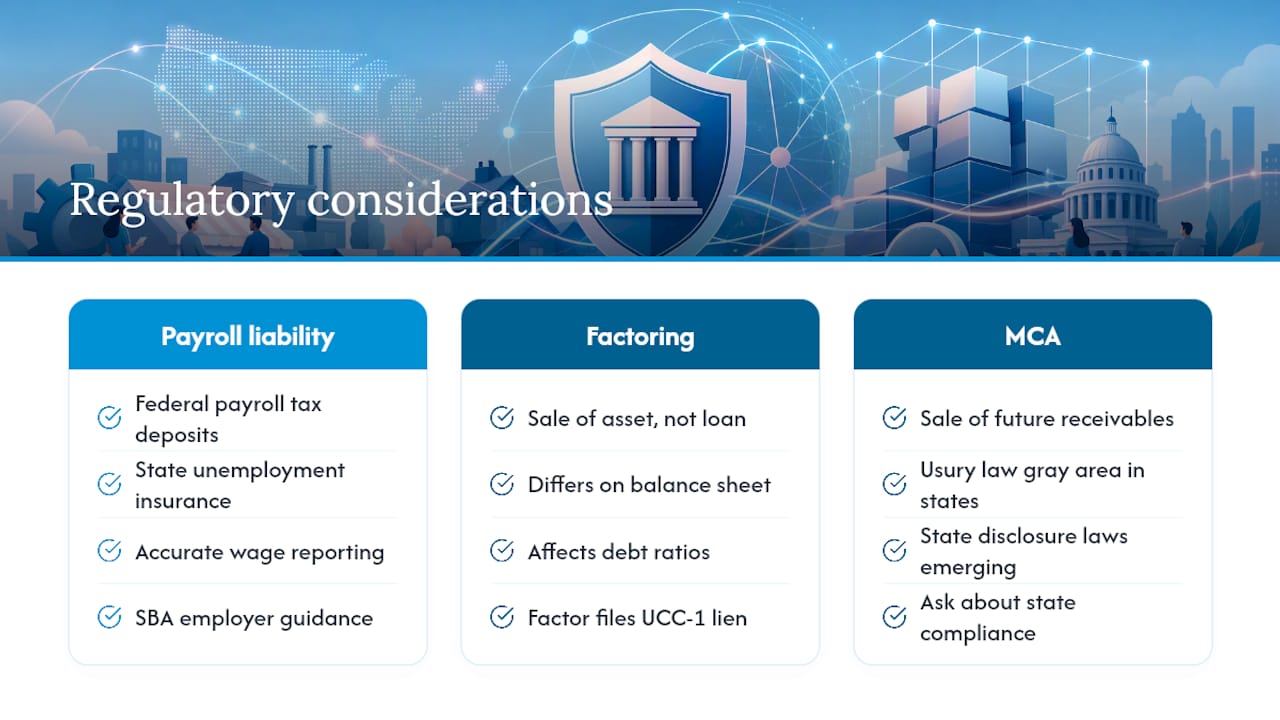
Payroll financing itself isn’t a regulated lending category the way mortgages are, but the underlying obligations you’re financing very much are. As an employer, you’re still on the hook for federal payroll tax deposits, state unemployment insurance contributions, and accurate wage reporting, regardless of where the cash to cover payroll came from. The SBA’s guidance on hiring and managing employees lays out these baseline employer responsibilities, and lenders routinely request proof you’re current on payroll tax filings before approving funding.
Invoice factoring carries its own compliance wrinkle: because it’s structured as a sale of an asset rather than a loan, it can be treated differently on your balance sheet compared to debt financing, which affects how your accountant reports it and how future lenders view your debt ratios. Factors will also file a UCC-1 lien against the invoices they purchase, which shows up on public record and can affect your ability to pledge the same receivables elsewhere.
Merchant cash advances sit in a gray area in some states because they’re structured as a sale of future receivables rather than a loan, which historically let some MCA providers avoid usury caps that apply to traditional lending. Several states have passed commercial financing disclosure laws in recent years requiring clearer cost disclosures on MCAs and similar products, so ask any provider directly whether they comply with your state’s disclosure requirements before signing.
Before you take on any financing product, check whether an operational fix solves the problem for free. Adjusting your payroll schedule, shifting from weekly to biweekly pay, for instance, can close a chronic timing gap without borrowing a dollar. Some businesses stagger pay dates by department or negotiate a short grace period with their payroll processor during a single tight month.
Government assistance programs are worth checking depending on your situation and industry: SBA disaster relief loans exist for businesses affected by declared disasters, and some state and local economic development programs offer bridge grants or low-interest loans to small employers during specific hardship windows. These aren’t always available, and eligibility is narrow, but they’re worth ten minutes of research before you accept a factor rate that costs more than the gap itself.
Tightening your own cash-flow cycle is the other lever. Shortening customer payment terms from net-60 to net-30, requiring deposits on large orders, or offering a small early-payment discount can pull cash forward without financing costs at all. Better document workflow and expense tracking also cuts down on the invoicing delays that create payroll gaps in the first place. Pairing these operational changes with an occasional line of credit, rather than repeat factoring or MCA use, is usually the cheapest long-term path.
The financing itself generally isn’t taxable income, and the fees or interest you pay are typically deductible as a business expense, but the structure of the product changes how it’s reported. Loan proceeds, whether from a line of credit or a short-term payroll loan, aren’t counted as revenue, and the interest paid is deductible in the year incurred.
Invoice factoring works differently because it’s a sale, not a loan. The advance you receive isn’t a loan liability on your books, and the factoring fee is generally deductible as a business expense rather than interest expense, a distinction your accountant needs for accurate year-end reporting, since factoring’s accounting treatment differs from debt financing in ways that affect your financial statements.
Merchant cash advances get murkier at tax time because the “factor rate” cost isn’t structured as traditional interest, and how it’s categorized for deduction purposes depends on your accountant’s treatment of the agreement. Whatever product you use, keep every fee disclosure and repayment schedule in writing. You’ll need that documentation for accurate quarterly tax estimates and for your accountant to correctly classify the cost when filing.
After years of watching small businesses navigate payroll gaps, the pattern is consistent: the businesses that use financing well treat it as a bridge, not a habit. The ones that get into trouble are the ones stacking a second MCA on top of a first because nobody addressed why the gap keeps recurring.
I generally advise a line of credit over factoring or a payroll-bridge product when a business expects to need flexibility more than once a quarter, since the reusable structure beats paying a fresh fee every cycle. Factoring earns its cost when your receivables are the actual bottleneck, slow-paying clients, not your revenue. Use financing to buy time, then spend that time fixing the underlying cash-flow issue.
— Rob
Fordham Capital gives you access to SBA loans, a business line of credit, and working capital financing, three of the products covered above, through a single one-page application instead of separate applications with separate lenders. That matters most when payroll is close and you don’t have time to shop five different underwriting processes.
Fordham Capital connects applicants to a network of banks and alternative lenders rather than acting as a single gatekeeper. Approvals can come within 24 hours of a completed application, and the process doesn’t require collateral or a hard credit pull to get started. If you’re weighing a line of credit against a working capital loan for your next payroll cycle, the fastest way to find out what you qualify for is to submit the one-page application directly through Fordham Capital’s site and get matched with a lender the same day.
Yes. Short-term payroll loans, business lines of credit, invoice factoring, and payroll-bridge products are all designed to cover payroll timing gaps, and providers like Fordham Capital connect businesses with lenders offering SBA loans and working capital financing for this exact purpose.
Payroll software choice depends on business size and complexity, but platforms with built-in financing features, like Gusto’s Payroll Bridge, add a useful safety net for businesses that occasionally run short on payroll cash.
Payroll is generally categorized by pay frequency, weekly, biweekly, semimonthly, and monthly, and the schedule you choose directly affects how tight your cash-flow timing gets between pay periods.
The monthly payment depends entirely on the interest rate, term length, and whether it’s structured as a line of credit or a fixed-installment loan, so it’s best to request an amortization estimate directly from your lender based on your specific offer.
Factoring generally doesn’t report to business credit bureaus the way a loan does, since it’s structured as a sale of receivables rather than debt, though your customers’ payment behavior still matters for renewal terms.
At Fordham Capital, we've made the application process straightforward and reassuring. Dive in and explore your financial options with confidence, knowing there's no impact on your credit score and no obligations. We review your details and offer customized solutions based on what you're looking for.