
Yes, U.S. small businesses can get financing without filing tax returns, through revenue-based financing, merchant cash advances, invoice factoring, bank-statement loans, or short-term online term loans. Lenders substitute bank statements, payment processor feeds, or unpaid invoices for the paperwork traditional banks require. Expect faster funding (sometimes same-day) but higher costs and shorter repayment terms than an SBA or conventional bank loan.
TL;DR:
- Revenue-based financing, merchant cash advances, and invoice factoring rely on real-time payment data or unpaid invoices rather than tax returns, offering faster funding but at higher costs.
- Most lenders accept as few as three to twelve months of bank statements or processor reports, with larger loans typically requiring at least 12 months of operating history.
- No-doc loans often feature higher interest rates or factor rates, shorter repayment periods, and may require personal guarantees or collateral, increasing overall risk.
- Borrowers should prioritize transparent lenders that disclose total repayment amounts upfront and avoid applications with unclear or delayed responses to minimize potential pitfalls.
- Traditional SBA or bank loans remain the most affordable options if businesses can wait 30 to 60 days for full documentation approval.
A no-tax-return business loan (also called a no-doc or low-doc loan) skips the standard requirement for two to three years of filed tax returns. Instead, the lender builds its decision around whatever financial signal is actually available, right now, from your business.
Traditional bank and SBA underwriting leans on tax returns because they’re audited, standardized, and show a multi-year trend the underwriter can trust. No-doc lenders can’t get that comfort, so they substitute other verifiable data streams:
This shift changes how risk gets priced. Instead of an interest rate tied to a credit tier, many no-doc products use a factor rate (a flat multiplier on the amount borrowed) or charge fees baked into a shorter repayment window. Some products require a personal guarantee, meaning you’re personally on the hook if the business can’t repay, and asset-backed options may ask for collateral instead of extensive paperwork. LivePlan’s rundown of alternative funding methods confirms this pattern across most non-bank lenders: less documentation almost always trades off against cost.
If you want a deeper walkthrough of how this works in practice, Fordham Capital’s explainer on bank-statement business loans breaks down exactly what reviewers look for in a statement, and the low-documentation loan definition covers which documents typically replace tax filings.
Six product categories cover most of the no-tax-return financing market. Each fits a different business profile.
LendingTree’s breakdown of no-doc and low-doc lenders notes that some of these lenders will accept as few as three months of bank statements and can fund the same business day, a speed advantage that’s the entire appeal of this category.
Lenders replace the tax-return checkbox with a handful of other checks, and knowing them in advance saves you from wasting an application.
Deposit patterns matter more than almost anything else in this process. A lender scanning your statements wants to see consistent inflows, not one big deposit propping up an otherwise thin account. If your business is seasonal, a short note explaining the dip (a landscaping company slowing down in January, say) helps a human underwriter read the numbers correctly instead of flagging them as a red flag on autopilot.
Pro Tip: Before you submit statements, circle or highlight recurring revenue deposits and label one-time transfers or loans separately. Underwriters move faster on accounts that are easy to read, and faster reviews often mean better offers.
For a closer look at how lenders weigh these factors, Fordham Capital’s guide to loan approval factors and its piece on how revenue affects eligibility both walk through the math lenders actually use.
Speed costs money in this market, and the gap between no-doc financing and a traditional bank loan is significant.
MCAs typically charge factor rates between 1.1 and 1.5, meaning you repay $1.10 to $1.50 for every dollar borrowed, collected through daily or weekly holdbacks on card sales. Short-term online term loans often carry APRs that run well above conventional bank rates once fees are annualized. Bank-statement loans fall somewhere in between, often priced closer to a traditional term loan than an MCA.
Repayment cadence matters as much as the headline rate. A daily debit from your operating account, common with MCAs and many short-term loans, can strain cash flow even when the total cost looks manageable on paper. Monthly repayment (typical of SBA and bank loans) gives you more breathing room between payments.
LendingTree’s research on no-doc lending confirms that the tradeoff is consistent across the market: faster access to capital comes paired with higher rates and compressed repayment windows. If your business can wait 30 to 60 days and has the paperwork, an SBA loan at a fraction of the cost is usually worth the wait.
Getting approved without tax returns comes down to making the alternative documentation as clean and complete as possible.
Before signing anything, ask the lender directly: What’s the total cost of capital, expressed as a dollar amount, not just a rate? What’s the exact repayment schedule? Is this a soft or hard credit pull? Is a personal guarantee or collateral required? A legitimate lender answers all four without hesitation.
Pro Tip: Get the total repayment amount in writing before you sign. If a lender doesn’t give you a straight number, or a straight answer, walk away.
Verify the lender’s legitimacy before applying. Check its registration on NMLS Consumer Access and review its standing with the Better Business Bureau. If you’re separately trying to track down old filed returns for comparison, a tax records retrieval reference can help you locate the right IRS contact points.
High-cost, short-term funding isn’t right for every business. If your margins are thin, retail and food service often run in the single digits, a daily MCA holdback can eat into cash flow faster than the capital helps. Seasonal businesses facing a slow stretch should be especially cautious about committing to daily repayment during a low-revenue month.
The Small Business Administration remains the strongest low-cost alternative for businesses that can assemble full documentation, its loan programs carry lower rates and longer terms than nearly anything in the no-doc space. Community lenders and credit unions often sit in between, sometimes flexible on documentation while still beating MCA or short-term loan pricing. If you have any runway at all, price out an SBA loan or a community lender first, and use no-doc financing as the fallback, not the default.
Fordham Capital built its process around businesses that don’t fit the traditional paperwork mold. The one-page application replaces the usual stack of forms, and it connects you to a network of banks and alternative lenders rather than pushing one product. Fordham reports an A+ BBB rating and says it has helped fund over $120 million for small and medium-sized businesses.
The platform typically gathers bank statements, basic business information, and revenue data rather than tax filings, with the possibility of quick approvals through its lender network. It’s a strong fit if you need to move fast, aren’t sure which product category fits your situation, or want one application to surface multiple offers instead of applying to five lenders separately.
Alternative business financing without tax returns is fully legal in the United States, but it operates under a patchwork of state and federal rules rather than one uniform law. Commercial lending isn’t regulated as tightly as consumer lending, which is part of why MCAs and short-term products can charge factor rates that would violate usury caps if applied to a personal loan.
Some states, California, New York, Utah, and a growing list of others, now require commercial financing disclosures that spell out the total cost of capital in plain terms before you sign. That’s a direct response to how opaque factor-rate pricing can be. If your state has one of these laws, the lender is required to give you a disclosure box similar to an APR, even on an MCA.
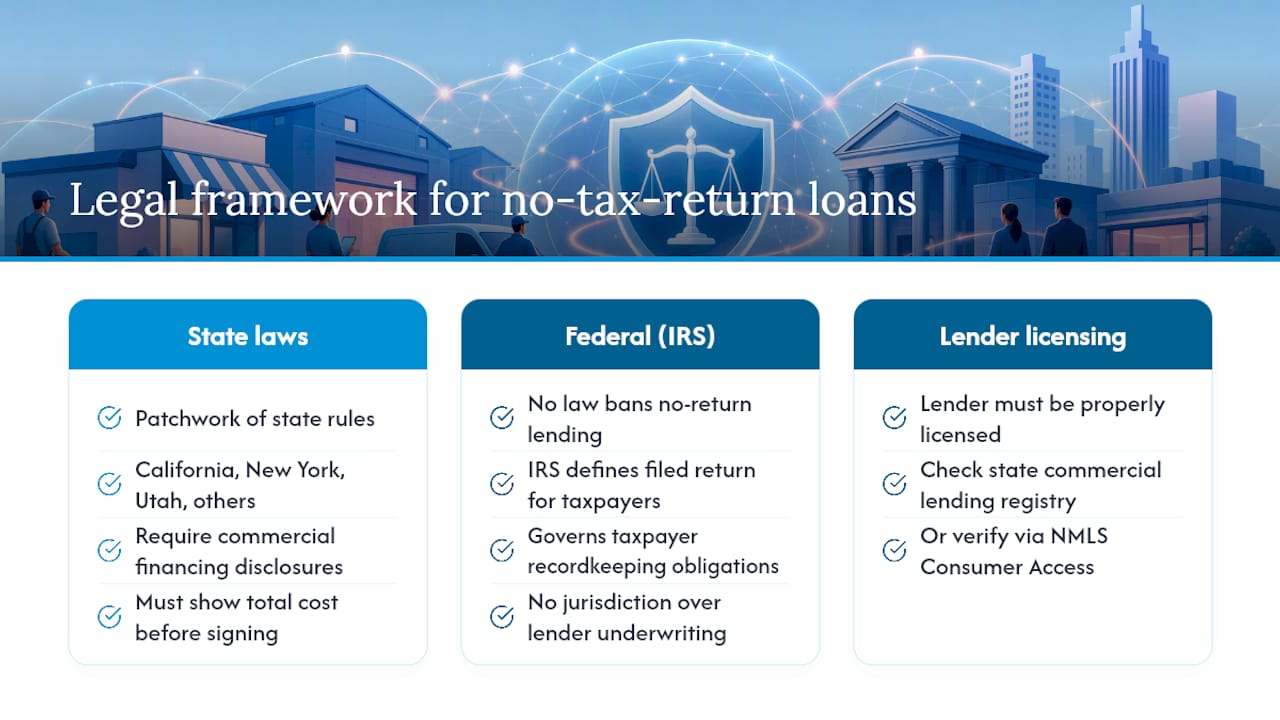
At the federal level, no law prohibits lending without tax returns. The IRS governs what counts as a filed return and your recordkeeping obligations as a taxpayer, but it has no jurisdiction over how a private lender underwrites a loan. That distinction matters: a lender skipping tax returns doesn’t change your obligation to file accurately with the IRS. Confirm any lender you’re considering is properly licensed, either through your state’s commercial lending registry or through NMLS Consumer Access, before signing.
Cost isn’t the only thing on the line with no-tax-return financing. Daily or weekly repayment structures can create cash-flow strain that shows up as overdrafts or missed vendor payments, even when the total cost looked reasonable at signing. That strain can cascade: a missed MCA payment sometimes triggers default clauses that accelerate the entire remaining balance.

Personal guarantees carry their own risk. If your business can’t repay and you signed a personal guarantee, your personal assets, including your home in some states, can be exposed to collection. Some no-doc products also report to business credit bureaus, so missed or late payments can damage your business credit profile even if your personal score stays untouched, or vice versa depending on how the lender structures reporting.
Predatory practices exist in this corner of the lending market. Watch for lenders who won’t disclose the total repayment amount upfront, who pressure you to sign the same day, or who stack multiple advances on top of each other, a practice sometimes called “stacking” that can trap a business in overlapping daily debits it can’t sustain. Finder’s research on no-credit-check lenders found that many products marketed as no-check still condition final terms on a credit pull you didn’t explicitly agree to, another reason to get every term confirmed in writing before signing.
If I were advising a business owner walking through this decision, I’d rank the options in this order: try a bank-statement loan first, since it’s usually the cheapest of the no-doc products. Look at revenue-based financing next if your income is recurring. Consider invoice factoring if you’re B2B and sitting on receivables. Treat a merchant cash advance as the last resort, not the first call, because the daily holdback structure is the least forgiving if revenue dips even briefly.
The businesses that get burned by no-doc financing usually aren’t the ones who used it. They’re the ones who used it as a first option instead of a considered one, without comparing what an SBA loan or a bank-statement product would have cost them over the same period.
— Rob
Fordham Capital exists for exactly the situation this article covers: you need capital, and your tax returns either don’t tell the full story or aren’t ready yet. The one-page application replaces the document pile a bank would demand, and it puts you in front of a network of banks and alternative lenders instead of just one, without affecting your credit score to get a quote.
Before you apply, have your last 3 to 12 months of bank statements ready, your EIN, a government ID, and a rough sense of your average monthly revenue. Fordham Capital uses this to match you against SBA loan programs, lines of credit, and working capital products across its lender network, often returning approvals within 24 hours. If your business has revenue but no return to show for it, start the one-page application on the Fordham Capital site and see which lenders in the network are ready to work with what you actually have.
Cross-check anything a lender tells you against a primary source before you commit.
Yes. Revenue-based financing, merchant cash advances, invoice factoring, and bank-statement loans all typically skip tax returns in favor of bank statements, processor data, or invoices as proof of income.
At that size, most no-doc lenders want strong, consistent monthly deposits (often $25,000 or more), at least 12 months in business, and a credit score in the mid-600s or higher; without those, an SBA loan with full documentation becomes the more realistic path.
Yes, several no-doc products never ask for a return, but expect the lender to compensate with more scrutiny on bank statements or processor sales, plus a higher rate than a bank would charge.
It’s difficult. Most no-doc and low-doc lenders require at least some months of verifiable revenue or processor sales; businesses with zero revenue typically need to look at startup grants, personal-credit-based financing, or equipment financing secured by the asset itself instead.
At Fordham Capital, we've made the application process straightforward and reassuring. Dive in and explore your financial options with confidence, knowing there's no impact on your credit score and no obligations. We review your details and offer customized solutions based on what you're looking for.