Fast working capital is short-term funding that covers payroll, inventory, rent or a gap between invoices and payments, and it can arrive in days instead of weeks when you apply through the right channel. The quickest route for most small businesses is one short application that reaches many lenders at once. That way you are not waiting on a single bank’s yes or no. At Fordham Capital, that is how we work: one page, a network of banks and alternative lenders, and approvals that can come within 24 hours, with no collateral required and no impact on your credit score from applying.
This guide explains the main types of fast working capital, how long each realistically takes, what lenders look at (including for startups and owners with imperfect credit), and how to compare offers before you accept one.
Working capital is the money a business uses to run day to day: paying staff, buying stock, covering rent and utilities, and bridging the weeks between delivering work and getting paid. Simple arithmetic describes it: current assets (cash, receivables, inventory) minus current liabilities (bills and debts due within a year).
When that number turns thin, even a profitable business can miss payroll. “Fast” working capital is any financing built to close that gap quickly. It usually has these traits:
The SBA’s own rules show how broad the permitted uses are: 7(a) and microloan proceeds may go to working capital, supplies and raw materials, provided the borrower is an operating, for-profit U.S. business that is small under SBA size standards and can demonstrate a need for the credit.
There is no single product called “fast working capital.” The label covers several, and the right one depends on whether your need is a one-time lump sum or a recurring swing in cash.
You receive a lump sum and repay it over a set period. This fits a defined need: a large inventory order, a seasonal hiring push, a deposit on a contract. Pricing varies by lender and by your profile, so on our site the working capital option has no single published price. We match you with lenders and you see the actual terms in the offers.
For a deeper explanation of how these loans are structured, see our guide to what a working capital loan is.
A line of credit gives you a limit to draw on as needed, and you pay for what you use. It suits uneven cash flow: a landscaper who needs fuel and wages in spring before invoices clear, or a retailer who stocks up before the holidays. As published on our site, our line of credit option is priced at 1-3% per month.
Because you can draw, repay and draw again, the line works as a standing cushion rather than a one-time injection.
SBA loans are made by lenders and partly guaranteed by the U.S. Small Business Administration, which is why they can offer long terms and lower rates. The SBA 7(a) program can fund working capital up to $5 million, with maturities up to 10 years for working capital and monthly principal-and-interest payments. On our site, the SBA loan is published at 8% per year.
Smaller amounts are available through microloans: up to $50,000 from nonprofit intermediaries for general business purposes, except paying personal debts. They are a fit for newer businesses with modest needs.
| Your situation | Best-fitting option | Why |
|---|---|---|
| One defined expense, such as a bulk inventory order | Working capital loan | Lump sum, fixed repayment |
| Cash flow rises and falls through the year | Line of credit | Draw only what you need, reuse as you repay |
| Larger need and you can wait for a longer process | SBA loan | Long terms and lower rates |
| Small amount, young business | Microloan or a smaller working capital loan | Lower amounts, built for newer firms |
Speed is mostly about who has the authority to say yes. The Yale School of Management explains that SBA lenders outside the Preferred Lender Program must send 7(a) applications to the SBA’s processing center, which takes two to three weeks, while preferred lenders with delegated authority can typically get SBA guarantee approval within 24 hours. More than 600 lenders were enrolled in that program in 2024.
That gap is the reason where you apply matters as much as what you apply for. The same applicant can wait weeks with one lender and a day with another.
Other things that slow a deal down are within your control:
We have broken the process down in how to speed up small business loan approval, and our write-up on small business loan timelines shows where the delays usually come from.
Faster does not mean lenders stop evaluating. It means they evaluate quickly, using the documents that tell the story most clearly. According to the FDIC’s small business financing guide, lenders typically look at the five Cs:
The same guide notes that requirements generally include thresholds for personal credit score, time in business and annual revenue, and that most lenders ask for three to twelve months of business bank statements, personal and business tax returns, a profit and loss statement and a list of existing business debt.
A practical way to prepare is to gather these before you apply:
Our piece on what lenders look for in loan approval goes through how each of these affects the decision.
Younger businesses and owners with bruised credit are not shut out. The Federal Reserve’s 2023 Small Business Credit Survey found that 47% of startup employer firms applied for financing in the prior 12 months and 43% were fully approved, compared with 34% applying and 54% approved among older firms. Startups apply more often, and a large share succeed.

The type of lender matters. In the 2016 survey, medium- and high-credit-risk startup applicants were more likely to receive at least some financing from online lenders (45%) than from small banks (35%) or large banks (26%), according to the New York Fed’s startup report. That is a 2016 snapshot, but it points to a lasting pattern: lenders built for speed and flexibility weigh cash flow more heavily and look past a single weak number.
The FDIC guide adds that online lenders may approve applicants with credit scores as low as 500, and that microloans are suited to small working-capital or inventory needs and newer businesses.
If your score is not where you want it, three moves help:
Yes. Many working capital loans and lines of credit are unsecured, meaning no equipment, property or inventory is pledged against them. Lenders then rely on your cash flow and track record instead of assets. Through Fordham Capital, no collateral is required.
Two points are worth knowing so nothing surprises you:
Asking for the right amount is the single best way to keep repayment comfortable. A simple method:
A bakery supplier is about to take a large holiday order. It needs $24,000 for ingredients and extra shifts, and expects the customer to pay roughly 45 days after delivery. Monthly operating cash after regular expenses is about $9,000 in a normal month. The owner asks for $24,000 plus a $3,000 cushion, $27,000 in total, and picks a line of credit so unused funds cost nothing. Once the customer pays, the balance is repaid and the line is available again for the next season.
This is an illustration of the method, not a quote. Your numbers and the offers you receive will differ.
Speed is valuable, but the terms last longer than the excitement of a fast yes. Before accepting, compare:
The FDIC guide also advises that lenders generally see seizing collateral as a last resort, so if you ever expect trouble repaying, contact your lender right away. Early conversations usually leave more options open.
Each lender has its own appetite: some prefer established firms, some focus on certain industries, some move faster than others. Applying to them one by one means repeating paperwork, waiting on each reply and, in some cases, taking a credit inquiry each time.
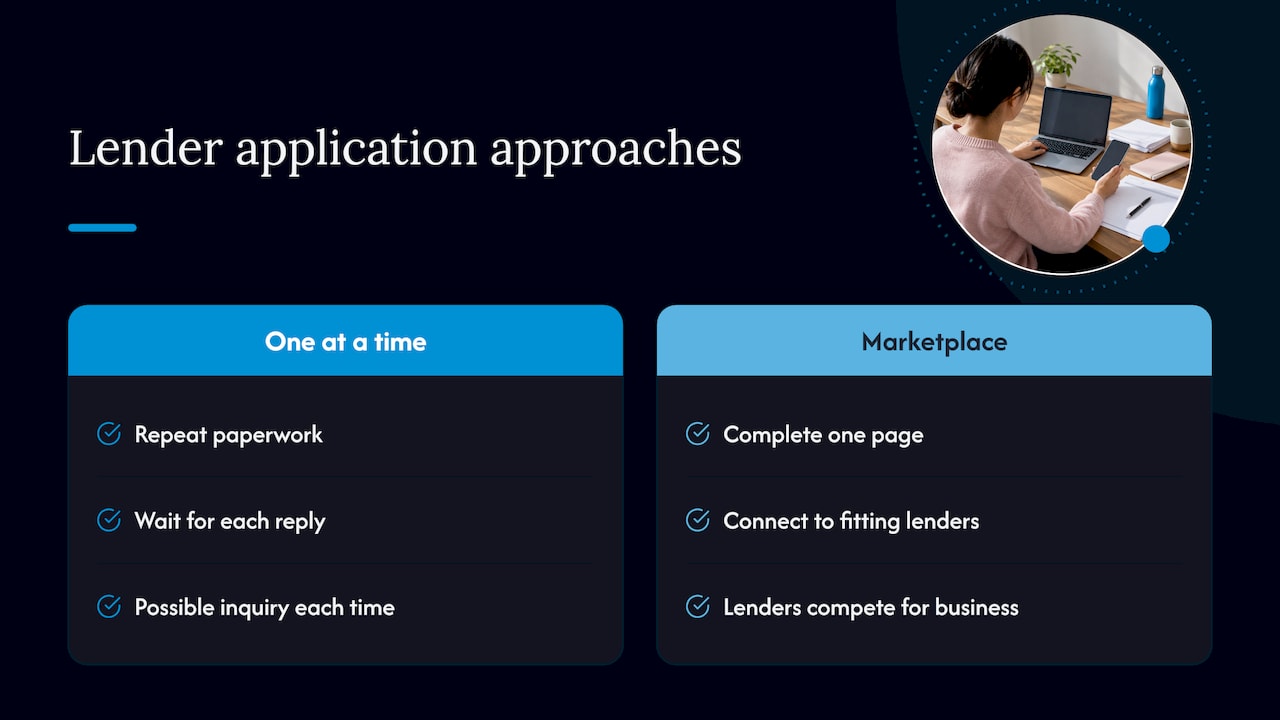
A marketplace changes the math. With Fordham Capital you complete one page, and we connect you to banks and alternative lenders in our network that fit your profile. We are an intermediary, not a direct lender, so the offers you see come from lenders competing for your business. Our comparison of fast-approval lenders and our explanation of why businesses choose non-bank lenders show how those options differ, and why fast funding beats slow approval covers what a delay can cost a growing business.
Most owners who come to us are not asking for a big, complicated financing package. They have a payroll to meet, a supplier waiting or an order they cannot yet afford to fill, and the bank has told them it will take weeks.
We built Fordham Capital around that moment. One page replaces a stack of forms. Our network of banks and lenders means your file is seen by more than one decision maker. And because you do not need collateral and applying does not touch your credit score, you can find out what is available without risking the credit you have worked to build.
Speed only helps if it comes with clarity, so we put a personal advisor between you and the offers. Our A+ BBB rating reflects the way we want every owner treated: plainly, with the terms in front of them before they decide.
If your business is growing, the question is rarely whether to borrow. It is whether the money arrives while the opportunity is still there.
Rob
If you know what you need the money for, the quickest next step is to apply. Our single-page application covers SBA loans (published at 8% per year), lines of credit (1-3% per month) and working capital financing, and you will be matched with lenders from our network of banks and alternative lenders. There is no collateral requirement and no impact on your credit score from applying. Start your application at Fordham Capital.
For a wider view of how we serve U.S. small businesses, see our page on fast business capital for U.S. small businesses.
It depends on the lender’s authority to approve. Lenders with delegated authority in the SBA program can typically obtain a guarantee decision within 24 hours, while others can wait two to three weeks. Through Fordham Capital, approvals can come within 24 hours, and funding follows once you accept an offer and complete the lender’s final steps.
Often, yes. Online and alternative lenders weigh cash flow and time in business alongside your score, and some approve scores as low as 500, according to the FDIC’s guide. Steady deposits in your bank statements and a request sized to your revenue strengthen the file.
Not with Fordham Capital. Many working capital loans and lines of credit are unsecured. Some programs, such as SBA 7(a), require a personal guarantee from owners with 20% or more of the business, so confirm who signs before you accept.
Choose a loan when you have a single, defined expense and want a fixed repayment plan. Choose a line of credit when your costs and receipts move up and down, because you draw only what you need and reuse the line as you repay.
Gather three to twelve months of business bank statements, business and personal tax returns, a profit and loss statement and a list of current business debts. Having these ready is the most reliable way to avoid delays.
At Fordham Capital, we've made the application process straightforward and reassuring. Dive in and explore your financial options with confidence, knowing there's no impact on your credit score and no obligations. We review your details and offer customized solutions based on what you're looking for.