
If you need working capital fast, a construction line of credit is usually your quickest, most flexible option. It behaves like a revolving credit card built for job sites: draw what you need for payroll or materials, pay interest only on that amount, and repay it as invoices clear. Other paths matter too, depending on your goals:
Fordham Capital built its process around speed: a one-page application, a network of banks and alternative lenders, and approval decisions often within 24 hours. The company also holds an A+ rating with the Better Business Bureau, which matters when you’re trusting a stranger with your financial details during a busy build season.
A construction line of credit gives most contractors the fastest, lowest-friction access to working capital, while SBA loans and equipment financing serve longer-term investments better.
| Point | Details |
|---|---|
| Match product to need | Use a line of credit for cash-flow gaps and SBA loans or equipment financing for long-term asset purchases. |
| Know your true cost | Add interest and all fees together, then divide by usable funds, to compare offers accurately. |
| Prepare documents early | Have bank statements, tax returns, backlog, and receivables ready before applying to speed approval. |
| Protect your credit | Check personal and business credit reports first, and ask every lender about personal guarantees and UCC filings. |
| Consider a fast network application | Fordham Capital’s one-page application connects you to multiple lenders with approval decisions often within 24 hours. |
Not every financing product solves the same problem, and mixing them up costs contractors real money. A line of credit is cheap for short bursts of cash but gets expensive if you leave a balance sitting for years. An SBA loan is the opposite: cheaper over the long run, but slow enough that it won’t save you when a supplier wants payment Friday.
Here’s how the main options stack up:
Routine cash-flow needs point toward a line of credit. Long-term investments point toward SBA loans or equipment financing.
A construction line of credit gives you a set borrowing limit, and you decide how much of it to use at any given time. Nav explains it well: you pay interest only on the funds you draw, not the entire limit, which makes it far cheaper than a term loan for irregular expenses like payroll timing gaps or a sudden materials price spike.
Contractor-focused lenders often underwrite these lines differently than a general small-business lender would. Instead of leaning purely on tax returns, providers like Financing for Contractors look at your project backlog, outstanding receivables, and job-level profitability. That distinction helps seasonal or lumpy-revenue contractors qualify for limits that a generic underwriting model would reject.
Limits vary widely by lender and revenue history, from smaller lines for newer firms to large revolving limits for established general contractors. Some providers, including Billd’s flex line product, offer revolving limits into the mid six figures specifically built for subcontractors, with faster draw processes than a traditional bank line.
Expect these common costs:
Here’s a typical scenario: a contractor draws $40,000 from a $150,000 line to cover payroll and a materials order while waiting on a progress payment. Once the client pays, the contractor repays the draw, the limit resets, and the line is available again for the next job. That reuse cycle is what makes revolving credit efficient for contractors juggling overlapping projects instead of reapplying for a new loan every time.
Pro Tip: Ask every lender for the total annual cost of the line, including maintenance and draw fees, not just the headline interest rate. Two lines with identical rates can carry very different real costs.
A line of credit isn’t the right tool for every job. If you’re buying a new excavator or expanding into a second office, longer-term products usually cost less over time.
SBA 7(a) loans work for general business purposes, working capital, and equipment purchases up to $5 million, with government backing that lets banks offer better terms than they’d give unsecured. SBA 504 loans are narrower, built specifically for fixed assets like real estate or heavy equipment, and typically pair a bank loan with a Certified Development Company loan. Both come with longer terms and capped interest rates compared to short-term products, but underwriting can take weeks, and the paperwork load is heavier than a revolving line.
Equipment financing shifts the collateral question. Because the machine itself secures the loan, approval tends to be faster and rates lower than unsecured credit, even for younger companies. Leasing spreads the cost differently and can preserve cash for firms that don’t want equipment tying up their balance sheet.
Supplier financing rounds out the picture. Negotiating net-30 or net-60 terms with your material suppliers effectively finances your job for free, as long as you pay within the window. Some vendors report payment history to business credit bureaus, which means consistent on-time payments can build your credit profile alongside whatever formal financing you’re using.
Every lender asks a version of the same four questions: can you pay this back, have you done this before, is there enough revenue to support it, and what happens if you don’t pay? How you answer determines your rate, your limit, and how fast you get funded.
Credit gets scrutinized on two levels. Lenders pull your personal credit score, and for larger lines or SBA products, they may reference your FICO SBSS score, a business-specific scoring model that blends personal and business credit data. Time in business matters, but it’s not a hard wall. A newer contracting company with an experienced operator and solid contracts in hand can often overcome a thin business credit file.
| Underwriting Factor | What Lenders Want to See |
|---|---|
| Credit history | Personal FICO plus business credit or FICO SBSS for larger requests |
| Time in business | Established track record, or operator experience that offsets a new entity |
| Revenue verification | Bank statements, tax returns, project backlog, and receivables aging |
| Collateral and guarantees | Equipment, receivables, or a personal guarantee; watch for UCC filings on your assets |
Revenue verification tends to be the slowest part. Lenders want bank statements and tax returns, but many also weigh your current backlog and receivables aging, since a contractor sitting on $300,000 in signed contracts looks very different from one with no pipeline at all.
Personal guarantees and UCC filings deserve real attention before you sign anything. A UCC filing gives the lender a claim on specified business assets if you default, and stacking multiple UCC filings from different lenders can quietly block you from qualifying for future financing. Ask every lender directly whether a personal guarantee is required and what assets a UCC filing would cover, and look into ways to limit that exposure before you commit.
Match the product to the actual problem. If you need cash within days for a payroll gap, a line of credit wins every time. If you’re financing a $200,000 excavator you’ll own for a decade, an SBA loan or equipment loan will cost you far less over its life.
To compare true cost, calculate the effective cost of capital: add all interest and fees together, then divide by the actual usable funds you received. A line with a 3% origination fee and a $500 annual maintenance charge is more expensive than the interest rate alone suggests, especially if you only draw a fraction of the limit.
Follow this sequence before signing:
Watch for red flags in any offer: unclear draw fees, prepayment penalties on a line you might pay off early, or vague language about what triggers a UCC filing.
Pro Tip: Before you accept any offer, ask the lender to walk through a worst-case scenario, a delayed payment on your biggest job. If their answer is vague, that’s your answer too.
Your credit score shapes almost every term you’ll be offered: your interest rate, your credit limit, whether you need a personal guarantee, and how fast you get approved. A contractor with a 720 personal score and clean business credit will typically see better rates and higher limits than one scraping by at 620, even applying for the exact same product.
The good news is that credit profiles for contracting businesses can improve faster than most owners assume, because so much of it comes down to reporting behavior rather than time. Paying suppliers on net-30 terms consistently, and confirming those vendors actually report to business credit bureaus, builds a payment history separate from your personal credit. Keeping utilization low on any existing business credit cards or lines helps too, since maxed-out revolving credit drags scores down regardless of how reliably you pay it off.
Before applying, pull both your personal credit report and your business credit file if you have one. Dispute any errors immediately. Pay down existing revolving balances if you can, even partially, since utilization ratio often moves faster than payment history. If your score sits in a gray zone, some lenders will still approve you but require a personal guarantee or a smaller starting limit until you build a track record.
Newer contracting businesses without much credit history aren’t locked out. Strong contracts in hand, healthy bank balances, and an experienced operator can offset a thin credit file at many lenders, particularly ones that specialize in construction rather than general small-business lending.
Grants for construction businesses are narrower than most owners expect. Direct cash grants for general working capital are rare. Most government support in this space comes through loan guarantee programs, tax incentives, or targeted set-asides rather than free money for operating costs.
The SBA doesn’t issue grants to for-profit construction companies for routine expenses, but its loan guarantee programs, including 7(a) and 504, function as the closest thing available: government backing that lowers the risk for banks and opens up better terms than a contractor would get on the open market alone.
Beyond the SBA, look at state and local economic development offices, which sometimes offer workforce training grants, energy-efficiency retrofit incentives, or minority and veteran-owned business set-asides tied to public contracting opportunities. Federal contracting programs, including 8(a) certification and HUBZone designation, don’t hand out cash but can open doors to set-aside contracts that provide steadier revenue than open-market bidding.
Tax incentives matter more than most contractors realize. Section 179 deductions let you write off qualifying equipment purchases in the year you buy them rather than depreciating slowly, which changes the math on financing new machinery. Energy-efficient building incentives, including provisions tied to commercial building upgrades, can also apply to construction firms working on qualifying retrofit or new-build projects.
None of these programs replace working capital financing. They supplement it, and they’re worth researching before your project starts, not after you’ve already committed to a repayment schedule you didn’t need to take on.
The right financing product changes as your business changes. What works for a five-person crew doesn’t fit a fifty-person outfit bidding on public contracts.
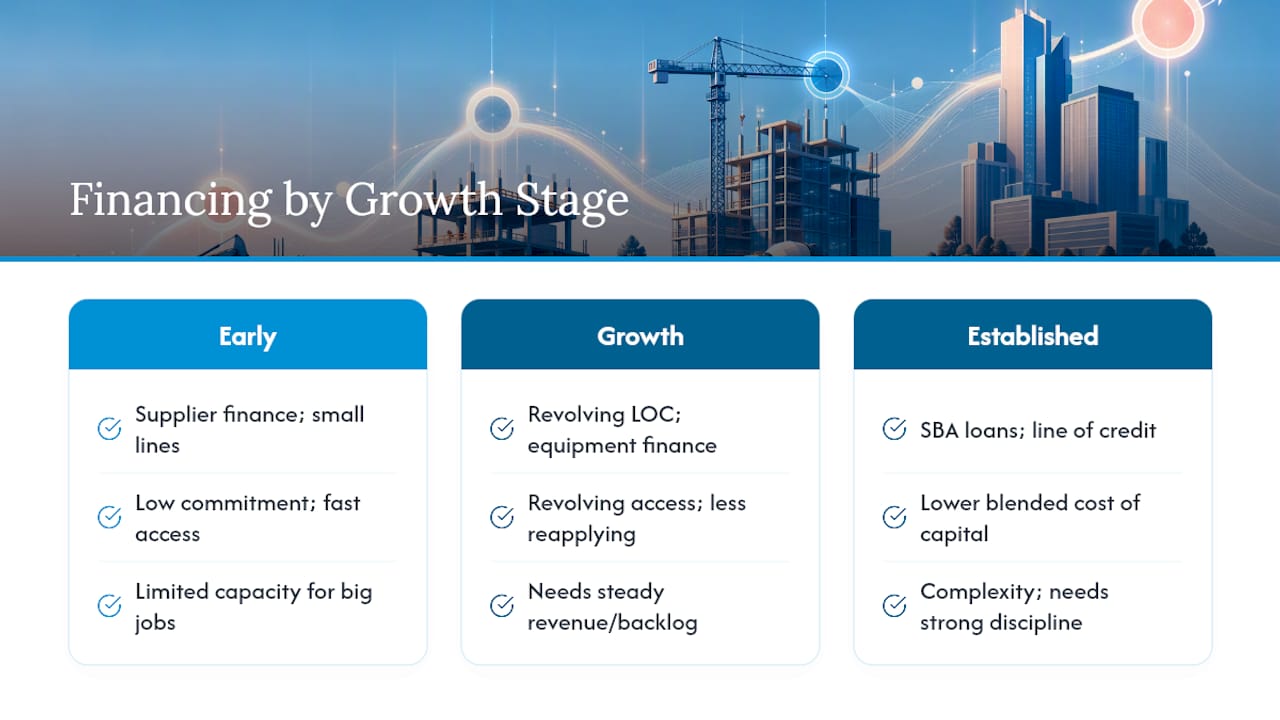
Early-stage contractors usually lean on supplier financing and small credit lines because formal loans are harder to qualify for without a long track record. The upside is low commitment and fast access. The downside is limited capacity, a $15,000 line won’t cover a $200,000 job’s material costs.
Growth-stage businesses typically graduate to larger revolving lines of credit and equipment financing. A construction line of credit becomes genuinely useful here, since revolving access reduces the friction of reapplying for every new job. The tradeoff is more scrutiny: lenders want to see consistent revenue and a real backlog before extending six-figure limits.
Established firms bidding on large public or commercial projects often combine SBA loans for equipment and facilities with a line of credit for operational flexibility. The advantage is lower blended cost of capital across the business. The disadvantage is complexity, managing multiple products and repayment schedules takes real financial discipline, and a missed payment on one product can affect your standing on others if personal guarantees overlap.
There’s no single best answer here. The mistake most contractors make is sticking with whatever financing got them started, long after their business has outgrown it.
Big projects create a specific cash-flow problem: you’re paying for labor and materials weeks or months before the client’s progress payment clears. Financing bridges that gap, but only if you plan the timing correctly.

Start by mapping your draw schedule against the project’s payment schedule before you break ground. If progress payments hit net-45 and your material suppliers want net-30, you already know where the gap sits, and you can size your line of credit or supplier terms accordingly instead of discovering the shortfall mid-project.
Retainage deserves special attention. Most commercial contracts hold back 5% to 10% of each payment until project completion, which means a chunk of your earned revenue is locked up for months. A revolving line of credit is particularly well-suited here because you draw against the gap, repay when retainage releases, and the limit resets for the next job instead of tying up a term loan for a temporary hold.
Build a buffer for weather delays and change orders, both of which push payment timelines without warning. A contractor onboarding checklist that aligns financing decisions with project milestones from day one catches these gaps before they become emergencies.
Finally, separate your financing by purpose. Use short-term revolving credit for payroll and materials, and reserve longer-term products for equipment or expansion. Mixing the two makes it much harder to track what you actually owe against what each job is bringing in.
Speed is the whole point when a job site can’t wait for a six-week underwriting process. Fordham Capital built its application around that reality: one page, submitted online, reviewed against a network of banks and alternative lenders rather than a single institution’s narrow criteria.
That network approach matters more than it sounds. Instead of getting one yes-or-no answer from a single bank, your application gets matched against multiple lenders simultaneously, which is a large part of how Fordham reaches approval decisions within 24 hours for many applicants. The company holds an A+ rating with the Better Business Bureau and has funded over $120 million to businesses that helped generate more than $500 million in client revenue, credentials worth checking before you hand over financial details to any lender.
Fordham also emphasizes protecting your credit score during the application process itself, a real concern for contractors who don’t want a round of hard inquiries dinging their score before they’ve even chosen a lender. Before you apply, have these ready: recent bank statements, basic revenue figures, time-in-business information, and a general sense of what you need the funds for. That’s largely it, since the one-page format is designed to cut the paperwork burden that makes traditional bank applications drag on for weeks.
If your business needs working capital now, not next month, start the application here and see what the network can offer.
Before you apply anywhere, do five things: pull your personal and business credit reports, gather three to six months of bank statements, confirm your current project backlog in writing, total your outstanding receivables, and decide the exact dollar amount and purpose for the funds. Skipping any one of these slows down underwriting and often costs you a better rate.
— Rob
At Fordham Capital, we've made the application process straightforward and reassuring. Dive in and explore your financial options with confidence, knowing there's no impact on your credit score and no obligations. We review your details and offer customized solutions based on what you're looking for.