For most auto repair shops, the fastest path to funding depends on what you need it for: an SBA 7(a) loan usually fits large equipment purchases or expansion, a business line of credit covers seasonal payroll and parts inventory, and equipment financing matches monthly payments to how long the asset will actually last. The SBA 7(a) program can fund up to $5 million, with an average loan near $480,000 in fiscal year 2023. Shops that need capital in days rather than weeks often start with a one-page application through a funding marketplace like Fordham Capital.
TL;DR:
- SBA 7(a) loans can provide up to $5 million for major equipment or expansion projects, with approval times often taking several weeks.
- Business lines of credit are ideal for seasonal cash flow needs like payroll and parts inventory, offering flexible draw and repayment options.
- Equipment financing terms should match the asset’s useful life, with longer terms for durable assets like lifts and shorter terms for tech or software tools.
- Presenting clear documentation such as tax returns, financial statements, and collateral details increases approval chances and can speed up the process.
- Nonbank lenders and quick funding options offer faster access but typically at higher costs, making them better suited for short-term needs.
Matching the product to the need saves time and money. A shop chasing a bank loan for a $15,000 tool upgrade is wasting weeks it does not have, and a shop using a cash advance to buy a $150,000 lift is paying far more than necessary.
The tradeoff across all of these is speed versus cost. Bank and SBA products cost less but take longer to underwrite; nonbank lenders move fast but charge for it.
Lenders look at a fairly predictable set of documents and numbers before deciding whether to fund an auto repair shop, and showing up prepared changes both your approval odds and the terms you get offered.
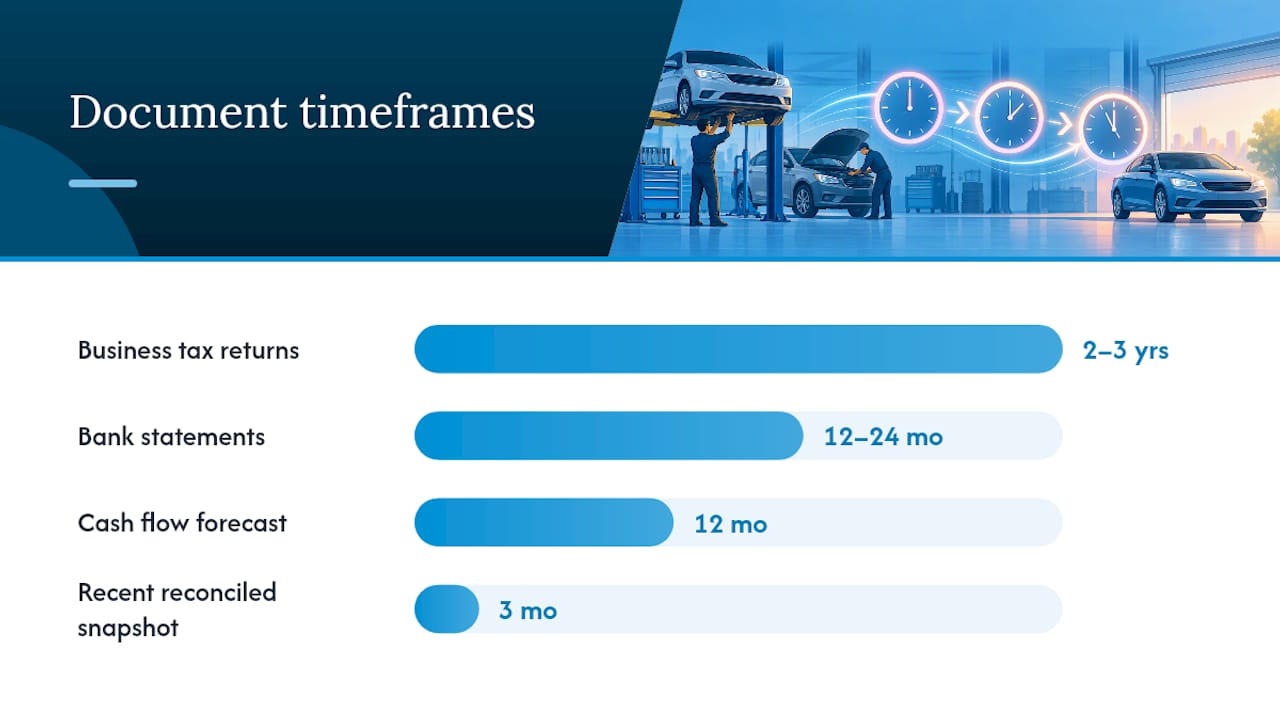
Lenders weigh time in business heavily. A shop open for five years with steady cash flow coverage will clear underwriting faster than a newer shop with the same revenue, and a personal credit score in the high 600s or above generally opens more doors than one below it. Outstanding liens or unresolved UCC filings against your equipment are a common reason applications stall, so clearing those before you apply is worth the effort. Understanding what factors lenders weigh most heavily helps you address weak spots before a lender finds them.
A few fixes tend to move the needle more than others. Writing a one-page executive summary of your shop, its history, and what the funds will do forces clarity that a lender notices immediately. A 12-month cash flow forecast shows you understand your own seasonality, which matters more for a repair shop than most retail businesses. Correcting bookkeeping errors before submission, rather than explaining them afterward, saves a round of follow-up questions that can cost you a week or more.
Pro Tip: Ask your bookkeeper to reconcile the last three months before you apply anywhere. A clean, recent snapshot reassures underwriters faster than a perfect five-year history with a messy last quarter.
The SBA 7(a) program covers equipment, working capital, and real estate improvements, with loan amounts running up to $5 million and an average loan size around $480,000 in fiscal 2023. That makes it a natural fit for a shop replacing a full bay of lifts or buying out a neighboring location, rather than covering a slow month.
Interest rates are capped based on loan size and tied to a base rate, so pricing stays more predictable than most alternative lending. The government guarantee behind the loan is what allows banks to extend these terms to small businesses that might not otherwise qualify on their own.
Shops with strong recent financials and clean documentation move through this process faster. Confirming you meet current SBA loan requirements before applying prevents a rejection that could otherwise be avoided with better preparation.
The rule of thumb from equipment financing advisors is simple: match the loan term to the equipment’s useful life. A heavy-duty lift that will run for a decade can reasonably carry a 60-month term, while diagnostic tech or software-driven tools with a shorter working life fit better on a 36-month schedule.
A property must be owned and used in the business, with a determinable useful life, to qualify for depreciation under IRS Publication 946, which also outlines the Section 179 election for shops looking to deduct equipment costs in the year of purchase rather than over several years. A tax advisor can tell you whether accelerating that deduction makes sense given your shop’s income for the year, since the right answer depends on your specific numbers.
When timing matters more than rate, nonbank lenders and merchant cash advances fill the gap, but they come with tradeoffs worth understanding before you sign anything.
The biggest mistake shop owners make is waiting until cash is tight to start the paperwork. For most needs between $25,000 and $500,000, the sequence that works is: prepare your documents first, approach an SBA lender or local bank if the timeline allows it, and use a funding partner when speed matters more than shaving a point off the rate.
An accountant is worth involving before you sign, not after, especially where Section 179 or depreciation choices affect your tax picture. A funding partner with a strong BBB rating and a track record of funding small businesses shortens the application step itself through a one-page form rather than the lender search.
— Rob
If you would rather spend your time running the shop than filling out five different lender applications, a funding platform with a one-page form and access to a network of banks and alternative lenders removes that friction, with approvals often available within 24 hours and no impact to your credit score during the process.
| Product | Interest rate | Best fit |
|---|---|---|
| SBA Loan | Fixed annual rates | Equipment, expansion, real estate improvements |
| Line of Credit | Variable monthly rates | Payroll, seasonal inventory, recurring costs |
| Working Capital | Rate details vary | Short-term operating gaps |
If you are weighing your options for shop equipment growth, background from an automotive growth partner covering how dealers and importers plan equipment investment can be a useful reference point alongside your financing decision. When you are ready to move, start your one-page application with Fordham Capital and see which lenders in the network fit your shop.
Review the SBA’s 7(a) loan terms, IRS depreciation guidance, and the Federal Reserve’s small business credit findings before submitting any application.
It depends on the need: an SBA 7(a) loan fits large equipment or expansion, while a business line of credit works better for payroll and inventory swings. Equipment financing is usually the better fit when you are buying a single piece of machinery with a known useful life.
Bank and SBA underwriting commonly takes several weeks given the documentation involved, while nonbank lenders and marketplaces can move much faster. Fordham Capital’s one-page application can return approvals within 24 hours by matching shops to lenders in its network.
It depends on the lender and product, since some pull hard credit inquiries during underwriting while others do not. Fordham Capital’s application process does not impact your credit score, which makes it a lower-risk way to compare options before committing to one lender.
Traditional bank and SBA loans generally require stronger personal and business credit, but nonbank lenders, CDFIs, and small community banks are often more flexible with marginal borrowers because they weigh relationship-based information alongside the numbers, according to FDIC lending survey findings. Improving cash flow documentation and clearing liens before applying still improves your odds regardless of lender type.
Most lenders want two to three years of tax returns, 12 to 24 months of bank statements, a current profit and loss statement, and a balance sheet. Equipment lists and accounts receivable aging reports round out what underwriters typically request.
At Fordham Capital, we've made the application process straightforward and reassuring. Dive in and explore your financial options with confidence, knowing there's no impact on your credit score and no obligations. We review your details and offer customized solutions based on what you're looking for.