
Non-traditional lenders, also called nonbank or alternative lenders, are financial institutions that provide business loans without taking deposits the way banks do. The main types include online/fintech lenders, merchant cash advance providers, invoice factoring companies, equipment financiers, revenue-based finance firms, peer-to-peer marketplaces, crowdfunding platforms, microlenders and CDFIs, hard-money and private lenders, and non-QM mortgage lenders. The Consumer Financial Protection Bureau and state regulators still oversee many of these lenders, and marketplace platforms like Fordhamcapital connect small businesses to this full range of options through a single one-page application.
Non-traditional lenders offer speed and flexibility that banks can’t match, but the true cost of capital, not the monthly payment, is the only metric that lets you compare offers fairly.
| Point | Details |
|---|---|
| Ten lender types to know | Online/fintech, MCA, invoice factoring, equipment, RBF, P2P, crowdfunding, CDFIs, hard-money, and non-QM mortgage lenders each serve different needs. |
| Factor rate vs. APR | A 1.35 factor rate over six months equals roughly 70% APR; always convert before comparing any two offers. |
| Personal guarantee risk | Even “no collateral” loans commonly require a personal guarantee; read the full contract before signing. |
| Verify licensing first | Check every lender through NMLS Consumer Access and your state’s financial regulator before submitting documents. |
| Fordhamcapital marketplace | One-page application, 24-hour approvals, no credit impact, and access to a network of banks and alternative lenders with over $120M funded. |
The term “non-traditional” is shorthand for any lender that does not hold a banking charter and does not take customer deposits. According to the Bipartisan Policy Center, this umbrella covers finance companies, factoring firms, leasing companies, fintech platforms, marketplace lenders, merchant cash advance providers, and CDFIs. They all reach the same destination — putting capital in a business’s hands — but they get there through very different underwriting engines.
Where a bank reviews two to three years of tax returns, a personal credit score, and collateral documentation, many nonbank lenders pull live data from accounting software like QuickBooks or a business’s bank feed and make a decision in hours using short-term business finance options tailored to fast-moving needs. That speed is structural, not just a marketing claim. Because they don’t manage deposits, they aren’t subject to the same capital-reserve requirements, which lets them move faster and accept risk profiles that would stall at a traditional credit committee.
The regulatory picture is more layered than most borrowers expect. Federal consumer protections still apply in many cases, and the CFPB has authority over certain nonbank financial companies. State-level licensing matters too: lenders must register in states where they operate, and you can verify registration through the NMLS Consumer Access portal. Some states have usury caps that limit interest rates; others have almost none. Checking your state’s financial regulator directory before signing anything is worth the five minutes it takes.
Who actually uses these lenders? Startups without two years of financials, seasonal businesses with lumpy revenue, owners with thin or bruised credit, and any business that needs capital in days rather than weeks. The U.S. Census Bureau’s research on gig-economy employment trends points to a growing share of self-employed and small-business owners whose income patterns don’t fit neatly into a bank’s underwriting model, which helps explain why demand for alternative financing channels keeps rising.
America’s SBDC notes that fintech lenders tend to concentrate on smaller loan amounts and shorter durations, which is exactly where traditional banks are least competitive. Here is a practical inventory of each lender type, what they offer, when they fit, and the risk to watch.
Online/fintech term loans and lines of credit Nonbank platforms that use technology and alternative data to underwrite quickly. Products: term loans ($5,000–$500,000+), revolving lines of credit. Best for: established businesses needing working capital or growth funding fast. Risk flag: APRs can run significantly higher than bank rates, especially for shorter terms.
Merchant cash advances (MCAs) A lump-sum advance repaid through a daily or weekly percentage of card or bank revenue (the “holdback”). Products: advances typically $5,000–$500,000. Best for: retail or restaurant businesses with strong card sales but weak credit. Small-business research consistently flags MCAs as high-cost, short-term tools rather than long-term financing.

Invoice factoring Products: spot factoring, full-ledger factoring. Best for: B2B businesses with slow-paying clients and immediate cash needs. Risk flag: customer notification required; fees compound quickly on slow-paying invoices.
Equipment financing and leases Loans or leases where the equipment itself serves as collateral. Products: equipment loans, sale-leaseback arrangements. Best for: manufacturers, contractors, medical practices buying machinery or vehicles. Risk flag: personal guarantee likely on smaller loans; equipment depreciation can leave you underwater.
Revenue-based financing (RBF) Capital repaid as a fixed percentage of monthly revenue until a predetermined total is reached. Products: RBF agreements, typically $10,000–$3M. Best for: SaaS companies or subscription businesses with predictable recurring revenue.
Peer-to-peer (P2P) and marketplace lenders Online platforms that match borrowers with individual or institutional investors. Products: unsecured term loans, sometimes lines of credit. Best for: borrowers with decent credit who want competitive rates without a bank relationship. Risk flag: approval not guaranteed; some platforms have tightened credit standards significantly since 2020.
Crowdfunding Raising capital from the public via reward, donation, or equity models. Products: Regulation Crowdfunding (equity), reward-based campaigns (Kickstarter-style). Best for: consumer-facing product launches, community businesses, early-stage startups. Risk flag: time-intensive; equity crowdfunding involves SEC disclosure requirements and ongoing reporting.
Microlenders and CDFIs Community Development Financial Institutions and nonprofit microlenders serve underserved markets with mission-driven capital. Products: microloans (often under $50,000), SBA Microloan Program funds. Best for: startups, minority-owned businesses, rural businesses, owners with thin credit files. Risk flag: lower loan ceilings; application process can still take weeks.
Hard-money and private lenders Asset-backed lenders, usually individuals or private funds, that lend against real estate or business assets. Products: bridge loans, fix-and-flip loans, short-term commercial real estate loans. Best for: real estate investors, businesses needing fast bridge capital.
Specialty lenders (non-QM mortgages, ITIN, foreign-national) Lenders that operate outside Fannie Mae/Freddie Mac agency guidelines. Products: non-QM mortgages, DSCR loans, ITIN loans, foreign-national mortgages, lite-doc loans. Best for: self-employed borrowers, real estate investors, foreign buyers without a Social Security number. Risk flag: higher rates than conforming loans; terms vary widely by lender.
For a broader overview of non-bank business financing options, Fordhamcapital’s resource library covers each product category in more detail.
Non-QM (non-qualified mortgage) loans don’t meet the Consumer Financial Protection Bureau’s “qualified mortgage” standards, which means lenders can use alternative documentation and more flexible underwriting. That flexibility is the point.
DSCR loans (debt-service-coverage-ratio) underwrite based on the rental income a property generates relative to its debt payments, not the borrower’s personal income. Lenders typically want a DSCR of 1.0 or higher, though some go below 1.0 with compensating factors.

ITIN loans serve borrowers who have an Individual Taxpayer Identification Number but no Social Security number, typically immigrants who file U.S. taxes but aren’t eligible for conventional financing. Documentation usually includes 12–24 months of bank statements, ITIN tax returns, and proof of residency.
Foreign-national mortgages go one step further, serving buyers with no U.S. tax history at all.
Lite-doc and bank-statement loans are the most common non-QM product for self-employed U.S. borrowers. Instead of two years of tax returns (which often understate income after deductions), lenders average 12–24 months of personal or business bank deposits to calculate qualifying income. A business owner whose Schedule C shows $60,000 in net income but whose bank statements show $180,000 in deposits is a classic candidate.
Common documentation substitutions across non-QM products: bank statements in place of tax returns, rent rolls and lease agreements in place of pay stubs, DSCR calculations in place of debt-to-income ratios, and CPA letters confirming self-employment for at least two years.
The practical differences come down to four variables: underwriting inputs, speed, collateral requirements, and price.
Traditional banks rely heavily on FICO scores, two or more years of tax returns, audited financials, and physical collateral. Nonbank lenders, especially fintechs, pull alternative data: bank transaction history, payment processor data, accounting software feeds, and sometimes social or operational signals. That broader data set lets them approve borrowers a bank would decline, and it lets them do it fast.
Many alternative lenders use one-page applications that connect directly to accounting and banking feeds, enabling underwriting decisions within 24 hours. A bank’s SBA loan, by contrast, can take 30–90 days from application to funding.
| Factor | Traditional banks | Non-traditional lenders |
|---|---|---|
| Underwriting data | Tax returns, FICO, collateral | Bank feeds, revenue data, alternative data |
| Approval timeline | 2–4 weeks (SBA: 30–90 days) | 24 hours to 5 business days |
| Documentation burden | High (2+ years returns, financials) | Low to moderate (bank statements, 1-page app) |
| Collateral requirement | Often required | Varies; personal guarantee common |
| Typical loan term | 5–15 years | 3 months to 5 years |
| Cost (APR range) | 6–12% (prime borrowers) | 10–70% depending on product |
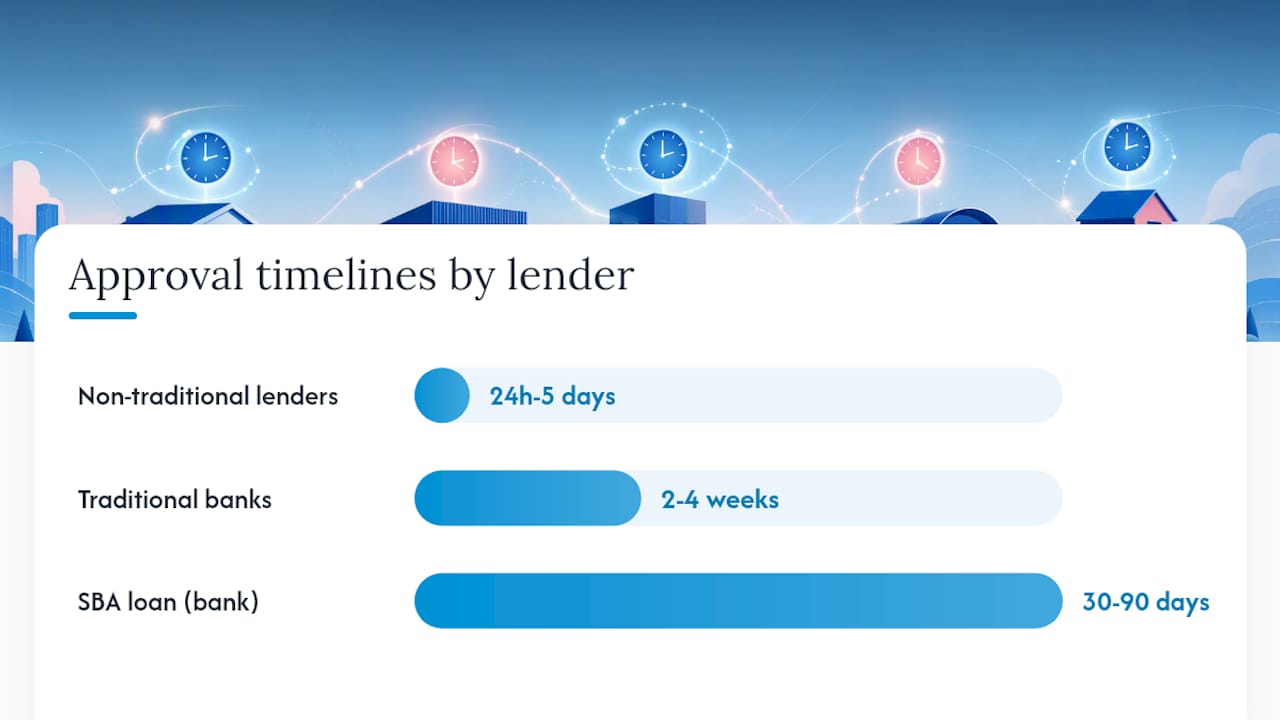
When does a bank still win? If you have strong credit, two or more years of clean financials, and you can wait 30–60 days, a bank or SBA loan almost always costs less. The non-traditional route makes sense when speed matters, when your credit profile is thin, or when the loan amount is too small for a bank to bother with.
Cost structures in alternative lending are genuinely confusing, and that confusion is sometimes intentional.
Common cost formats:
Because nonbank lenders operate under different regulatory structures than deposit-taking banks, borrowers must read contracts carefully. A loan advertised as “no collateral required” may still carry a personal guarantee, which means your personal assets are on the line if the business defaults.
Red flags to stop you cold:
The Consumer Action non-bank fact sheet is a useful due-diligence reference that walks through borrower rights and what to check before signing with any nonbank lender.
Start with the cost of capital, not the monthly payment. A $50,000 advance with a 1.4 factor rate repaid over six months costs $20,000 in fees. Same amount, very different outcome.
Evaluation checklist:
Questions to ask every lender before you commit:
For a deeper guide on how to choose the right lender for your specific situation, Fordhamcapital’s resource covers the full decision framework.
| Document | Purpose | Typical timeline to gather |
|---|---|---|
| 3–6 months business bank statements | Revenue and cash-flow verification | 1–2 days |
| Business tax returns (1–2 years) | Income verification for term loans | 1–3 days |
| Driver’s license / government ID | Identity verification | Immediate |
| Voided business check | Bank account confirmation | Immediate |
| Business license or formation docs | Entity verification | 1–2 days |
| Accounts receivable aging report | Required for invoice factoring | 1–2 days |
| Processor statements (if MCA) | Revenue verification for advances | 1–2 days |
Most fintech lenders can move from application to funded in 1–5 business days once documents are in. Hard-money lenders typically take 7–14 days for property appraisal and title work. SBA-backed nonbank lenders run 2–4 weeks.
Numbers make this concrete. Here are two scenarios a small business might actually face.
Scenario A: Merchant cash advance
Scenario B: Short-term term loan
Same $50,000. The MCA costs $17,500 in fees over six months; the term loan costs roughly $5,200 over twelve. If cash flow allows the monthly payment, the term loan is the clear choice. The MCA only wins if you genuinely cannot qualify for anything else and the capital need is urgent.
Simple formula to convert a factor rate to approximate APR:
APR ≈ (Factor Rate − 1) ÷ Loan Term in Years
Pro Tip: The most common mistake borrowers make is comparing a factor rate to an interest rate directly. Always convert to APR before comparing any two offers.
From an editorial standpoint, the marketplace model has one underappreciated advantage: it surfaces offers from multiple lenders simultaneously, which creates real competitive pressure on pricing. A borrower who applies to a single MCA provider gets one offer. A borrower who applies through a marketplace that connects to a network of banks and alternative lenders gets several, and the spread between the best and worst offer in that set can be substantial.
Fordhamcapital operates as exactly that kind of marketplace. Its A+ BBB rating and over $120M funded reflect a track record that matters when you’re handing over bank statements and business financials. The one-page application connects to a lender network that includes both regulated banks and alternative lenders, which means some offers that appear “alternative” actually originate from institutions operating under full banking oversight. Industry analysis from Morgan Stanley notes that traditional banks increasingly rely on alternative platforms for small-balance lending, so the line between “bank loan” and “alternative loan” is blurrier than most borrowers realize.
One honest caution: a marketplace connects you to third-party lenders, not a single direct lender. Before accepting any offer, confirm the funding entity’s identity, verify their state licensing through NMLS, and read the full term sheet. The marketplace’s job is to match you; your job is to evaluate what you’re matched with.
Most small businesses don’t fail to find capital because good options don’t exist. They fail because navigating a dozen different lender types, each with its own application, documentation requirements, and pricing structure, takes time most owners don’t have.
Fordhamcapital cuts that process to a single one-page application that reaches a network of banks and alternative lenders at once. No credit score impact from the inquiry, no collateral required to apply, and approvals typically arrive within 24 hours. With over $120M funded and an A+ BBB rating, the platform has a documented track record with the kinds of businesses traditional banks routinely pass on: thin-file borrowers, startups, and seasonal operators who need capital on their timeline, not a bank’s. Whether you need a working capital line, an SBA loan, or a short-term advance, start your application and see which lenders in the network match your profile. The process takes minutes; the offers give you real numbers to compare.
Regulatory and consumer protection:
Further reading:
Fordhamcapital resources:
This article provides general information about non-traditional lending options and is not a substitute for professional financial or legal advice. Verify current terms, rates, and licensing requirements with the lender and your state’s financial regulator before accepting any offer.
At Fordham Capital, we've made the application process straightforward and reassuring. Dive in and explore your financial options with confidence, knowing there's no impact on your credit score and no obligations. We review your details and offer customized solutions based on what you're looking for.