
An EIN gets you nowhere on its own with a traditional bank or SBA lender, both of which typically require a personal guarantee from anyone owning 20% or more of the business. Certain alternative products, like invoice factoring, merchant cash advances, and equipment loans, do lean more heavily on business performance than personal credit. Getting approved through those still means showing revenue, bank statements, and some business credit history.
TL;DR:
- EIN-related approval for financing relies heavily on business credit reports, bank statements, and vendor payment history, not just the EIN on its own.
- True EIN-only business loans are scarce because most lenders require a personal guarantee from owners holding 20% or more equity, regardless of EIN use.
- Certain products like invoice factoring, merchant cash advances, and equipment loans can focus on business performance over personal credit, but often at higher costs.
- Building a credible credit file involves opening dedicated accounts, registering for a D-U-N-S number, and maintaining consistent deposits for at least three to six months.
- Approaching lenders with full documentation and a developed credit history reduces costs and improves approval chances, especially when applying through firms like Fordham Capital.
An EIN is a nine-digit number the IRS assigns to identify a business for tax purposes, the same way a Social Security number identifies a person. It lets you open a business bank account, file payroll taxes, and apply for vendor credit. What it does not do is carry any repayment history, revenue data, or risk score. A lender looking at a bare EIN sees an identifier, not a track record.
This is where the marketing around “EIN-only business loans” gets misleading. Plenty of websites promise financing with no personal credit check at all, and while a handful of products get close, true EIN-only underwriting is rare. Lenders use your EIN as a lookup key. Once they have it, they pull:
The reason personal information still comes into play so often traces back to a single SBA rule: any owner holding 20% or more equity in the borrowing entity must sign a personal guarantee. That rule doesn’t just apply to SBA loans. Most banks and many online lenders copy the same threshold into their own underwriting, because it gives them recourse if the business folds. An EIN opens the file. It doesn’t close the loan.
Some financing categories genuinely weigh business metrics over personal credit history, though “weigh more” rarely means “check nothing.” Here’s where an EIN-centered approach realistically gets you approved:
Invoice factoring. A factoring company buys your unpaid invoices at a discount and advances you the cash, and the underwriting focuses mostly on your customers’ creditworthiness, not yours. If you bill reliable commercial clients, this can function almost entirely as an EIN-first product.
Merchant cash advances. MCA providers underwrite off daily or weekly card sales, often approving within 24 to 48 hours. Speed comes at a price. Effective APRs on MCAs can exceed 40% once the fee structure gets converted into annualized terms.
Equipment loans. The equipment itself acts as collateral, which reduces (though doesn’t eliminate) a lender’s reliance on your personal credit profile. Down payments and business revenue still matter.
Microloans through nonprofit and community lenders. Amounts typically stay small, often under $50,000, but approval standards flex more than a traditional bank’s, especially for newer businesses without long credit histories.
Revenue-based lenders and online lines of credit. Requirements vary widely by lender, but expect to show 3 to 12 months of consistent bank statements before anyone extends a line based mainly on cash flow.
Net-30 vendor accounts. These aren’t loans, but they matter more than most owners realize. Paying a supplier on 30-day terms and having that payment reported to Dun & Bradstreet is one of the fastest ways to start a PAYDEX history tied directly to your EIN.
Every lender in this space runs through a similar mental checklist before they say yes, regardless of how they market the product. Knowing it ahead of time saves you from applying blind and getting rejected for something fixable.
Revenue and cash flow. Most lenders want several months of business bank statements showing consistent deposits. Online lenders tend to accept the shorter end of that range; banks and SBA lenders usually want the full year, sometimes more.
Time in business. Fintech lenders will often work with businesses as young as six months old. Banks generally want a few years of operating history before they’ll talk seriously.
Business credit scores. This is where the EIN actually starts to matter as a credit identifier rather than just a tax number. A PAYDEX score of 80 or above from Dun & Bradstreet is widely treated as a strong benchmark, and lenders also pull Experian Business Intelliscore and, increasingly, FICO LiquidCredit scores built specifically for small business risk assessment.
Personal guarantees and identity verification. As covered above, any owner with 20% or more equity should expect to sign one for SBA-backed products and most bank loans.
Documents worth having ready before you apply:
The path from “just an EIN” to “a business lenders will underwrite on its own merits” runs through deliberate steps, not time alone. A business with a five-year-old EIN and zero reported trade lines is functionally invisible to a credit bureau. Here’s what actually moves the needle.
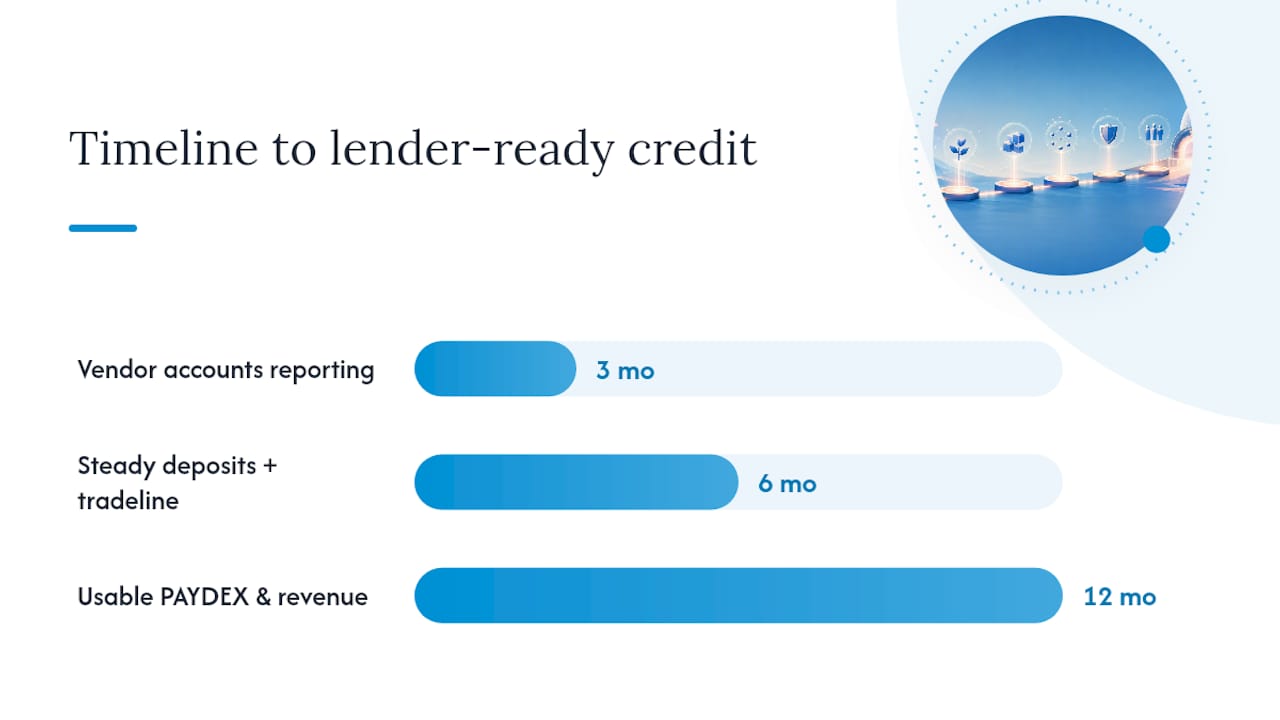
A realistic timeline looks like this: by month 3, you should have one to three net-30 accounts reporting. By month 6, you want a steady deposit pattern and at least one tradeline or small microloan on the books. By month 12, if the vendor accounts have reported consistently, you’re often in range of a usable PAYDEX score and three or more months of qualifying revenue for revenue-based products.
Pro Tip: Start with net-30 vendors and one small microloan before chasing a bigger line of credit. Lenders read a thin file with clean, on-time payments far better than a blank one, and it costs you almost nothing to build.
EIN-favoring products cost more because lenders are pricing in the exact risk they’d otherwise offset with your personal credit and guarantee. Fewer personal safeguards for the lender means a higher rate for you. That trade-off shows up clearly once you line the products up:
Watch for these signals before signing anything:
A personal guarantee isn’t the enemy here. In many cases it’s the thing that gets you a materially lower rate and a longer repayment term, because it gives the lender recourse beyond the business itself.
If your revenue and credit profile qualify for both an EIN-first product and a guaranteed loan, run the actual cost comparison before assuming the credit check is the worse deal. Sometimes it isn’t. For a deeper look at limiting that exposure, see how to protect your personal credit score while still borrowing through the business.
Fordham Capital fits readers who’ve already got some revenue history and just need a faster route through the underwriting maze than a bank offers. Approvals often come within 24 hours of a completed application.
Fordham Capital works best for:
The one-page application is built to move quickly once you have your bank statements and formation documents ready. Some alternative products discussed above, particularly net-30 vendor credit or SBA microloans, may end up cheaper for very early-stage businesses with thin revenue. For businesses ready to move now, applying directly is the fastest way to see real offers.
The “no personal credit check” pitch sells because it promises a shortcut that barely exists. What the research actually supports is less exciting but more useful: business credit is buildable, and the owners who treat their EIN as the start of a credit file, not a magic key, get better offers within a year.
Conventional advice tends to stop at “here are five products that don’t check your credit.” That’s incomplete. The better move is to run both paths side by side: build the vendor tradelines and PAYDEX history over the next six to twelve months, while applying for the working capital you need now through a lender who’s transparent about rate and terms.
Prioritize documentation before product shopping. A lender can only underwrite what you can prove.
— Rob
Fordham Capital is the practical alternative to spending weeks chasing separate applications at separate banks. Instead of filling out five different forms, one application puts your business in front of a network of banks and alternative lenders at once. That’s especially useful if you’re piecing together the credit-building steps above and need working capital now rather than in six months.
If your business already has a few months of steady deposits and some documentation in order, an application won’t cost you anything to submit and see what offers come back. For businesses buying capital equipment as part of the plan, resources like this equipment financing guide can help you understand how collateral-backed terms typically work before you compare them against Fordham’s offers. When you’re ready, start your one-page application and see what your business qualifies for.
Key references used throughout: the SBA’s personal guarantee requirement, the FDIC’s 2024 small-business lending survey, and explainers from NerdWallet and Forbes Advisor on EIN-based lending mechanics.
At Fordham Capital, we've made the application process straightforward and reassuring. Dive in and explore your financial options with confidence, knowing there's no impact on your credit score and no obligations. We review your details and offer customized solutions based on what you're looking for.