
Business working capital is the calculated difference between a business’s current assets and current liabilities, and it is the single most direct measure of your company’s short-term financial health. Every small business owner needs to understand this number because it determines whether you can pay suppliers next week, cover payroll this month, or seize a growth opportunity when it appears. Tools like QuickBooks, NetSuite, and insights from J.P. Morgan all point to the same truth: working capital is not a back-office accounting concept. It is the daily pulse of your business.
Business working capital is defined as current assets minus current liabilities, giving you a snapshot of the liquid resources available to run your operations right now. The industry term you will see in financial statements and banking conversations is net working capital, and it means exactly the same thing. Both terms are used throughout this guide.
Current assets are resources your business expects to convert to cash within 12 months. These include cash on hand, accounts receivable (money customers owe you), inventory, and prepaid expenses. Current liabilities are obligations due within the same 12-month window, including accounts payable, accrued expenses, and short-term debt. The gap between the two is your working capital position.

What makes this metric powerful is its immediacy. A profitable business on paper can still run out of cash if its current liabilities outpace its liquid assets. Working capital captures that tension in a single number, which is why lenders, investors, and financial advisors treat it as a foundational measure of operational stability.
The formula is straightforward: Working Capital = Current Assets − Current Liabilities
Here is how it looks with real numbers. Suppose your bakery has $85,000 in current assets (cash, receivables, and flour inventory) and $50,000 in current liabilities (supplier invoices and a short-term equipment loan). Your working capital equals $35,000, meaning you have a $35,000 buffer to meet near-term obligations. A larger business might show $500,000 in current assets against $350,000 in current liabilities, producing $150,000 in positive working capital.
The sign and size of the result both matter. Positive working capital means you can cover short-term obligations and have room to operate. Negative working capital means your liabilities exceed your liquid assets, which signals potential cash flow stress.
| Scenario | Current Assets | Current Liabilities | Working Capital | Interpretation |
|---|---|---|---|---|
| Healthy small retailer | $85,000 | $50,000 | +$35,000 | Comfortable liquidity buffer |
| Growing manufacturer | $500,000 | $350,000 | +$150,000 | Strong position for investment |
| Struggling startup | $40,000 | $65,000 | -$25,000 | Liquidity risk, needs attention |
| Fast-turnover grocer | $120,000 | $130,000 | -$10,000 | Manageable if cash cycles quickly |
Pro Tip: Never count inventory at face value without checking how fast it actually sells. Slow-moving stock inflates your current assets and makes your working capital look healthier than it really is.
Working capital is the difference between a business that survives a slow month and one that misses payroll. Profitability tells you whether your business model works over time. Working capital tells you whether you can keep the lights on today. These two measures can diverge sharply, and many profitable small businesses have failed because they ran out of liquid cash at the wrong moment.
The importance of working capital shows up most clearly in timing mismatches. You pay your supplier on net-30 terms, but your customer pays you on net-60 terms. For 30 days, you are funding that gap out of your own working capital. Add in a slow inventory month or an unexpected equipment repair, and that gap becomes a crisis.
Here is what adequate working capital actually enables:
The risks of inadequate working capital are equally concrete. Missed supplier payments damage relationships and can trigger stricter payment terms. Late payroll destroys employee trust. Inability to restock inventory means lost sales. According to Stripe’s business insights, working capital provides a liquidity snapshot while cash flow measures movement over time, and a business can appear liquid on paper while facing a genuine cash crunch due to delayed payments.
Pro Tip: Track your accounts receivable aging report every two weeks. If customers routinely pay 15 to 30 days late, your working capital number is overstating your real liquidity.
The term “working capital” covers several related but distinct measures. Knowing which one you are looking at prevents costly misreads of your financial position.
Net working capital, operating working capital, and working capital ratios each serve a different analytical purpose. Net working capital is the standard formula: total current assets minus total current liabilities. Operating working capital narrows the focus to assets and liabilities directly tied to operations, excluding items like short-term investments or the current portion of long-term debt. This gives a cleaner view of how efficiently your core business generates liquidity.
The working capital ratio, also called the current ratio, expresses the relationship as a proportion rather than a dollar amount. Divide current assets by current liabilities. A ratio of 1.5 means you have $1.50 in assets for every $1.00 in liabilities. Most financial advisors consider a ratio between 1.2 and 2.0 healthy for small businesses.
| Measure | Formula | What it tells you |
|---|---|---|
| Net working capital | Current assets − Current liabilities | Dollar amount of short-term liquidity |
| Operating working capital | Operating assets − Operating liabilities | Liquidity from core business operations |
| Working capital ratio | Current assets ÷ Current liabilities | Proportional coverage of short-term obligations |
| Working capital requirement (WCR) | Receivables + Inventory − Payables | Cash needed to fund the operating cycle |
The working capital requirement (WCR) is particularly useful for product-based businesses. It tells you exactly how much cash you need to fund the gap between paying for goods and collecting from customers. A high WCR means your business model requires significant cash to operate, which directly shapes your short-term financing needs.
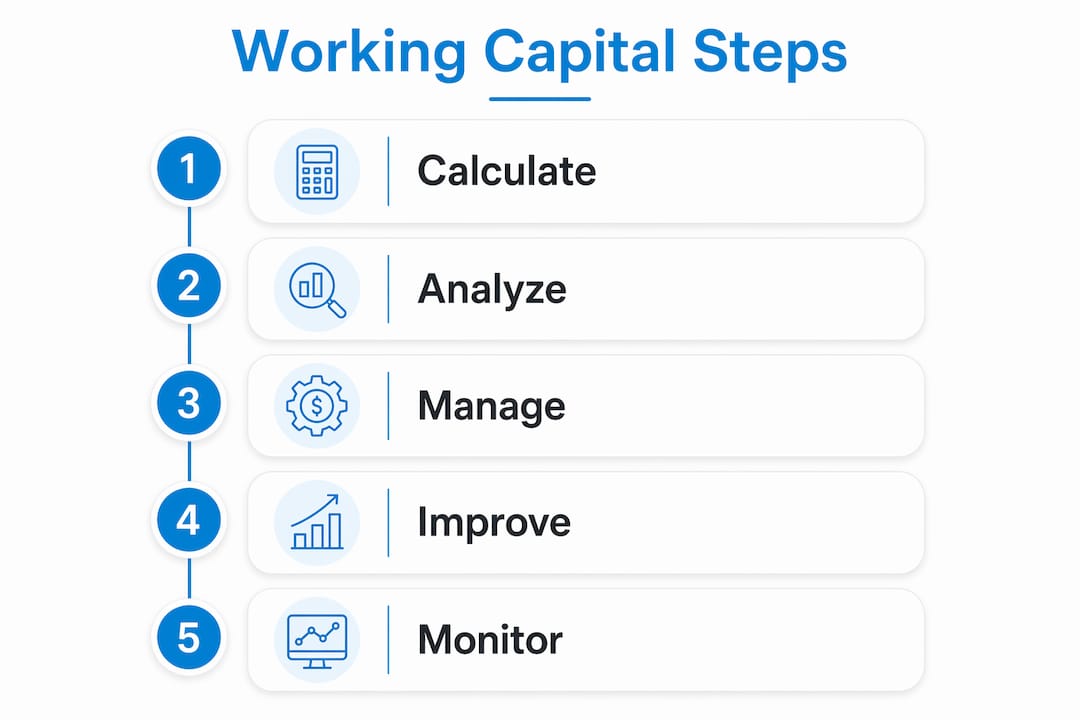
Managing working capital means actively controlling the four levers that drive it: receivables, inventory, payables, and cash reserves. Monitoring the operational drivers of liquidity converts a balance sheet number into actual cash you can use.
Here are the most effective strategies, in order of impact:
Accelerate collections. Send invoices immediately upon delivery, not at the end of the month. Offer a 1% to 2% early payment discount for customers who pay within 10 days. Use accounting software like QuickBooks or NetSuite to automate payment reminders and flag overdue accounts.
Tighten inventory management. Excess inventory ties up cash without generating return. Review your inventory turnover rate monthly. If a product category turns over fewer than four times per year, consider reducing order quantities or negotiating consignment terms with your supplier.
Extend payables strategically. Negotiate net-45 or net-60 payment terms with suppliers where possible. Paying on day 45 instead of day 15 keeps cash in your account longer without damaging the relationship. Always pay within terms to protect your credit standing.
Build a cash reserve. Set aside a percentage of monthly revenue into a dedicated reserve account. Even a 3% to 5% reserve creates a buffer against timing mismatches and unexpected expenses.
Use working capital financing when needed. Working capital loans provide short-term liquidity when your own resources fall short. These are repaid through regular scheduled payments and are designed specifically for operational gaps rather than long-term investment.
A common accounting pitfall worth flagging: overstated receivables or slow-moving inventory can make your working capital look stronger than it is. Adjusting for doubtful accounts and writing down obsolete inventory gives you a realistic picture of what you can actually spend. Good bookkeeping practices make this adjustment automatic rather than a quarterly scramble.
Consider a small landscaping company that lands a $120,000 commercial contract in March. The work runs through June, but the client pays net-60 after project completion. The owner must pay crews weekly, buy materials upfront, and cover fuel and equipment costs for four months before a single dollar arrives. Without adequate working capital, this “win” becomes a cash crisis.
Now consider the opposite scenario. A boutique clothing retailer carries $90,000 in seasonal inventory heading into a slow January. Sales drop, but rent, payroll, and supplier payments do not. The retailer’s working capital, which looked strong in November, collapses in six weeks. The owner must either liquidate inventory at a loss or find short-term financing to bridge the gap.
Many startups intentionally operate with negative working capital in early stages, relying on working capital funding to stay solvent while building revenue. This is a calculated strategy, not a failure, but it requires precise cash flow forecasting and a clear timeline to profitability. The risk is that any delay in revenue growth or unexpected expense can accelerate insolvency.
J.P. Morgan’s analysis makes a point that experienced operators know well: working capital reflects operational efficiency, not just financial position. A business that collects receivables fast, turns inventory quickly, and negotiates smart payment terms will always show stronger working capital than a competitor with the same revenue but looser operations.
Working capital is the most direct measure of whether your business can meet its short-term obligations, and managing it actively separates businesses that grow from those that stall.
| Point | Details |
|---|---|
| Core definition | Working capital equals current assets minus current liabilities, measuring short-term liquidity. |
| Calculation matters | A positive result signals financial stability; a negative result requires immediate cash management attention. |
| Profitability is not liquidity | A profitable business can still face a cash crisis if working capital is poorly managed. |
| Four management levers | Control receivables, inventory, payables, and cash reserves to improve your working capital position. |
| Financing fills gaps | Working capital loans provide a legitimate bridge when operational cash falls short of near-term obligations. |
Most small business owners check their working capital once a quarter when their accountant sends a report. That is the wrong frequency. Working capital changes every time a customer pays late, every time you reorder inventory, and every time a supplier invoice lands in your inbox.
I have seen businesses with strong annual profits hit a wall in February because they did not track the gap between what they were owed and what was due. The number on the balance sheet looked fine. The bank account told a different story. The difference was timing, and timing is exactly what working capital management is designed to address.
The entrepreneurs who manage working capital well do not obsess over the single net figure. They watch the components. They know their average collection period, their inventory days on hand, and their payables cycle. When one of those metrics drifts, they act before it becomes a crisis. Tools like QuickBooks and NetSuite make this tracking accessible even for businesses without a full-time CFO.
My honest advice: treat your working capital review as a weekly habit, not an annual event. Set up a simple dashboard that shows receivables outstanding, inventory value, and upcoming payables. Review it every Monday morning. That 15-minute habit will tell you more about your business’s financial health than any quarterly report.
— Rob
When your working capital falls short, waiting weeks for a traditional bank loan is not a realistic option. Fordham Capital provides fast, flexible funding designed specifically for small and medium-sized businesses that need capital quickly to cover operational gaps, restock inventory, or bridge a payment timing mismatch.
Fordham Capital’s one-page application takes minutes, approvals arrive within 24 hours, and the process does not impact your credit score. With an A+ BBB rating and over $120M funded, Fordham Capital has helped businesses generate more than $500M in revenue. If your working capital needs a boost, explore your funding options and get a decision before the week is out.
Working capital equals current assets minus current liabilities. For example, $85,000 in current assets minus $50,000 in current liabilities produces $35,000 in working capital.
Current assets include cash, accounts receivable, inventory, and prepaid expenses. Current liabilities include accounts payable, accrued expenses, and any debt due within 12 months.
A working capital ratio between 1.2 and 2.0 is generally considered healthy for small businesses. A ratio below 1.0 means liabilities exceed assets, signaling liquidity risk.
The biggest drivers are how quickly customers pay you, how fast you turn over inventory, and the payment terms you hold with suppliers. Slow collections and excess inventory are the most common causes of working capital shortfalls.
Yes. Profitability measures long-term performance while working capital measures short-term liquidity. A business can show strong annual profits and still face a cash crisis if receivables are slow or liabilities come due before revenue arrives.
At Fordham Capital, we've made the application process straightforward and reassuring. Dive in and explore your financial options with confidence, knowing there's no impact on your credit score and no obligations. We review your details and offer customized solutions based on what you're looking for.