Most trucking funding needs break down into five buckets: equipment loans, SBA loans, business lines of credit, invoice factoring, and online working capital. Banks win on cost but move slowly and demand strong credit; online marketplaces trade a slightly higher rate for speed and looser eligibility, adapting to changes like the shift toward superfast charging electric trucks that impact upfront costs. For owner-operators who need capital fast without gambling their credit on multiple applications, a lender marketplace like Fordham Capital is the practical starting point.
TL;DR:
- Equipment and SBA loans require good credit, significant documentation, and can take weeks to months to process, making them unsuitable for urgent needs.
- Online lenders offer approvals within hours and funding in one or two days but charge higher interest rates, making speed accessible at a cost.
- Invoice factoring is quick and accessible for those with limited credit history, but the cost is a percentage of the invoice, which can be less transparent than traditional rates.
- Prequalifying with a soft credit pull helps compare offers without damaging credit, but actual costs depend on total APR, fees, and loan recourse.
- Fordham Capital’s simplified application process provides approvals within 24 hours, making it ideal for owner-operators needing fast, flexible financing options.
Each financing category solves a different problem. Matching the right tool to the right job saves you money and headaches down the road.
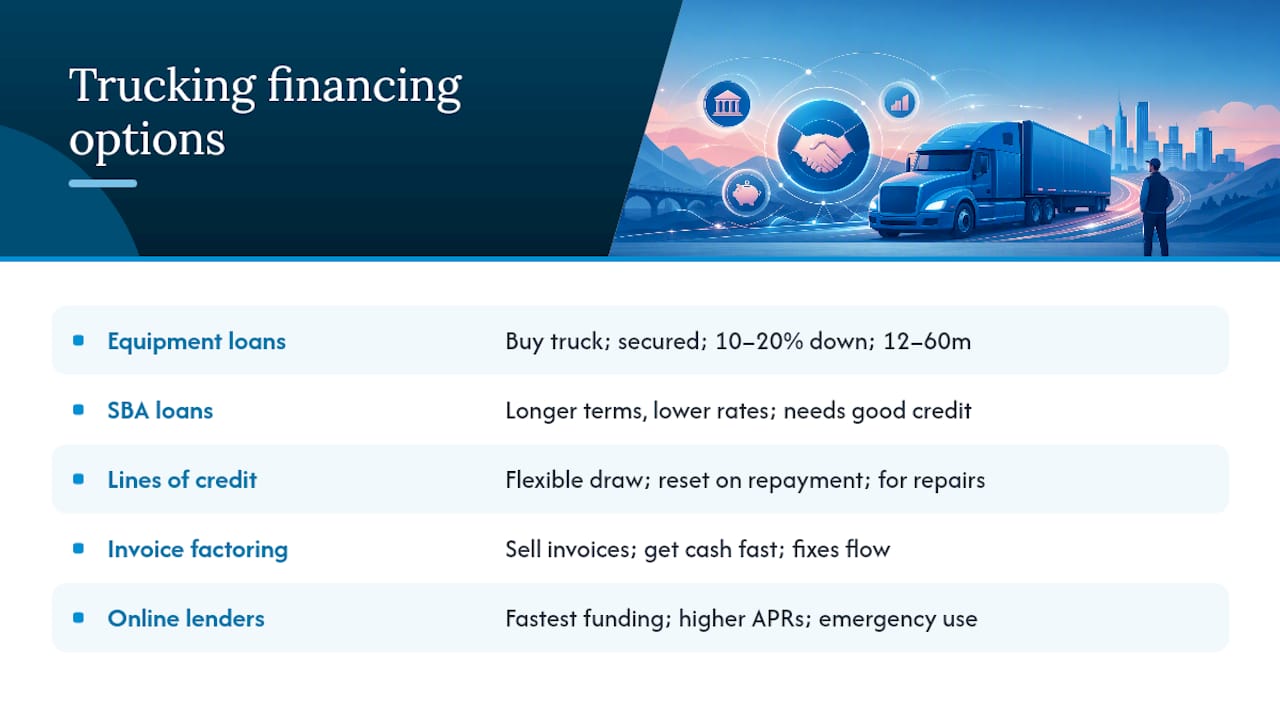
Equipment and commercial truck loans are secured by the vehicle itself, which is why lenders offer decent terms even to newer operators. Expect a down payment of 10% to 20% and repayment terms stretching from 12 months on a short-term note up to 60 months or longer on a full-size Class 8 tractor. This is the default route for buying a truck, whether new or used.
SBA loans come through banks but carry a partial government guarantee, which lets lenders extend longer terms and lower rates than they’d otherwise risk. The catch: SBA 7(a) loans generally require good personal credit, some years in business, and a paperwork trail that may take several weeks to assemble. This is the better path for an established fleet expanding operations, not a first truck for a new authority.
Business lines of credit work like a financial shock absorber. Draw what you need for a transmission repair or a slow payout month, then repay it and the credit resets. No lump-sum obligation, no rigid payment schedule tied to one purchase.
Invoice or freight factoring turns your unpaid loads into cash within a day or two by selling the receivable to a factoring company instead of waiting 30 to 60 days on a broker’s payment terms. This solves a cash-flow problem, not an equipment problem.
Online lenders and merchant advances move fastest of all but charge for that speed with higher APRs. Useful when a breakdown can’t wait for a bank’s underwriting calendar.
Speed, cost, and eligibility rarely line up in your favor at the same time. Understanding the tradeoff up front keeps you from choosing on rate alone and then losing the deal to a slow closing.
Working-capital products on lending panels often carry 14% to 34% APR, while secured equipment loans on the same panels commonly run 9% to 18% APR depending on credit and collateral.
Lenders and marketplaces move faster when your file is complete the first time. Missing paperwork is the single biggest reason applications stall for a week instead of closing in a day.
Credit matters, but not as a hard gate. Panels can start routing applications at around a 500 FICO score, though the best rates go to operators above roughly 670. Down payment size, vehicle age and mileage, and whether the title is clean all factor into approval odds too.
Pro Tip: Pull your documents into one folder before you apply anywhere. A soft-pull marketplace lets you shop multiple lenders off a single submission instead of retyping the same information five times.
Numbers help more than adjectives here. A $100,000 truck financed over 60 months at 12% APR runs roughly $2,225 a month before taxes and fees. Stretch to $200,000 at the same rate and term, and you’re near $4,450 monthly, before insurance and maintenance reserves.
Funding speed varies enormously by channel:
The “cost of waiting” is worth running as actual math, not a gut feeling. A load that pays $3,000 and needs a repaired truck this week is worth more than the extra points you’d pay for same-day funding versus a cheaper loan that closes in three weeks. Advisors frequently point out that a faster, slightly pricier loan beats losing the contract entirely.
Run through a short checklist before you touch an application. How urgent is the need? What’s the money actually for? Do you have collateral beyond the truck itself? What’s your real credit picture? And what monthly payment can your freight income actually absorb without stress?
When you’re comparing offers, ask every lender the same four questions: What’s the full APR including fees, not just the headline rate? Is there a prepayment penalty? Is the loan recourse or non-recourse? And who holds the title while the loan is active?
Watch for red flags: lenders who won’t put fees in writing, pressure to sign before you’ve seen full terms, or a company with no verifiable track record. Checking a lender’s BBB profile before applying is a five-minute step that catches most of the bad actors.
Pro Tip: Prequalifying with a marketplace that only soft-pulls lets you compare three or four term sheets before a single hard inquiry hits your credit report.
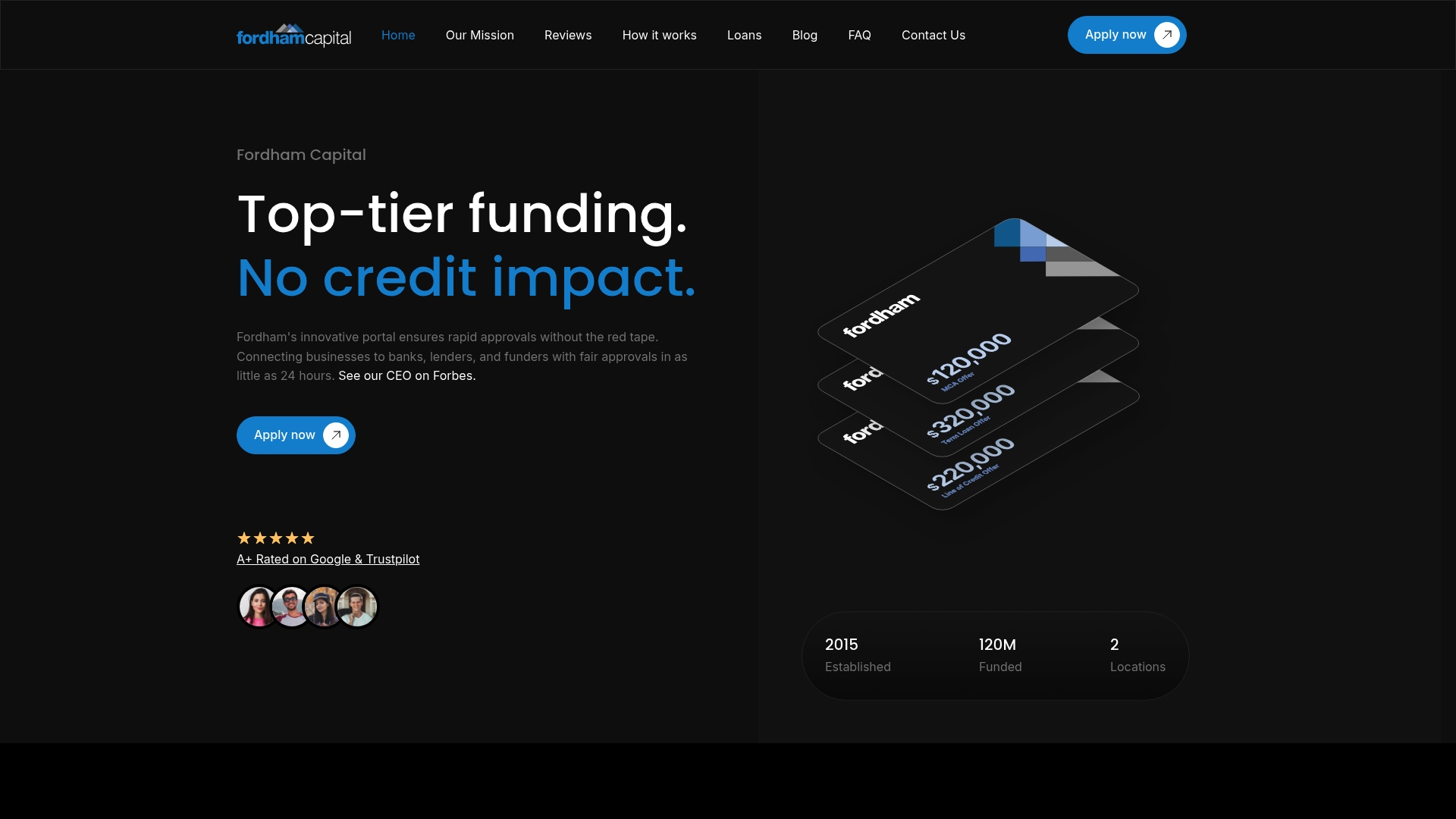
Fordham Capital built its process around the two things trucking operators complain about most: paperwork and waiting. The application is one page, and approvals can come back within 24 hours, which matters when a truck is down and every idle day costs you freight.
What sets the approach apart:
For a fleet owner who doesn’t have weeks to spare chasing separate bank applications, that network access alone is the practical advantage.
The conventional advice in this space treats every financing decision like a rate-shopping exercise: find the lowest APR, ignore everything else. That’s backward for most owner-operators. A loan that saves you three points of interest but takes six weeks to close doesn’t help you when a transmission dies on Tuesday and your only truck is the one that pays your bills.
What actually determines whether financing works out isn’t the rate on paper. It’s whether the terms match your real cash-flow pattern, whether you understood the total cost before you signed, and whether the lender behaved the way they said they would once money changed hands. Factoring gets dismissed as expensive by people comparing factor fees to APRs incorrectly, when for a cash-strapped operator waiting on broker payments, it’s often the cheapest available option once you count the cost of not having cash at all.
Prioritize speed and lender choice first, then negotiate rate within that pool. Chasing the theoretical lowest rate across the entire market usually costs more time than it saves in dollars.
— Rob
If you’ve read this far, you already know the tradeoff: banks are cheaper but slow, and speed usually costs something. Fordham Capital’s marketplace is built for the owner-operators and small fleets who need both, fast access and real lender choice, without gambling their credit score on five separate applications.
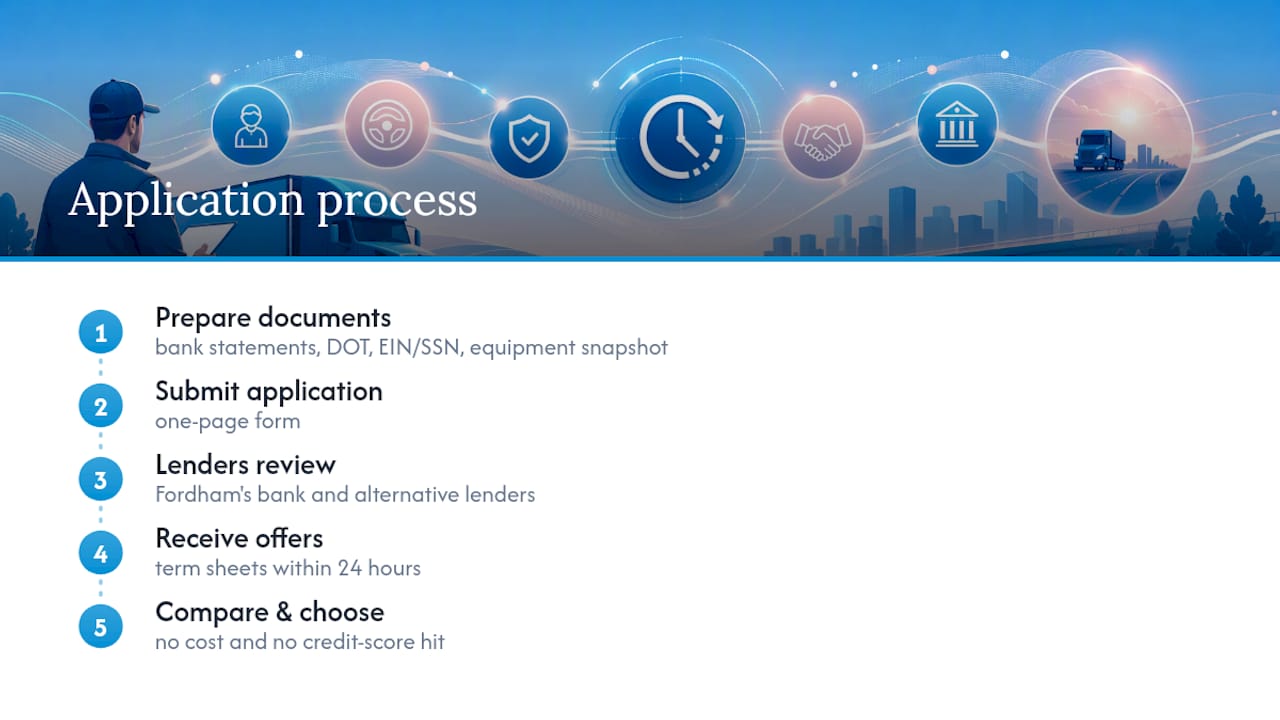
The application itself is one page. It asks for the basics covered above: your bank statements, DOT number, EIN or Social Security number, and a snapshot of what you’re financing, whether that’s a new tractor, a working-capital cushion, or a factoring relationship for your invoices. Once submitted, Fordham Capital’s network of banks and alternative lenders reviews your file and can return term sheets within 24 hours, letting you compare real offers instead of guessing at rates.
There’s no cost to see what you qualify for and no credit-score damage from checking. Apply now and see your funding options before your next load is due.
For readers who want to dig further into the figures above:
At Fordham Capital, we've made the application process straightforward and reassuring. Dive in and explore your financial options with confidence, knowing there's no impact on your credit score and no obligations. We review your details and offer customized solutions based on what you're looking for.