
A startup loan gives you one lump sum that you repay on a fixed schedule. A business line of credit (LOC) gives you a limit you can draw from, repay and draw from again. Choose the loan for a single, known expense. Choose the line of credit for costs that come and go, such as inventory, payroll gaps or slow-paying customers. Many young businesses end up using both, at different stages.
This guide compares the two on cost, repayment, collateral, approval and speed. It also walks through what a $1,000,000 loan payment looks like and how an LLC with a thin credit history can approach either option.
With a startup loan (a term loan), you borrow a set amount, say $75,000, and receive all of it at once. You repay principal plus interest in regular installments over a set term. You know the payment, you know the end date, and you can’t borrow more without a new loan.
With a business line of credit, a lender approves a maximum, say $75,000, and you draw only what you need. Interest applies to the drawn balance. As you repay, the available limit refills, so the same approval can cover several needs over time.

The trade-off is simple. A loan gives you predictability. A line of credit gives you flexibility. The right choice depends on whether your need is a one-time purchase or a recurring swing in cash flow.
| Factor | Startup (term) loan | Business line of credit |
|---|---|---|
| How you receive funds | One lump sum | Draw as needed up to a limit |
| What you pay interest on | The full amount borrowed | Only the amount drawn |
| Repayment | Fixed installments to a set end date | Pay down the balance; limit refills |
| Best for | One-time, defined investments | Ongoing or unpredictable costs |
| Budget certainty | High | Lower, because balances and rates can move |
| Collateral | Depends on program and size | Depends on product; unsecured options exist |
| Typical use | Equipment, launch costs, expansion | Inventory, payroll timing, seasonal gaps |
The two products quote prices differently, which makes them easy to compare badly.
A monthly figure is not directly comparable to an annual one. A simple rule: multiply a monthly percentage by 12 for a rough annualized figure, then remember that real cost also depends on fees and how long you carry the balance. That is why the cost of a line of credit depends so heavily on how you use it. If you draw $20,000 for three weeks and repay it, you pay for three weeks. If you carry $20,000 for a year, you pay for a year, and a line of credit is generally not the cheapest way to fund something you will carry that long.
When you receive offers, compare the same items across all of them:
For SBA 7(a) loans, lenders may negotiate interest rates, but the SBA caps those rates at maximums that vary by loan size. That cap is one reason SBA loans are often the lowest-cost route for qualified borrowers.
Searchers often ask about the payment on a $1,000,000 business loan. The answer depends on three inputs: the rate, the term and whether payments are fully amortizing. Using the standard amortization formula with monthly payments, here is what the same $1,000,000 costs under different assumptions (our own calculation, for illustration only, not a quote):
| Rate (APR) | Term | Approx. monthly payment |
|---|---|---|
| 8% | 10 years | $12,133 |
| 10% | 10 years | $13,215 |
| 12% | 10 years | $14,347 |
| 10% | 5 years | $21,247 |
Two lessons follow. First, a longer term lowers the monthly payment but raises total interest. Second, a one-point change in rate moves the payment by roughly $1,000 a month at this size. If you are comparing a loan to a line of credit at this scale, ask each lender for an amortization schedule so you can see the real number rather than a headline rate. Most startups borrow far less, but the same logic applies at $50,000.
Many founders have no real estate or equipment to pledge, so collateral is often the deciding factor.
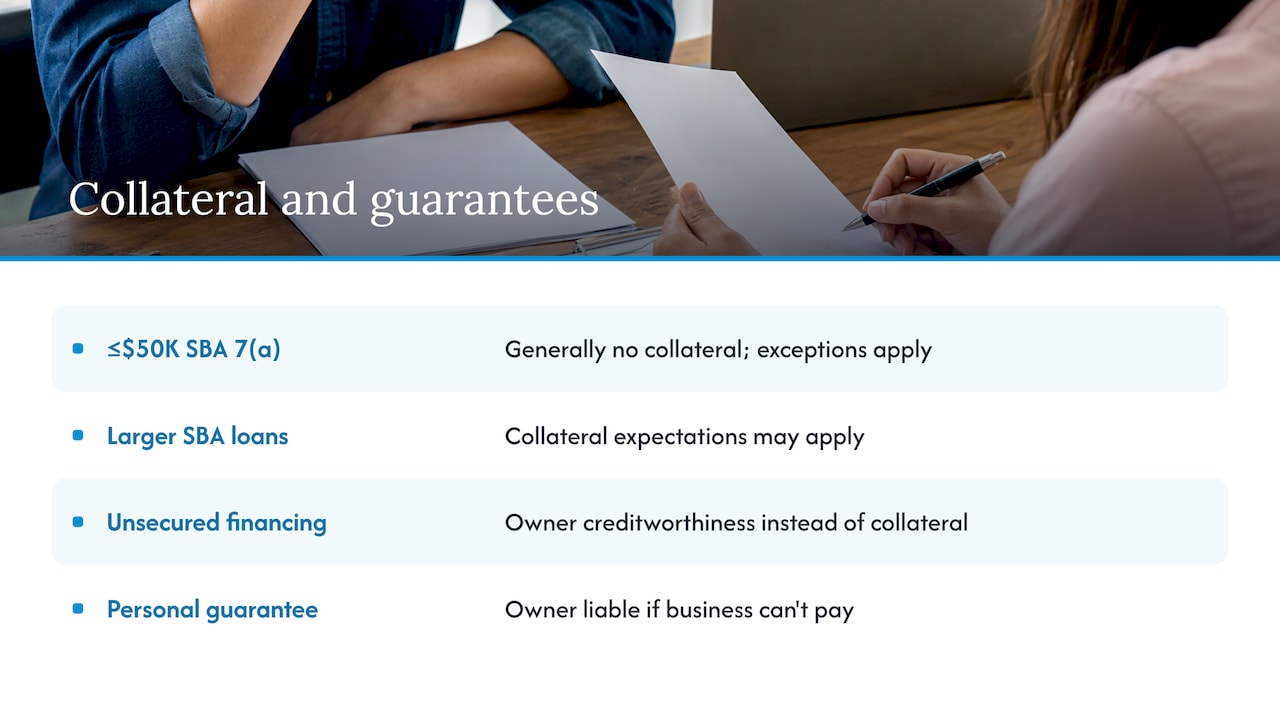
For standard SBA 7(a) loans of $50,000 or less, collateral is generally not required, except for specific programs such as international trade loans. Larger SBA loans can carry collateral expectations, so ask the lender what it will require at your amount.
Unsecured financing works differently. According to the SBA, an unsecured loan or line of credit relies on the owner’s creditworthiness instead of collateral. Lenders may offset that risk with higher rates, and personal guarantees may still be required. If you sign a personal guarantee, you are personally responsible for the debt if the business can’t pay, so read that clause before you accept.
Our platform connects you with banks and alternative lenders where collateral is not required, and applying does not impact your credit score.
Yes. Legal structure is not the barrier. For SBA 7(a) assistance, a business must be for-profit, located in the U.S., meet SBA size standards and show a reasonable ability to repay. An LLC that meets those tests is eligible, and so is a sole proprietorship or corporation.
The SBA also expects that the borrower can’t obtain the desired credit on reasonable terms from non-government sources. In practice that means SBA lenders look at what you could otherwise get elsewhere.
For a young company, lenders typically focus on:
Our guides go deeper on what lenders look for when approving a business loan and whether you meet SBA loan requirements. For lines of credit specifically, see what lenders check when you apply for a startup line of credit.
Timelines depend on the lender and the program. Online lenders tend to be fastest, banks take longer, and SBA loans take the longest because of added review steps. Our network is built for speed: a one-page application, and approvals that can come within 24 hours. Final funding still depends on the lender and on how quickly you return documents.
Having paperwork ready is the biggest lever you control. Commonly requested items include:
For realistic ranges by lender type, read our breakdown of small business loan timelines, and see how to speed up loan approval.
Pick a loan when:
Example: A café owner needs $60,000 for an espresso bar, seating and signage. The cost is known and the equipment will serve for years. A term loan with fixed payments lets her plan around one number.
Pick a line of credit when:
Example: A landscaping company buys materials in spring and gets paid by commercial clients 45 days later. A $40,000 line lets the owner cover supplies, repay when invoices clear and draw again for the next job.
The SBA also has a structure that blends the two ideas. Its 7(a) Working Capital Pilot offers monitored lines of credit up to $5 million for growing businesses with at least 12 months of operating history. We explain how it works in our guide to the SBA CAPLines program.
The choice is not always either/or. A common sequence for a growing business:
A record of on-time repayment on the line also strengthens your next application. Our article on how fast approval loans fuel startup growth covers how this plays out in the early stages.
Most founders ask us which product is “better.” We ask a different question first: what is the money for, and when will it come back to you?
If the answer is a single purchase that will pay for itself over years, we point owners toward a loan, often an SBA loan, because a fixed schedule is easy to plan around. If the answer is “it depends on the month,” we point them toward a line of credit or working capital, because paying only for what you use matches how a young business really operates.
The bigger problem we see is not picking the wrong product. It is waiting. Owners spend weeks visiting banks one at a time, each with its own forms, and some applications hurt their credit along the way. That is why we built one short application that reaches a network of banks and lenders, with no credit score impact and no collateral required. You compare real offers side by side and choose the one that fits.
We are not a lender. We are the advisor who helps you find the right one, and we have done it for more than ten years.
Rob
If you already know your use of funds, you can see what is available without a hard credit pull. We offer SBA loans (published at 8% per year), lines of credit (published at 1-3% per month) and working capital financing, all through a single one-page application. An advisor can help you compare offers. Start at Fordham Capital.
If you want to see how lenders stack up first, our guide to comparing lenders with fast approval lays out the criteria.
Answer these five questions before you apply:
Then gather your documents, request offers from more than one lender, and compare APR, fees and total repayment, not the monthly figure alone.
Neither is better in general. A line of credit is better when costs vary and you want to pay interest only on what you use. A loan is better when you have one defined expense and want a fixed payment and a clear end date.
Yes. Lenders look at whether the business can repay, along with its revenue, time in business and the owners’ credit, not at whether it is an LLC. For SBA 7(a) loans, the business must be for-profit, based in the U.S., within SBA size standards and able to show reasonable repayment ability.
It depends on the rate and term. At 10% APR over 10 years the payment is about $13,215 a month, and over 5 years it is about $21,247. Ask any lender for the full amortization schedule and fee details before you decide.
Often, yes. SBA 7(a) loans of $50,000 or less generally don’t require collateral, and unsecured products rely on your creditworthiness instead. Expect that lenders may charge higher rates or ask for a personal guarantee.
It varies by lender type and program. Online lenders are usually the quickest, banks take longer, and SBA loans take the longest. Having your bank statements, tax returns and financials ready shortens the process on any route.
At Fordham Capital, we've made the application process straightforward and reassuring. Dive in and explore your financial options with confidence, knowing there's no impact on your credit score and no obligations. We review your details and offer customized solutions based on what you're looking for.