To qualify for a retail business loan in the US, you need to show a lender three things: your store brings in enough cash to repay the loan, you have a record of managing credit, and you can explain what the money is for. Exact cutoffs for credit score, revenue and time in business differ by lender and loan type. The documents and the questions behind them are remarkably consistent, so you can prepare once and apply with confidence.
This guide walks through what lenders evaluate, the paperwork a retailer should gather, how collateral works, what to do if your credit is not perfect, and how to avoid unnecessary credit damage while you shop.
Before a lender looks at a single document, it is asking one question: will this business repay? The FDIC’s small business financing guide says lenders assess financial health, creditworthiness and ability to repay, and that an application states the amount and purpose of the loan, with collateral details when the loan is secured.
The same guide describes the five Cs of lending:
| The C | What it means for a retailer |
|---|---|
| Character | Your track record with credit and your reputation as an operator |
| Capacity | Cash flow, revenue and profitability that can cover payments |
| Capital | What you have invested in the business yourself |
| Collateral | Equipment, inventory or real estate that could back the loan |
| Conditions | The loan’s purpose and the market and industry the store operates in |
The FDIC lists these as character, capacity, capital, collateral and conditions, and notes that capacity includes cash flow, revenue and profitability, while collateral may include equipment, inventory or real estate. For a retailer, inventory is both your biggest asset and your biggest cash drain, so lenders pay close attention to how fast it turns into sales.
Revenue is the headline number, but it is not what repays a loan. FDIC supervisory guidance states that business cash flow is generally the primary source of repayment, and that it should be analyzed under a reasonable range of future conditions, not optimistic assumptions. Collateral and guarantees sit behind it as secondary support.
In practice, a store with $800,000 in annual sales and thin margins can look weaker than a store with $400,000 and steady, predictable deposits. Lenders read your bank statements to see how much is left after rent, payroll, inventory and sales tax. Seasonality matters too. A gift shop that earns half its income in the fourth quarter should be ready to show the full year, not just the busy months.
The FDIC’s guidance on small-business underwriting says prudent lenders consider debt-service capacity, collateral value and quality, borrower creditworthiness, equity invested, secondary repayment sources, and guarantees. FDIC examination guidance adds that commercial loan analysis can cover loan purpose and structure, management, industry outlook, financial statements, projections and borrowing history. In other words, a lender wants to understand your store as a business, not only as a set of numbers.
For a deeper look at the same ground, see our breakdown of business loan approval factors.
These are the three numbers retailers ask about most, and the honest answer is that they vary. A traditional bank, an SBA-backed lender and an online lender each set their own thresholds, and the same lender may flex them based on other strengths in your file. No single federal rule sets a minimum score for a retail loan.
What you can count on is how lenders think about each:
If you want to see how cash-flow-focused lenders think, read about what lenders look for in cash flow loans.
The FDIC’s guide lists what a strong application typically includes. It points to a loan application stating the amount and purpose, a business plan, financial statements, recent business tax returns and sometimes personal tax returns, credit reports and scores, documents related to the loan purpose, and collateral information for secured loans.
Here is how that translates into a retailer’s folder:
Our page on online business loan requirements shows how this list tends to look when the lender is an online platform.
The purpose of the loan shapes the structure. Stocking up for the holidays is short-term working capital. A new register system or refrigerated cases is equipment. A second location may involve property. When real estate is part of the picture, lenders often want to know what the property is worth, which is why articles such as this one on bridge loan appraisal requirements are useful to read: they show how the amount you request and the intended use of the funds affect what a lender will want to see. For more examples of what lenders fund, see small business loan uses.
Many retailers assume every loan needs a pledge of property. It does not. The FDIC guide says that some financing may be unsecured and rely on the borrower’s creditworthiness, while lenders still evaluate financial health and ability to repay, and collateral where it applies.
When collateral is requested, retailers have natural options: inventory, fixtures, equipment, vehicles or real estate. A lender may value these below what you paid, so the pledged assets can need to be worth more than the loan. If you own no real estate, ask early whether unsecured or cash-flow-based options fit your situation. We cover the topic in why collateral requirements block business loans and, for government-backed financing, in our piece on SBA loan collateral.
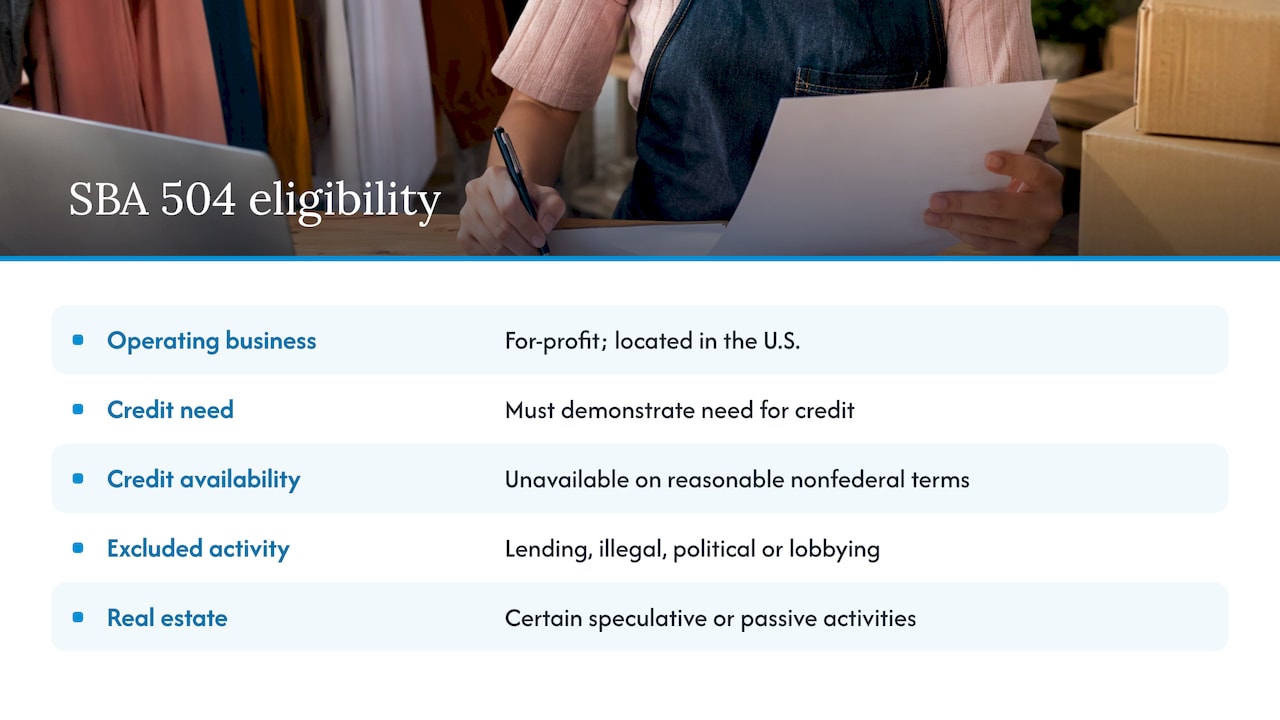
SBA-backed loans are popular with retailers because they are made by participating lenders with a government guarantee. Programs differ, but the SBA’s eligibility form for its 504 program gives a feel for the baseline. An applicant must be an operating, for-profit business located in the United States, demonstrate a need for credit, and show that credit is unavailable on reasonable terms from nonfederal sources. The same form lists ineligible categories, including businesses primarily engaged in lending, illegal activity, political or lobbying activity, and certain speculative or passive real-estate activities. An ordinary retail store, whether independent or franchised, fits comfortably outside those exclusions, but confirm the current rules for the specific program with a lender, since forms and terms are updated over time.
Yes, financing exists for both, but the terms and loan type change. Lenders weigh the whole file, so a weaker area can be offset by a stronger one. The five Cs framework above shows where you can compensate:
Expect that stronger risk can mean shorter terms or higher costs, so compare the total cost of each offer, not just the payment. If you are shopping now, our guide to business loan prequalification explains how to check eligibility before committing.
A hard inquiry is what lenders typically make after you submit a credit application. The CFPB explains that hard inquiries can affect credit scores because scoring models consider how recently and how frequently you seek credit. That is why many owners prefer to compare options before formally applying.
Federal rules treat the early stage differently. Under the CFPB’s small-business lending regulation, an inquiry or prequalification request is a preliminary request for terms or likely eligibility and is generally not a covered application for reporting purposes, though a mandatory screening that turns away an ineligible business can count as an application. In plain terms: ask each lender how its prequalification works and whether it involves a hard pull before you share your Social Security number.

The FDIC guide says strong packages use accurate, consistent financial statements, realistic cash-flow projections, an explained use of proceeds, and a complete business plan. Here is what that means week to week:
Our perspective
Retailers tell us the same thing: the requirements are not the hard part, the process is. Stacks of paperwork, weeks of waiting, and a hard credit pull for every lender you approach.
We built Fordham Capital around a different idea. A one-page application, a network of banks and alternative lenders, and an advisor who walks you through the options. Because we are a marketplace and not a single lender, your request can be seen by several funding sources, which matters when a bank has overlooked a business like yours.
Our approach is designed for owners who need an answer fast and who may not have perfect credit or hard collateral. We highlight cash flow and the purpose of the funds, because that is what lenders care about most. With an A+ BBB rating and more than $120M funded, we have seen what a well-presented request looks like, and we help you present yours.
Rob
If your folder is ready, or nearly so, you can move straight to an application. Fordham Capital connects retailers with banks and alternative lenders through a one-page application, with no collateral required and no credit score impact to apply. Our site lists SBA loans at 8% per year and lines of credit at 1-3% per month, and working capital is available too. Rates for your business depend on the lender and your profile.
See the options and start on Fordham Capital, and talk to an advisor about which product fits your store.
It is more demanding because a new business has less history for a lender to evaluate. Lenders lean on the owner’s credit, relevant experience, the plan and projections, and any collateral or guarantees. Matching the loan type to your stage, such as working capital or a line of credit, can make approval more realistic.
Banks generally ask for a loan application stating the amount and purpose, a business plan, financial statements, tax returns, credit information and, for secured loans, collateral details, according to the FDIC’s small business financing guide. Specific score and revenue minimums are set by each bank, so ask before you apply.
Often yes. Some financing is unsecured and relies on the borrower’s creditworthiness and cash flow. Lenders still evaluate your financial health and ability to repay, so strong deposits and clean financials matter more when no collateral backs the loan.
Hard inquiries, which usually follow a formal application, can affect your score. A prequalification is meant as a preliminary look at likely eligibility, so ask the lender whether it uses a hard pull. Fordham Capital’s application is designed to avoid a credit score impact.
At Fordham Capital, we've made the application process straightforward and reassuring. Dive in and explore your financial options with confidence, knowing there's no impact on your credit score and no obligations. We review your details and offer customized solutions based on what you're looking for.