
Startup buildouts and major equipment purchases call for an SBA or bank term loan because the rates are lowest and terms run longest. Cash flow gaps between slow and busy seasons call for a business line of credit you draw on only when needed. Fast, small amounts for an urgent repair or inventory buy point toward an alternative online lender, while merchant cash advances deserve real caution given their cost. Owners who want to compare multiple lenders at once without a hard credit pull often start with a broker like Fordhamcapital’s one-page application.
TL;DR:
- SBA loans offer the lowest cost for large projects but require weeks to months to close and strict eligibility, making them unsuitable for urgent needs.
- Equipment financing approvals are quicker due to collateral use and typically match the equipment’s lifespan, which is ideal for replacing key appliances.
- Using a broker can streamline multiple lender applications with a single form, avoiding multiple credit checks and speeding up approval, especially for those without established banking relationships.
- Comparing actual costs in dollars, repayment schedules, and collateral requirements is essential to avoid hidden fees and prevent overpaying on high-cost debt options.
Every restaurant financing option trades off cost, speed, and eligibility differently, and knowing where each one sits on that spectrum saves you from applying to the wrong lender and wasting weeks.
SBA loans are partially guaranteed by the federal government, which lets banks extend credit to businesses they’d otherwise turn down. The 7(a) loan program covers general business purposes up to five million dollars, while the 504 program is built specifically for real estate and heavy equipment purchases. SBA microloans, typically up to around fifty thousand dollars, suit newer operators who need working capital but can’t yet qualify for a larger facility. The catch: SBA loans take weeks to months to close because of the paperwork, and they’re a poor fit if you need cash inside 72 hours. A restaurant group buying its building and renovating a second location is the classic 504 use case.
Bank term loans are the non-SBA cousin. Community and regional banks still write conventional term loans to restaurants with two or more years of financials and decent credit, usually at somewhat higher rates than SBA paper but with less documentation and a faster path to closing. They work well for a proven operator opening a second unit who doesn’t want to wait on SBA processing.
Equipment financing uses the equipment itself as collateral, which is why approval tends to be easier than an unsecured loan even for younger businesses. A pizzeria replacing a walk in cooler and a combi oven can usually get financed for that specific purchase in days rather than weeks. Terms typically match the equipment’s useful life, three to seven years, and IRS depreciation rules affect whether financing or leasing nets out cheaper after taxes, so it’s worth running both scenarios before you sign.
Lines of credit function like a credit card for your business. You get approved for a ceiling, you draw against it as needed, and you pay interest only on what you use. This is the natural tool for restaurant working capital: covering payroll during a slow February, buying extra inventory before a holiday rush, or bridging the gap while you wait on a catering invoice to get paid. Lines renew, so a well-managed one becomes a permanent cash flow cushion rather than a one-time fix.
Alternative online lenders approve based on bank deposits and cash flow rather than years in business, often funding within a day or two. That speed comes at a real cost: APRs run substantially higher than bank or SBA products, and terms are shorter, frequently six to eighteen months. These lenders make sense when a walk-in freezer dies on a Friday and you can’t wait for a bank to process paperwork. For a broader map of these fast funding options, speed and cost tend to move in opposite directions, and it’s worth seeing the full range before committing to one.
Merchant cash advances (MCAs) aren’t loans at all. A provider buys a slice of your future card sales at a discount, then collects daily or weekly through automatic deductions from your merchant account. Approval is fast and credit requirements are loose, which is exactly why MCAs proliferate among restaurants that banks won’t touch. They also carry the highest effective cost of any option here, and the Federal Trade Commission has taken enforcement action against a provider it accused of overcharging small businesses.
Invoice factoring applies mainly to restaurants with a catering or wholesale arm that generates B2B invoices. You sell those unpaid invoices to a factoring company at a discount and get most of the cash upfront instead of waiting 30 to 60 days for the client to pay.
Here’s how the main options stack up on the factors that matter most:
APR and factor rates aren’t measuring the same thing, and confusing them is how restaurant owners end up paying far more than they expected. APR (annual percentage rate) expresses the true annualized cost of borrowing, including interest and most fees, which makes it the standard for comparing SBA loans, bank loans, and most lines of credit. A factor rate, used mostly by MCA providers and some short-term online lenders, is a flat multiplier like 1.3 applied to the amount borrowed, with no time value built in.
That difference in Bethlehem matters enormously in practice. A 1.3 factor rate on a $50,000 advance means you repay $65,000 total. Spread that same $15,000 in fees over three years, and the annualized cost looks completely different. Factor rates hide the timeline, which is exactly why they’re harder to compare at a glance.
Beyond the headline rate, watch for:
A $40,000 MCA at a 1.35 factor rate repaid over six months costs $14,000 in fees alone, and annualizes to an effective rate several multiples higher than the SBA option, even though the dollar fee looks smaller.
Repayment frequency also affects your daily operations more than most owners expect. A restaurant with unpredictable weekday traffic can get squeezed hard by daily MCA debits on a slow Tuesday, while a monthly bank loan payment lines up more naturally with how you actually collect cash. Understanding how lenders price unsecured loans helps you see past the sticker rate to the real repayment burden.
Lenders sort applicants by credit score, time in business, and revenue before they even look at your concept or menu. A personal credit score above 680 opens up SBA and bank products; scores in the 600s usually push you toward equipment financing or online alternative lenders; scores below 600 mostly limit you to MCAs or asset-backed options. Time in business matters just as much: banks and SBA lenders generally want two or more years of financials, while online lenders and equipment financiers will work with six to twelve months of revenue history. Most lenders also want to see $10,000 to $15,000 or more in average monthly revenue before extending a meaningful facility, and how revenue is calculated affects which tier you qualify for.
Have these ready before you apply:
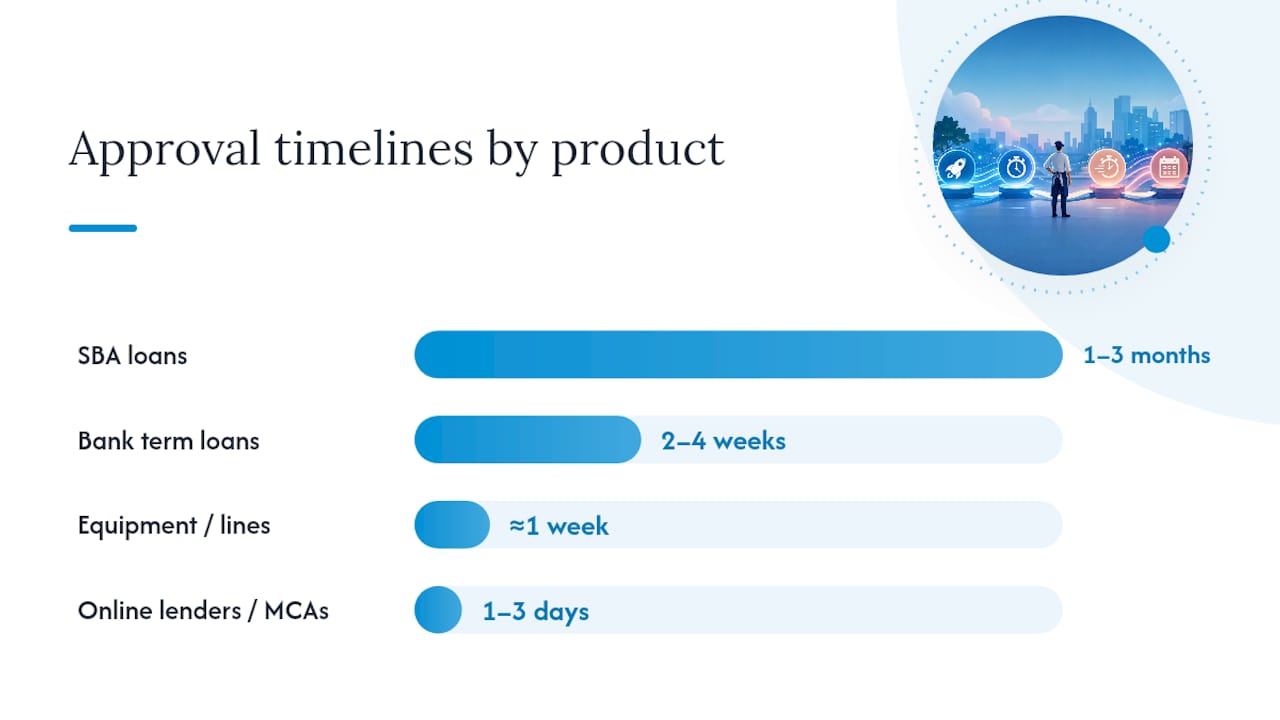
Approval timelines vary sharply by product. SBA loans typically take between one and three months from application to funding. Conventional bank term loans close in about two to four weeks. Equipment financing and lines of credit often close within a week once documentation is complete. Online alternative lenders and MCAs can fund within one to three days. A full checklist of what lenders evaluate is worth reviewing before you submit anything, and the commercial loan application process itself has its own set of forms worth preparing in advance.
Pro Tip: Clean up your business bank statements before you apply, not after. Lenders flag frequent overdrafts and erratic deposit patterns faster than almost anything else, and three months of tidy statements can move you into a better rate tier.
If your restaurant is pre-revenue or just months old, standard underwriting won’t work in your favor yet. Founders in that position have different paths worth exploring before assuming they’re stuck with the highest-cost options.
Start with the need, not the product. Define exactly what the money is for and over what timeframe you’ll repay it, then work backward to the financing family that matches.
If you’re funding a buildout, buying real estate, or launching a second location, an SBA or bank term loan is worth the wait because the rate savings compound over years. If you need a single piece of equipment replaced now, equipment financing beats a general loan because approval is faster and the collateral lowers your rate. If the need is recurring, seasonal cash flow rather than a one-time purchase, a line of credit is the right tool because you’re not paying interest on money sitting idle. If you need cash inside 48 hours and can absorb a higher cost temporarily, an alternative lender is the honest answer. If you’re being pitched an MCA as your only option, treat that as a signal to shop harder before signing.
Ask every lender you talk to the same set of questions, in this order:
Watch for red flags: fee structures the lender won’t explain in plain language, “rollover” offers that stack new advances on top of ones you haven’t paid off yet, and repayment schedules tied to daily card swipes with no cap on total cost. A short script works well here: “I want the total cost of capital in dollars, the exact repayment schedule, and whether early payoff saves me anything. If you can’t answer those three questions clearly, I’m not moving forward.” Any legitimate lender will answer without hesitation.
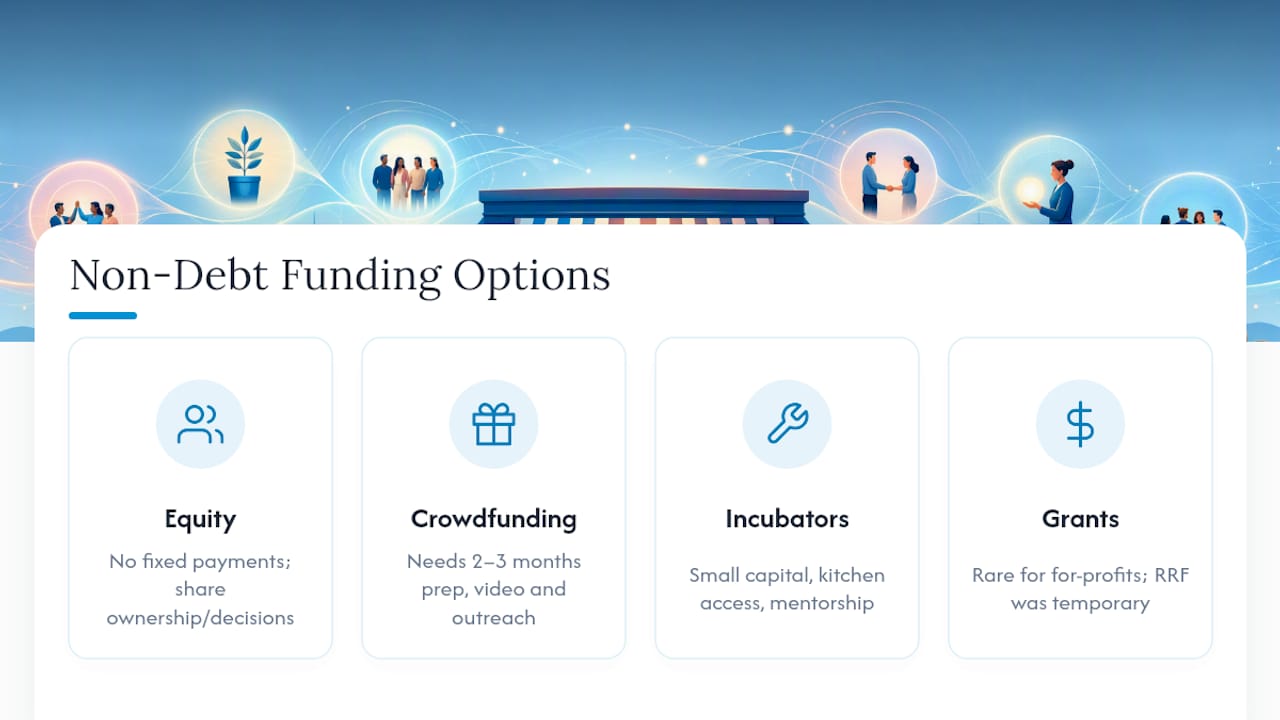
Debt isn’t the only route, and for some owners it isn’t the best one. Bringing on an equity investor or a revenue-share partner means giving up a slice of ownership or future profit in exchange for capital with no fixed monthly payment, which can be the right trade for a first-time owner without collateral, though it means sharing decision-making and upside long-term.
Crowdfunding and community investment campaigns work for concepts with a strong local following and a compelling story. Realistically, expect two to three months of preparation, video content, and outreach before a campaign launches, and treat any dollar figure as a bonus rather than a plan.
Food business incubators and accelerators offer a mix of small capital, commercial kitchen access, and mentorship, which suits early-concept founders more than an established restaurant needing a fast cash infusion.
Grants are the option owners hope for most and qualify for least. Federal grant dollars for for-profit restaurants are limited, and most real grant opportunities come from state economic development offices, city small-business programs, or corporate sponsorships tied to specific causes. The one major exception was the Restaurant Revitalization Fund, a pandemic-era program under the American Rescue Plan Act that covered revenue losses with caps per business and per location. It’s closed now, but it remains the benchmark for what large-scale restaurant relief looked like when it existed.
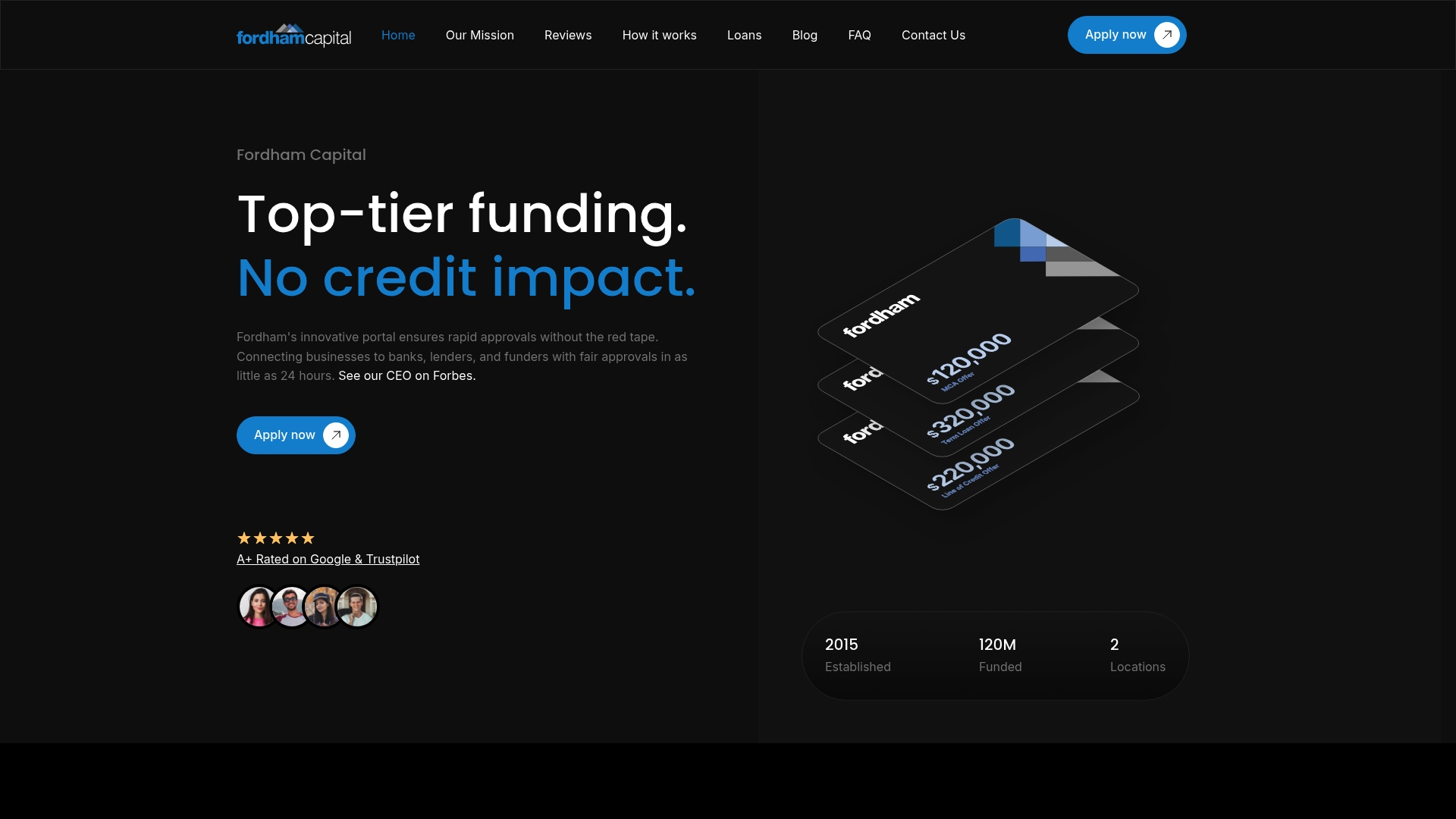
Most restaurant owners waste weeks applying to banks one at a time, collecting rejections before finding the lender who actually wants their deal. A marketplace connects small and medium-sized businesses to a network of banks and alternative lenders, so one application reaches multiple potential lenders instead of one.
The mechanics matter here. A one-page application replaces the stack of forms each bank normally demands, and checking eligibility through this platform doesn’t ding your credit score the way multiple hard-pull bank applications would.
Going direct to a single bank still makes sense when you have an existing relationship there and qualify comfortably for SBA terms. A broker earns its place when you’re not sure which lender fits, when speed matters, or when you want to see several offers side by side before committing to one.
— Rob
This platform gets restaurant owners in front of a wide network of banks and alternative lenders through a single one-page application, with approvals often coming back quickly and no impact to your credit score just for checking. That’s the real advantage over shopping banks one at a time: instead of multiple separate applications and multiple credit pulls, you fill out one form and let the matching happen behind the scenes.
Before you start, have a rough idea of how much you need and what it’s for, whether that’s a kitchen buildout, new equipment, or working capital to get through a slow stretch, along with basic bank statements and revenue figures on hand. The clearer your ask, the faster a lender in the network can respond with real terms instead of a generic quote.
If you’re ready to see what’s available, apply now and get matched against Fordhamcapital’s lender network directly. And if you’re still comparing revenue-boosting moves to strengthen your application first, running a few limited-time restaurant promotions in the months before you apply can help your bank statements tell a stronger story.
For the official word on federal loan programs, go straight to the SBA’s 7(a) loan page and the Restaurant Revitalization Fund program page for historical context on pandemic-era relief. For tax treatment of equipment purchases, the IRS depreciation guidance in Publication 946 covers how financed versus leased equipment gets written off. For consumer protection concerns around merchant cash advances, the FTC’s press release on MCA overcharging is worth reading before signing any advance agreement.
This article is general information, not a substitute for advice from a qualified financial advisor. Consult a qualified financial professional about your own circumstances before acting on anything here.
At Fordham Capital, we've made the application process straightforward and reassuring. Dive in and explore your financial options with confidence, knowing there's no impact on your credit score and no obligations. We review your details and offer customized solutions based on what you're looking for.