Yes, you can refinance a merchant cash advance (MCA) with a term loan, and for many businesses it is the cleanest way out of daily or weekly remittances. The catch is qualification: a term loan lender wants to see a business that can carry regular, amortized payments. The refinance only pays off if the total cost and the monthly cash-flow relief both improve. This guide walks through the steps, the numbers and the fallback options.
An MCA is not a loan. It is the purchase of a share of your future receivables, repaid through a fixed percentage of sales or a set daily or weekly amount. That structure is fast and forgiving at the start. It gets heavy when sales dip, because the withdrawals keep coming. We explain the mechanics in what a merchant cash advance is and how it works.
Refinancing is often the exit strategy from that repayment structure. According to one lender’s guide to MCA refinancing, it can make sense when repayments strain cash flow or when the business has improved since it took the advance. Typical triggers:
The same guide warns that a business in genuine distress gains little from layering new financing on top of existing problems. That usually delays closure rather than preventing it. Be honest about which category you are in before you apply.
The two products price money differently, which is why the comparison is rarely obvious.
| Feature | Merchant cash advance | Business term loan |
|---|---|---|
| Legal form | Purchase of future receivables | Loan |
| Cost expressed as | Factor rate (for example 1.3) | Interest rate or APR |
| Repayment | Daily, weekly or a share of sales | Usually monthly, fixed |
| Term | Often a few months | Commonly one to five years or more |
| Early payoff benefit | Often little or none, since the total is fixed | Interest savings depend on the loan agreement |
| Approval focus | Card or bank deposits | Revenue, cash flow, credit, time in business |
The key difference is the factor rate. A factor rate of 1.3 means you repay $1.30 for every $1.00 advanced, regardless of how quickly you repay. Because the term is short, the equivalent annual rate can be far above a term loan’s rate. Our overview of term loans and when a business needs one covers the other side of that table.
The numbers below are hypothetical and for illustration only. Your offers will differ.
Suppose you owe a remaining payoff balance of $40,000 on an MCA, remitting $450 per business day. Over a month of about 22 business days, that is roughly $9,900 leaving your account.
Now suppose you qualify for a $40,000 term loan at 20% APR over 24 months. The monthly payment works out to about $2,039, and the total repayment to about $48,900.
| MCA (remaining balance) | Term loan (hypothetical) | |
|---|---|---|
| Monthly outflow | About $9,900 | About $2,039 |
| Amount repaid on the $40,000 | $40,000 (the remaining balance) | About $48,900 |
| Payment frequency | Daily | Monthly |
The monthly relief is large, yet the term loan costs about $8,900 more in interest over its life than the remaining MCA balance. That is not a reason to skip the refinance. It is the price of breathing room, and whether it is worth paying depends on what the freed-up cash does for the business. If the extra $7,800 a month lets you restock, hire or stop missing vendor payments, the trade can be sound. If the MCA is nearly paid off, refinancing may leave you worse off. Another lender’s analysis makes the same point: compare total cost and payment relief before you sign.
Also ask for a payoff letter from your MCA provider. Some agreements carry fees, and the payoff figure is not always the same as the balance you assume.
Step 7 is easy to skip and expensive to forget. If debits continue after payoff, you could pay twice.
A term loan lender is asking one question: can this business make fixed payments on time? The factors are explained in more depth in our guide to what lenders look for in business loan approval. For an MCA refinance, these usually carry the most weight:
None of these is a hard rule that applies to every lender. Requirements vary by lender and product, which is why applying to many options through one application can save time.
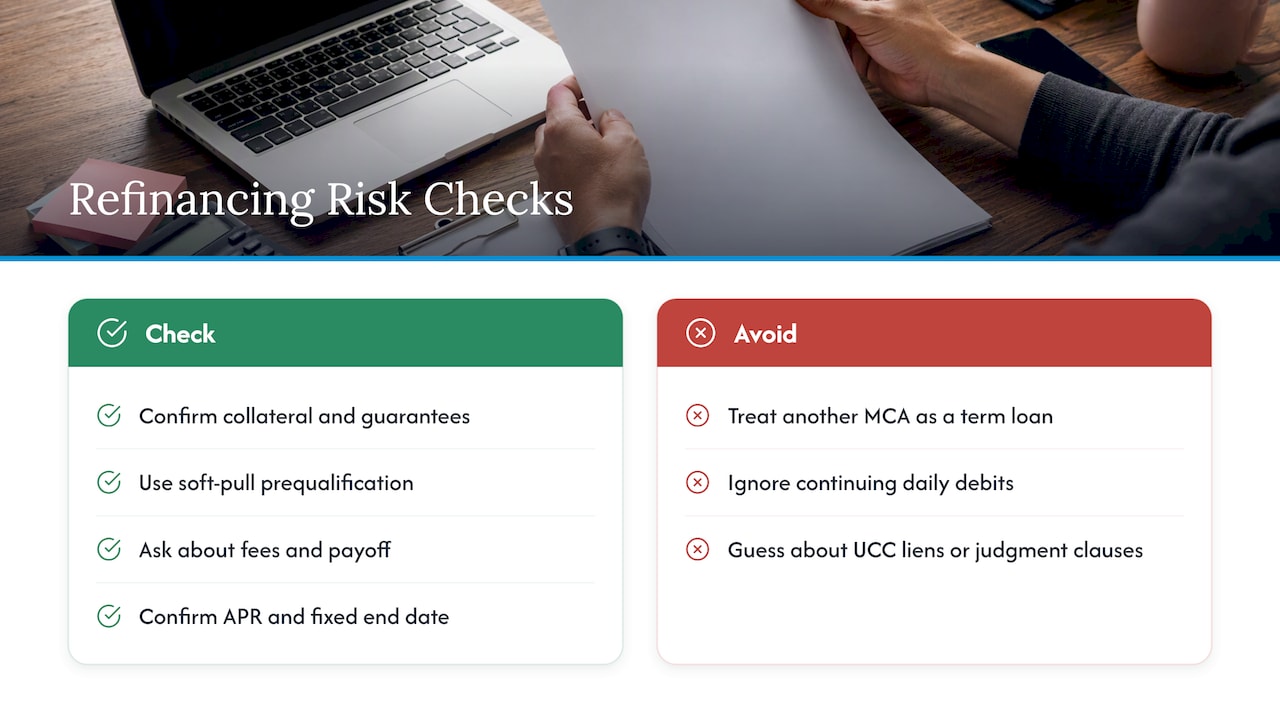
Collateral and guarantees. Many term loans require a personal guarantee, and some require a lien on business assets. Some alternative products need no collateral, but they usually cost more. Know what you are pledging before you sign.
Credit inquiries. Each full application can generate a hard credit inquiry. A soft-pull prequalification lets you see likely terms before the inquiry, which is why we built our process around no credit score impact at the application stage.
Prepayment and fees. Origination fees reduce the cash you actually receive. If the payoff is $40,000 and the lender takes a fee from the proceeds, you may need to borrow more to cover it.
The “refinance” that is another MCA. Some products marketed as refinancing are simply new advances that pay off the old one. They can reset the clock, and the daily debits continue. Ask directly: is this an amortizing loan with an APR and a fixed end date?
Legal exposure. If you already defaulted or the funder has sued or placed a lien, talk to a business attorney before taking new financing. Do not guess about confession of judgment clauses or UCC liens.
Not anymore. SBA policy changes that took effect on June 1, 2025 prohibit using SBA loan proceeds to refinance merchant cash advance debt, according to the way those rules have been widely reported. If you were hoping to use a lower-rate SBA loan for this, the route is closed for that purpose. The SBA’s rules are updated periodically, so confirm the current treatment with an SBA-participating lender before you plan around it.
SBA loans still make sense for other goals, such as equipment, expansion or real estate. Our piece on term loans versus lines of credit and the SBA rules to check explains where they fit.
A refinance is not the only way out. If you are not ready for a term loan, there are other options:
The lender guide cited above also advises against taking additional advances to cover your existing payments. That cycle is how a manageable obligation becomes an unmanageable one.
A practical path: use consolidation or a line of credit to stabilize cash flow for six to twelve months, build a clean record of deposits and on-time payments, then apply for the term loan.
We are a marketplace, not a direct lender. We connect small and medium-sized businesses with a network of banks and alternative lenders through a one-page application. That means we see many owners in the same place: an advance that made sense at first, then payments that outgrew the cash flow.
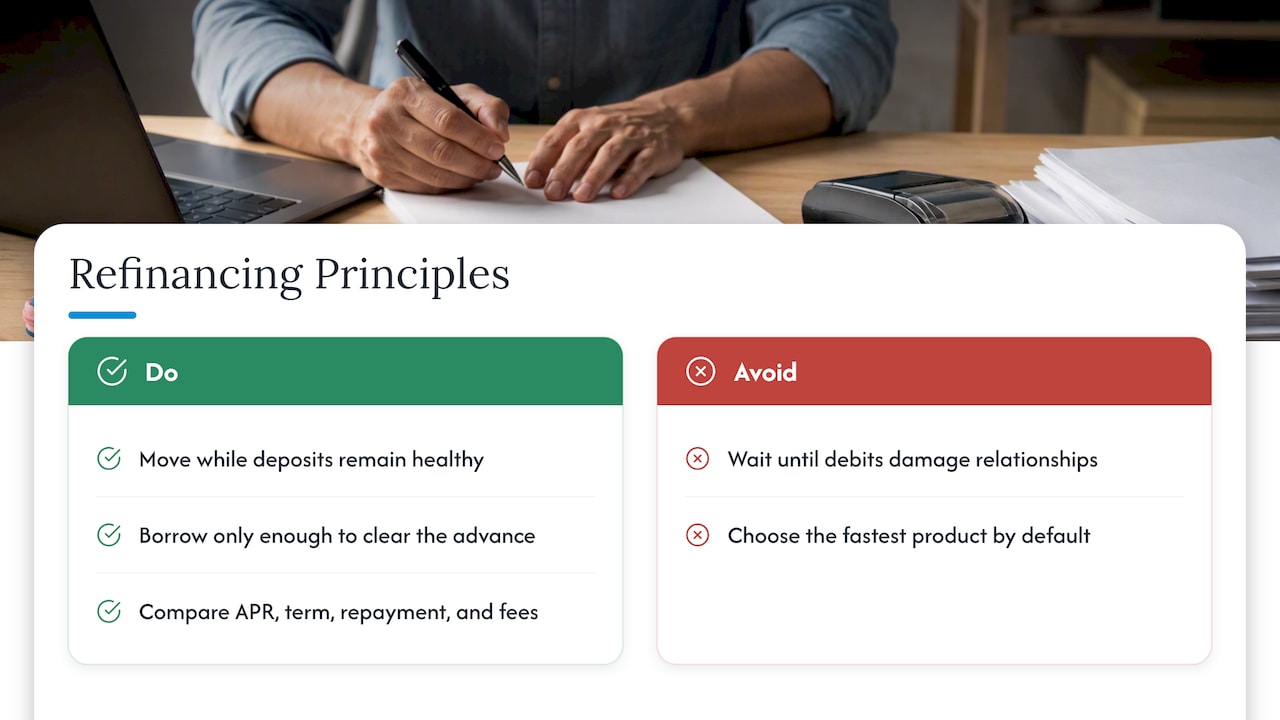
Our view is simple. Refinancing is a tool, not a rescue. It works best when you move early, while your deposits are still healthy, and when you borrow only enough to clear the advance and give yourself a small cushion. The worst outcomes come from waiting until the daily debits have already damaged your vendor relationships and your bank balance.
We also think owners should demand plain numbers. Ask every lender for the APR, the term, the total repayment and the fees, and compare them side by side. A good advisor will tell you when staying put is cheaper than refinancing. Our advisors do that, and it is why we focus on matching you with the right product rather than the fastest one.
— Rob
If you want to see what a refinance could look like, one application gets you in front of multiple lenders without a credit score impact, and approvals can come within 24 hours. We offer SBA loans (published at 8% per year), lines of credit (published at 1-3% per month) and working capital financing, with no collateral required on the products we describe. Rates depend on the lender and your profile. Start on the Fordham Capital funding page and a personal advisor will walk you through the options.
If you are still deciding whether an advance is the right product at all, read our breakdown of the pros, cons and suitability of MCAs first.
Yes. A term loan can pay off the remaining balance on an MCA and replace it with a fixed monthly payment. Approval depends on your revenue, cash flow, time in business and credit. Compare the total cost first, because a lower payment over a longer term can cost more overall.
A full application with a hard inquiry can lower your score slightly and temporarily. Many marketplaces and lenders offer soft-pull prequalification, so you can see likely terms first. Making on-time term loan payments afterward can help your credit profile over time.
No. SBA policy now prohibits using SBA loan proceeds to refinance MCA debt, effective June 1, 2025. Look to a conventional bank loan or an alternative term loan instead, and check with your lender for current rules.
Ask the lender why, then fix the cause. Common fixes include cleaning up bank account overdrafts, correcting credit report errors and waiting for a stronger revenue trend. In the meantime, consolidation, a line of credit or invoice factoring can ease cash flow, but avoid taking another advance just to cover the current one.
It depends on the lender and how quickly you can supply documents. Some online lenders decide within a day or two, while banks can take weeks. Having bank statements, tax returns and your payoff letter ready speeds things up.
At Fordham Capital, we've made the application process straightforward and reassuring. Dive in and explore your financial options with confidence, knowing there's no impact on your credit score and no obligations. We review your details and offer customized solutions based on what you're looking for.