The difference comes down to one question: if your customer never pays the invoice you sold, who takes the loss? With recourse factoring, you do. With non-recourse factoring, the factor takes it, but usually only for a narrow cause, such as the customer’s insolvency. Recourse is cheaper and easier to qualify for. Non-recourse costs more and depends heavily on how creditworthy your customers are. If you want working capital that does not hinge on your customers’ payment behavior at all, a business line of credit or working capital loan is worth comparing, and we explain how at the end.
Factoring means selling your unpaid invoices at a discount to a company called a factor. The U.S. House Committee on Small Business defines factoring as an advance of roughly 70 to 80 percent of the invoice’s face value up front, with the balance, minus the factor’s discount, paid once your customer pays.
The IRS’s audit guide on the subject lists what a factor may do in return for its discount: investigate your customer’s credit, assume the credit risk, collect the receivable, handle bookkeeping and reporting, deal with disputes and returns, and advance the money. It also notes that the factor typically charges interest on the advance plus a commission. The recourse question is about the “assume the credit risk” item: does the factor do it, or do you keep it?
In a recourse arrangement, the IRS guide explains, the client bears the risk that a customer fails to pay. If the factor cannot collect, you repay the advance, usually plus fees, or substitute another invoice.
The IMF’s guidance on factoring describes the mechanics: the factor advances only a percentage and holds the rest in reserve. If the debtor defaults beyond that reserve, the supplier may have to repay part or all of the advance, plus interest or fees.
What this means for you:
Under non-recourse, the IRS guide says, the factor bears the risk when a customer fails to pay because of financial inability. The International Factoring Association adds the key detail: you do not have to pay the factor back if the customer cannot pay due to bankruptcy, but that usually applies only if the bankruptcy happens while the invoice is outstanding within a set period. Bankruptcies outside that window are often not covered.
The same source is clear that non-recourse does not protect you from late payment. A customer who is simply slow, or who disputes the invoice because of a problem with your product or service, generally stays your responsibility under the contract. The factor also tends to charge more and set tighter rules in return for the extra risk.
What this means for you:
| Recourse | Non-recourse | |
|---|---|---|
| Who bears loss if a customer cannot pay | You | The factor, for covered causes |
| Typical fees | Lower | Higher |
| Advance rate | Higher | Lower |
| Qualification | Easier | Stricter customer credit requirements |
| Late payment or disputes | Your responsibility | Still generally your responsibility |
| Best fit | Reliable customers, tight margins | Concentrated or less predictable customers, if they qualify |
Say you invoice a customer $50,000 on net-60 terms. These numbers are illustrative only, since real advance rates and fees vary by contract.
The gap in fees is the price of shifting the insolvency risk. Whether it is worth it depends on how likely that event is for your specific customers.
The IRS guide observes that many U.S. factoring agreements combine both bases in one contract, depending on each customer’s creditworthiness. A single agreement can be non-recourse for your strongest customers and recourse for weaker ones. Do not assume a contract described as non-recourse treats every invoice the same way. Ask which customers are approved for which treatment.
Whatever label the contract carries, the details decide who pays. Go through these:
Putting two offers side by side on total cost, not on the headline rate, is the discipline that works for any financing choice. A breakdown like this DSCR loan versus conventional mortgage comparison shows the habit of weighing advance, reserve and repayment exposure in one view.
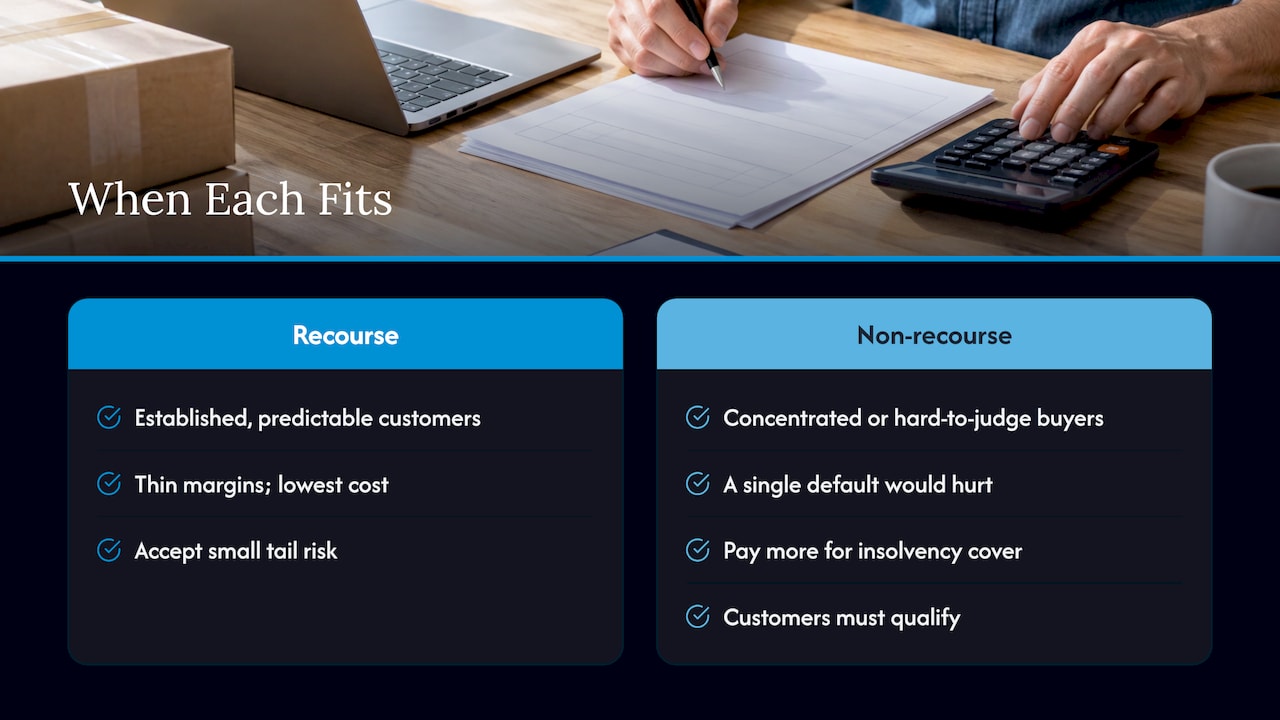
Recourse tends to fit when your customers are established and pay predictably, your margins are thin, and you want the lowest cost. You accept the tail risk because it is small.
Non-recourse tends to fit when one or two customers make up a large share of your sales, you are selling to buyers whose finances you cannot easily judge, and a single default would hurt. You pay more for insolvency cover and you need customers strong enough to be approved.
In both cases, factoring ties your funding to your customers. Your approval, your advance and your risk all depend on who you invoice. That is the central trade-off, and it is the reason some owners look at financing that is based on the business itself. Our $100,000 example comparing AR financing and factoring walks through that comparison in numbers.

If your goal is smoothing out the gap between invoicing and getting paid, there is another route that does not involve selling invoices or taking on recourse questions. A business line of credit gives you a limit you draw on as needed. A working capital loan gives you a lump sum. Neither one depends on whether a particular customer pays a particular invoice. You can read more about how revolving credit differs from an installment loan to see which structure matches your cash cycle.
Pricing is published on our site: SBA loans at 8% per year and lines of credit at 1-3% per month, with working capital offered without a published price. Because costs are quoted per month for lines of credit and per year for SBA loans, convert them to the same basis before comparing them with a factor’s discount.
Our perspective
Factoring asks a question of your customers: can they pay? Recourse and non-recourse only decide who is left holding the bag if the answer turns out to be no. Most small business owners we talk about this with are not really shopping for a risk transfer. They are trying to cover payroll, inventory or a big order while receivables sit unpaid.
That is why we built Fordham Capital around the business owner, not the invoice. One short application reaches a network of banks and alternative lenders, with approvals possible within 24 hours, no collateral required and no impact on your credit score. For owners with imperfect credit, that matters: the decision rests on the whole business, not on how a single customer behaves.
If you have already looked at factoring and the recourse terms made you uneasy, take that as a signal to compare. A line of credit or working capital financing lets you keep control of your customer relationships and your invoices.
Rob
Fordham Capital connects small and medium-sized businesses to banks and alternative lenders for SBA loans, business lines of credit and working capital. The application is one page, there is no credit score impact to apply, and no collateral is required. A personal advisor supports you through the process. We hold an A+ rating with the BBB.
See the options and start on the Fordham Capital application.
It is a factoring arrangement where the factor takes the loss if your customer cannot pay for a covered reason, typically bankruptcy that happens within a set window after the invoice. Per the IRS guide, this is the defining feature: the factor bears the risk of the customer’s financial inability to pay. Late payment and disputes are generally not covered.
Usually, yes. The factor carries less risk under recourse, so it charges lower fees and tends to advance a higher share of the invoice. The trade-off is that you owe the money back if your customer does not pay.
Yes. The IRS notes that many U.S. agreements combine the two, with non-recourse treatment for creditworthy customers and recourse for weaker ones. Ask the factor which customers fall under which treatment before you sign.
The idea is similar: recourse means the lender or factor can come back to you to recover what is owed. In factoring, it applies to an invoice you sold. In a loan, it applies to a debt you owe. Check each agreement for what the lender can pursue if payments stop.
Often yes. Our guide to funding without strong credit explains how lenders in our network look at your business, and applying with us does not affect your credit score.
At Fordham Capital, we've made the application process straightforward and reassuring. Dive in and explore your financial options with confidence, knowing there's no impact on your credit score and no obligations. We review your details and offer customized solutions based on what you're looking for.