

In this guide, “net 30 business credit” means short-term financing you get through an online lending marketplace: business lines of credit, working capital loans, and SBA 7(a) Working Capital Pilot funding, not vendor payment terms. If you need working capital fast, a marketplace line of credit or an SBA working capital pilot application is the practical starting point, and we can walk you through both.
TL;DR:
- Most marketplace short-term financing options primarily serve small businesses needing quick access to modest amounts, often under $100,000.
- These products include lines of credit, short-term loans, and SBA-backed programs, each suited for different cash flow needs and documentation willingness.
- Approval can often happen within one day and funds are typically disbursed within 24 to 48 hours after acceptance, but longer for SBA options.
- Costs are influenced by fees, repayment schedules, and draw periods, making total dollar cost calculations essential for fair comparisons.
- Red flags include unclear total costs, high-pressure tactics, and automatic rollover clauses; always clarify repayment terms and total expenses before acceptance.
We use this term to cover marketplace-sourced, short-term financing products rather than supplier payment terms. That distinction matters because the products, costs, and approval paths are completely different, and confusing them leads business owners to the wrong application entirely.
Here, net 30 business credit spans three product types. A business line of credit gives you revolving access to funds you draw against as needed. A short-term working capital loan delivers a lump sum repaid over a fixed, usually brief, schedule. The SBA 7(a) Working Capital Pilot program adds a government-backed option built specifically for recurring working capital needs, with its own fee structure and size caps.
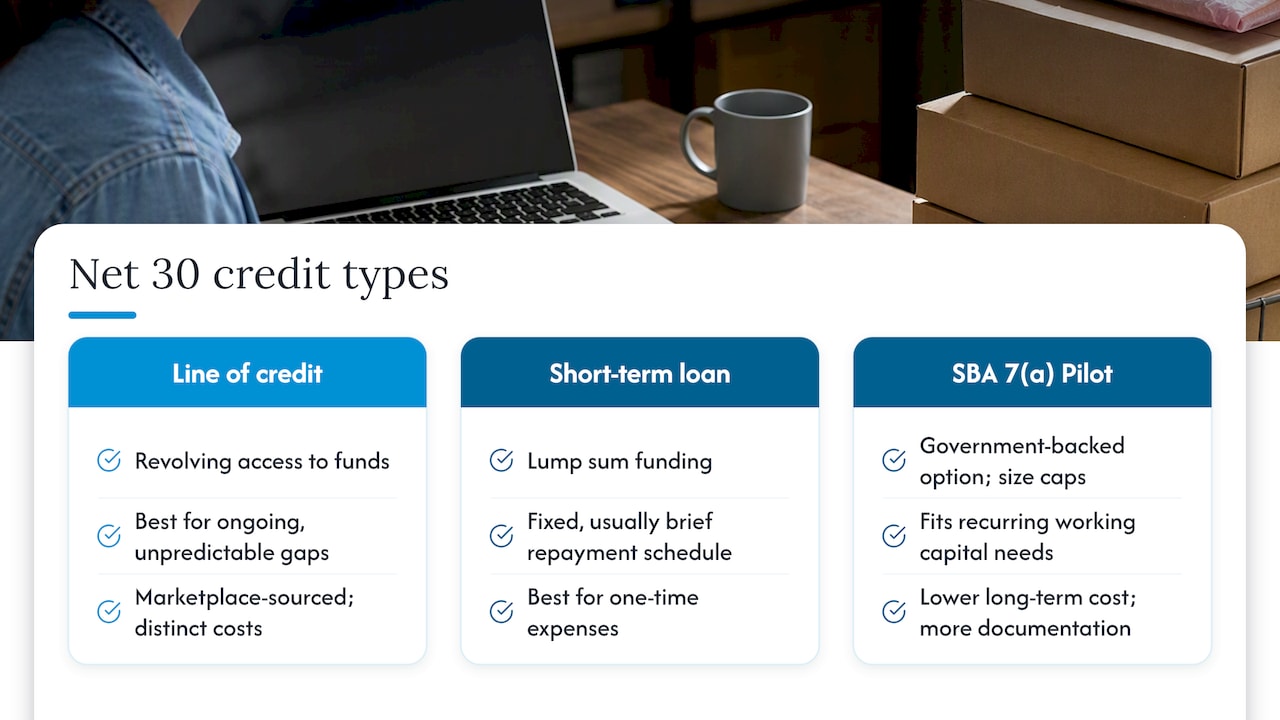
Each product fits a different situation. A line of credit suits ongoing, unpredictable cash gaps. A term loan fits a one-time expense. The SBA option fits businesses that want lower long-term cost and can handle more documentation.
Marketplace financing tends to fit businesses that need speed or that banks have historically underserved. According to Federal Reserve data, 37% of small employer firms applied for a loan, line of credit, or merchant cash advance in 2023, and half of those applicants sought $100,000 or less. That tells you most small-business credit demand is modest in size, which is exactly the range marketplaces are built to serve quickly.
Common situations where this financing route makes sense include:
Marketplaces tend to win over traditional banks when speed, lighter documentation, or a shorter operating history matter more than the lowest possible rate.
The three main product categories differ in structure, cost, and the kind of need they solve.
Choosing among these comes down to how predictable your need is and how much paperwork you’re willing to handle for a lower rate.
Every lender looks at a similar core set of signals, but marketplaces generally apply them with more flexibility than traditional banks.
Standard checks include:
Federal Reserve survey data shows banks have been tightening lending standards for small firms while seeing more inquiries about new credit lines, a combination that makes marketplace underwriting, which often relies on alternative signals like cash flow instead of strict credit thresholds, comparatively more accessible.
Before you apply, gather three to six months of bank statements, your most recent tax return, and a clear picture of monthly revenue.
Pro Tip: Apply with accurate, consistent revenue figures across every document; mismatched numbers are one of the fastest ways to trigger a denial or a lower offer.
The marketplace path is built to move fast, and the application itself is usually the shortest part of the process.
Timelines vary by lender and product, but marketplaces built for speed can return decisions same-day, with funding often following within 24 to 48 hours once an offer is accepted. SBA-backed products generally take longer because of the additional documentation and guaranty processing involved.
Headline rates rarely tell the full story on short-term financing. Fees, repayment frequency, and draw period all change what a product actually costs you.
Watch for these cost factors:
To compare offers fairly, calculate total dollar cost over your expected draw period rather than relying on an advertised rate alone: divide total fees and interest by the average outstanding balance over that period. This approach avoids the common mistake of comparing a short-term factor rate directly against a long-term APR, which understates the real cost of short-term products.
Small-dollar financing is common among small businesses. Federal Reserve research found that 30% of applicants in 2023 sought $50,000 or less, underscoring how much of this market is built around modest, short-term needs rather than large capital raises.
A few direct questions during underwriting conversations can save you from a costly mismatch.
Ask lenders and marketplaces:
Red flags include pressure to sign quickly, reluctance to state total cost in dollar terms, and unclear language about renewal fees or automatic rollovers.
Pro Tip: When speed and cost conflict, weigh how much the delay itself would cost your business, a missed contract or stockout often outweighs a slightly higher financing fee.
While this guide focuses on marketplace financing, many business owners juggle both supplier payment terms and marketplace credit at the same time, so it’s worth knowing how to negotiate the former without derailing the latter.
Start by asking for net 30 terms only after you’ve established a payment history with a vendor, even if that history is short. Vendors are more willing to extend terms once they’ve seen at least one or two on-time payments, even paid upfront or on faster terms.
Bring leverage to the conversation. If you can commit to a larger order size or a longer-term relationship, say so directly, since vendors often extend terms to secure recurring business rather than one-off sales.
Ask for net 30 terms explicitly rather than assuming they’re standard. Many vendors default to shorter terms or require payment on delivery unless you request otherwise, and the request itself often gets you a better outcome than silence would.
Keep your own payment history clean once terms are granted. Consistent on-time payments make it easier to negotiate net 45 or net 60 terms later, and vendors who report payment history can factor into how other lenders view your business’s reliability.
Finally, don’t treat vendor terms and marketplace financing as separate problems. If a vendor won’t extend terms, a short-term marketplace line can bridge the same gap while you build the payment history needed to negotiate better terms directly.
Marketplace financing solves a real speed problem, but it carries risks that are worth naming clearly.
The biggest risk is cost compounding when you roll over or stack multiple short-term products. Daily or weekly repayment schedules can strain cash flow fast if revenue dips even briefly, and businesses sometimes take a second advance to cover payments on the first, which erodes margins quickly. Mitigate this by calculating your total weekly or daily payment obligation against realistic revenue before you accept an offer, not your best-case projection.
A second risk is comparing products poorly. Factor rates and flat fees don’t translate directly into APR, so a product that looks cheap on the surface can cost more than a traditional loan once you compute the effective rate over your draw period, as covered earlier in this guide.
A third risk involves lenders with unclear renewal or rollover terms. Some short-term products renew automatically or add fees for early payoff, which catches borrowers off guard. Read the repayment and renewal terms before signing, and ask directly whether early payoff reduces the total cost or not.
Finally, relying exclusively on short-term marketplace products without ever building toward lower-cost options, like an SBA-backed line, can keep your financing costs permanently higher than necessary. Use marketplace credit for the immediate need, but revisit your financing mix periodically as your revenue and credit profile improve.
The “net” terminology shows up across different financing contexts, and it’s easy to conflate them even though the mechanics differ.
In the marketplace financing world covered in this guide, “net 30” generally describes short repayment windows on working capital products, loans or lines structured around 30-day cycles rather than the multi-year terms typical of traditional bank loans. Net 15 structures compress that same working capital into a tighter two-week cycle, which usually means smaller draw amounts and faster turnover, useful for businesses with very short cash conversion cycles. Net 60 structures stretch repayment further out, giving more breathing room per cycle but often at a higher total cost since the lender’s capital is tied up longer.
The practical difference for you as a borrower comes down to how your revenue cycle matches the repayment cycle. A business with fast inventory turnover and frequent sales can often handle a net 15 or net 30 structure comfortably. A business with longer sales cycles, like one selling to other businesses on extended contracts, may need the breathing room a net 60 structure provides, even if it costs more in total fees.
When you’re comparing offers across these structures, always convert each one to total dollar cost over its own cycle length rather than comparing the headline fee alone. A net 15 product with a lower flat fee can still cost more per month than a net 60 product with a higher one, once you account for how often you’re paying that fee across a given period.

Marketplace credit is a tactical tool, not a permanent financing strategy. It’s the right call when speed matters more than squeezing out the lowest possible rate, but treat it as a bridge.
Keep your bank relationship active even while using marketplace products. Banks still offer the best long-term rates once your revenue and credit history qualify, and that relationship takes years to build.
— Rob
We built our process around helping small businesses get funding faster. Our one-page application requests basic business details without a hard credit pull, and approvals can come back quickly.
We offer SBA loans, lines of credit, and working capital funding, matched to whichever product fits your revenue and timeline. We hold an A+ BBB rating, have funded over $120 million, and have helped clients generate more than $500 million in revenue. If you’re a project-based business juggling invoicing timing instead of a funding gap, a resource like Firmanager’s progress invoicing guide is worth a look before you borrow at all.
If working capital is the actual constraint, start your one-page application today and see what offers come back.
Here, it refers to short-term financing, business lines of credit, working capital loans, or SBA-backed options, sourced through an online lending marketplace rather than a single bank. It’s distinct from vendor payment terms, which is a separate topic entirely.
Our line of credit runs 1% to 3% per month, and our SBA loan option runs 8% per year. Working capital pricing is available on request once we review your application.
Net 45 structures stretch the repayment cycle a bit longer than net 30, typically meaning slightly lower payment frequency but a longer total commitment. The right choice depends on how your revenue cycle lines up with the repayment schedule.
Approval timelines vary by lender and product, but marketplaces built for speed can return decisions the same day, with funding often following within 24 to 48 hours of accepting an offer. SBA-backed products generally take longer due to added documentation requirements.
Many marketplace lenders weigh revenue and cash flow more heavily than personal credit, though credit factors still play a role in the offers you receive. Requirements vary by lender within the marketplace’s network.
At Fordham Capital, we've made the application process straightforward and reassuring. Dive in and explore your financial options with confidence, knowing there's no impact on your credit score and no obligations. We review your details and offer customized solutions based on what you're looking for.




.jpg)


