
The fastest low-impact capital raise for most small businesses is a revenue based or receivable backed product with a transparent factor rate and a one-page application. That means picking an option built around your sales or invoices instead of your personal credit file.
Your next move: get your last three to six months of bank statements ready and either prequalify with a soft-pull revenue product or submit Fordham Capital’s one-page application to see multiple offers at once.
The safest fast-funding move for most SMBs is matching a revenue- or invoice-backed product to their actual cash-flow cadence, then insisting on total repayment disclosure before signing.
| Point | Details |
|---|---|
| Prioritize soft-pull products | Choose revenue, invoice, or equipment-backed financing to avoid a hard credit inquiry. |
| Convert factor rate to APR | A 1.3 factor rate can equal over 100% APR-equivalent depending on term length. |
| Demand total repayment in writing | Walk away from any lender that won’t state the exact dollar amount owed. |
| Prepare documents first | Bank statements, processor history, and invoices speed approval more than anything else. |
| Use Fordham Capital for speed and comparison | Its one-page application and lender network often return offers within 24 hours. |
Not every fast-funding product works the same way, and the differences matter more than most SMB owners realize until they’re staring at a repayment schedule. Here’s the quick rundown of what typically avoids a hard personal credit pull.
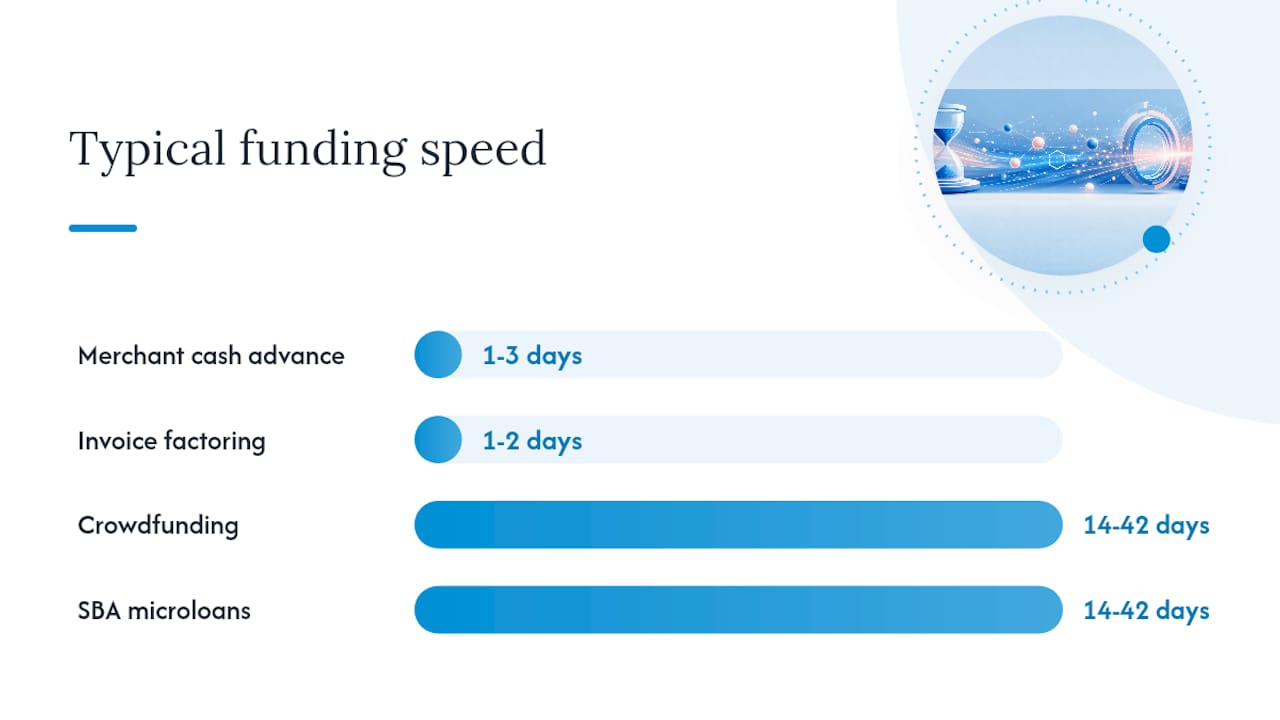
Nav’s comparison of financing types breaks out typical ranges and qualifiers for each category, and the pattern is consistent: the faster the funding, the more the underwriter leans on your revenue or receivables instead of your credit file.
Speed snapshot: cash advances and factoring can land in your account in a few days. Crowdfunding and SBA microloans usually take two to six weeks.
Lenders offering these products aren’t skipping risk assessment. They’re just measuring a different set of signals. Instead of pulling your FICO score, they look at what your business is actually doing right now.
Here’s the nuance that trips people up: a soft pull for prequalification doesn’t touch your score, but many of these products still require a personal guarantee. If you default, that guarantee can lead to collections activity that eventually shows up on your personal credit report anyway. Some lenders also report payment history to business credit bureaus, which is good news when you pay on time and bad news when you don’t. Low-impact doesn’t mean zero-impact. It means the application itself won’t ding you.
This is where most owners get burned, not on the application, but on the math they never did before signing. A factor rate looks deceptively simple: borrow $50,000 at a 1.3 factor rate, and you owe $65,000 total. But that flat number hides the real cost when converted into an annualized rate.
NerdWallet’s guidance is blunt about this: focus on the factor rate and total repayment, not the speed of approval, because a fast yes can mask a costly total.
Two quick examples:
The trade-offs stack up beyond the rate itself: daily or weekly repayment cadence strains cash flow during slow weeks, holdbacks reduce what hits your account from each sale, and SoFi points out that these products generally cost more and have shorter terms than traditional bank financing.
Pro Tip: Always ask the lender to state the total repayment amount in dollars, not just the factor rate. If they hesitate, that’s your answer.
Two offers with similar factor rates can have wildly different real costs once you factor in holdbacks and fees. Before you sign anything, run through this list of questions.
Red flags worth walking away from: a lender that guarantees approval before reviewing any documents, anyone charging a fee just to apply, vague answers when you ask for the total repayment figure, or aggressive collection language buried in the fine print.
On the flip side, trust signals worth insisting on include a clearly disclosed factor rate in writing, a verifiable one-page application process, and third-party accountability like an A+ BBB rating. Practitioner guidance consistently points back to one theme: transparency in offer terms matters more than how fast the money shows up.
Pro Tip: Ask for the total repayment in writing before you provide bank login credentials. A legitimate lender will give you this number without pushback.
Underwriters move faster when your paperwork is organized before you hit submit. Here’s the priority order.
A few habits shorten review time even more: save everything as PDFs with clear filenames, use a dedicated business email for the application, and disclose any liens or judgments upfront rather than letting an underwriter discover them mid-review.
Pro Tip: Export your bank transactions into a single CSV before applying. It saves an underwriter time and often shaves a day off approval.
If your business needs cash in days rather than weeks, and you’d rather compare several soft-pull offers than chase down individual lenders one by one, a marketplace model fits better than a single-bank application. That’s the specific gap Fordham Capital is built to fill.
Fordham Capital’s model centers on a one-page application, with approvals often coming back within 24 hours. The company carries an A+ BBB rating and has funded more than $120 million, helping clients generate over $500 million in revenue.
Businesses that get overlooked by conventional banks aren’t necessarily bad credit risks. They’re often just running on a timeline traditional underwriting wasn’t built to match.
To apply: gather your bank statements and basic business documents, complete the one-page application, and expect a response within a business day if your revenue history supports it.
Getting funded is the easy part. What happens over the next 60 to 90 days determines whether this capital helped your business or just delayed a bigger problem.
Start by mapping your repayment cadence against your actual cash-flow calendar, not your best-case revenue month. If you took a daily-debit product, know exactly what hits your account each morning before you spend a dollar of what’s left. Cash-flow management becomes the single most important discipline once repayment starts, because a product that looked affordable on paper can strain you fast during a slow sales week.
If multiple repayments are draining your account at once, consider consolidating or restructuring before you fall behind, not after. Practical debt management strategies can help you sequence which obligations to pay down first without damaging vendor relationships.
On the credit side, this is also your window to build something lasting. Register your business properly, get vendor tradelines reporting on-time payments, and use fast capital as a stepping stone toward stronger long-term financing options, not a permanent fix. Set a calendar reminder to review your repayment progress monthly. Small course corrections early beat a scramble later.
Speed is seductive, and that’s exactly why it deserves scrutiny. I’ve come to believe the biggest risk in low-impact capital isn’t the cost, it’s the temptation to skip the math because the application felt easy.
Match the product to your actual cash-flow pattern, not the fastest yes you get. Treat quick capital as a bridge to solve a specific, time-bound problem, never as a permanent fix for a structural cash-flow gap. Insist on total repayment numbers before you sign anything. [author_bio]
Traditional lenders make you wait weeks for an answer while a hard credit pull sits on your file the whole time. Fordham Capital works differently: one application, reviewed against a network of banks and alternative lenders, with approvals often landing within 24 hours and no impact on your personal or business credit score just for applying.
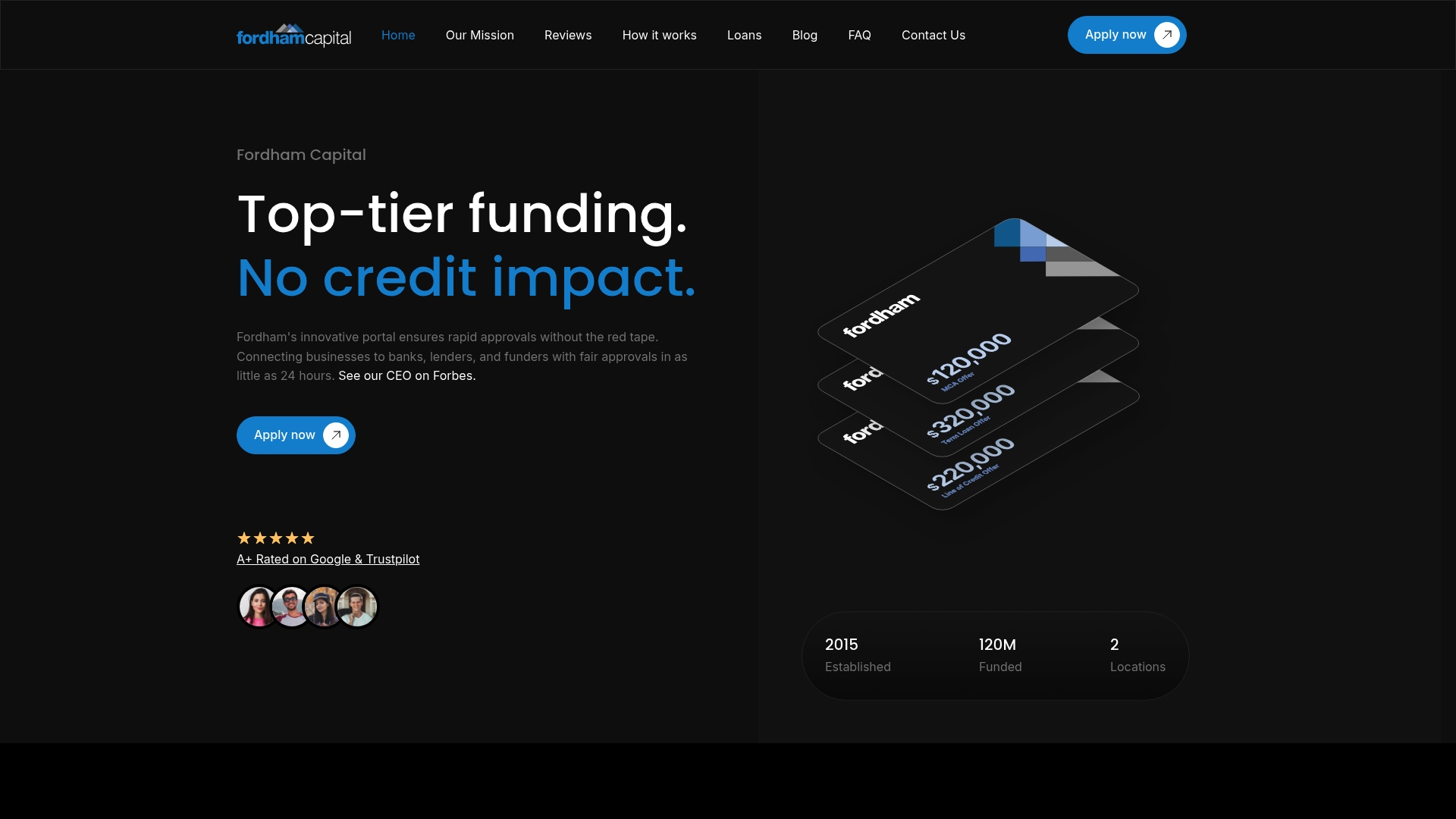
That network matters more than it sounds. Instead of getting a single yes or no from one bank, you’re comparing multiple offers side by side, so you can actually pick the one with the better factor rate instead of settling for whatever your local branch offers. Fordham Capital carries an A+ BBB rating and has funded over $120 million for businesses that traditional banks often overlook, helping those clients generate more than $500 million in combined revenue. If you’re ready to see what you qualify for, complete the one-page application and get real offers back without the weeks-long wait.
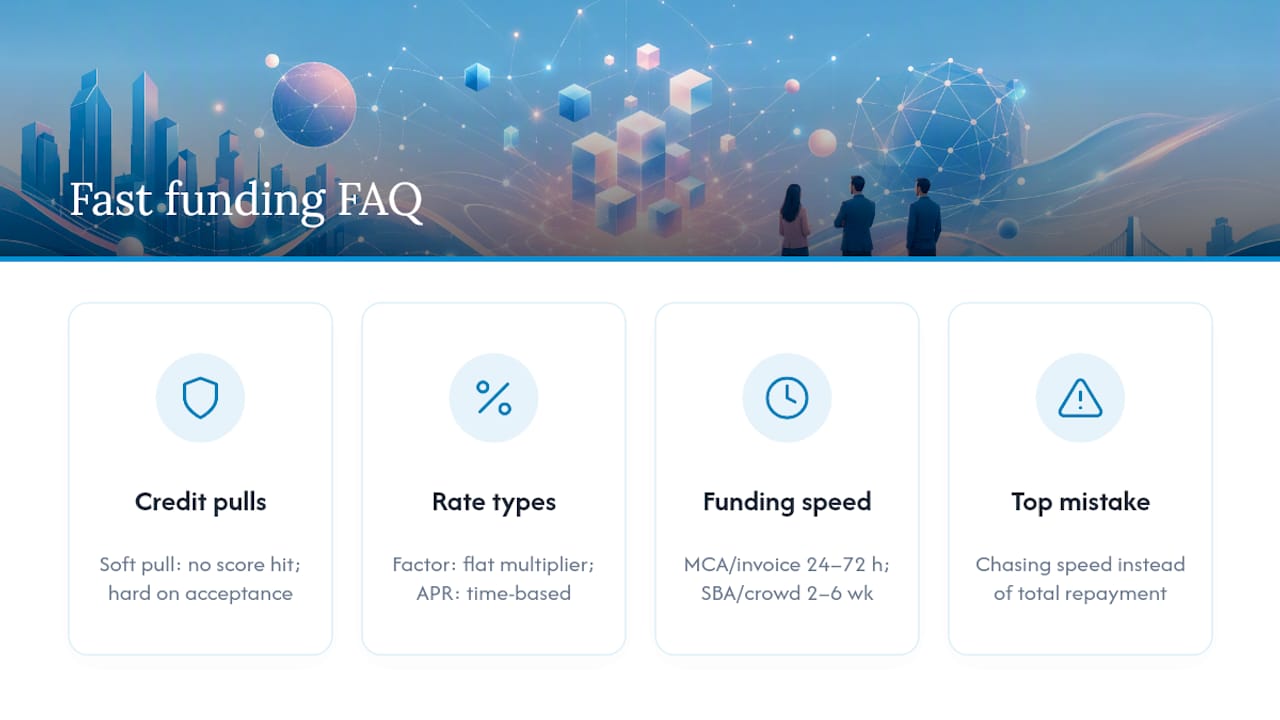
Does prequalifying for fast business funding hurt my credit score? No, as long as the lender uses a soft pull for prequalification. A hard pull only happens if you move forward and formally accept an offer, and even then, many revenue-based products skip it entirely.
What’s the difference between a factor rate and an APR? A factor rate is a flat multiplier applied to the amount you borrow, while APR accounts for time and compounds annually. Converting a factor rate to its APR-equivalent, which can range widely depending on your repayment term, is the only way to compare it fairly against a traditional loan.
How fast can I actually get funded through a low-impact capital raise? Merchant cash advances and invoice factoring often fund within 24 to 72 hours once your bank statements or invoices are verified. SBA microloans and crowdfunding campaigns take longer, usually two to six weeks.
Will a personal guarantee affect my personal credit even if there’s no hard pull? It can. A personal guarantee doesn’t trigger a credit check upfront, but if you default and the lender pursues collections, that activity can eventually show up on your personal credit report.
What’s the single biggest mistake business owners make with fast funding? Focusing on approval speed instead of total repayment. A one-page application that gets you funded in a day means nothing if you didn’t confirm the actual dollar amount you’ll pay back.
This article is general information, not a substitute for advice from a qualified financial advisor. Consult a qualified financial professional about your own circumstances before acting on anything here.
At Fordham Capital, we've made the application process straightforward and reassuring. Dive in and explore your financial options with confidence, knowing there's no impact on your credit score and no obligations. We review your details and offer customized solutions based on what you're looking for.