For most small businesses, the split is simple: loans handle big, planned investments with lower rates and longer terms, while credit cards cover routine spending and short-term gaps if you pay balances off. The SBA 7(a) program can fund up to $5 million for larger needs, and firms like Fordham Capital (A+ BBB rated, $120M+ funded) can match you to a lender fast if speed matters more than shopping around.
TL;DR:
- Business loans offer larger funding amounts, lower interest rates, and fixed repayment schedules, making them suitable for large purchases or expansion projects.
- Business credit cards provide faster approval, higher credit limits for routine expenses, and rewards on weekly spending, ideal for managing day-to-day costs.
- Loan approval can take weeks and often requires collateral or personal guarantees, while credit cards generally approve within days with minimal paperwork.
- Using a rewards card for recurring expenses and paying in full maximizes benefits, but carrying a balance on a credit card becomes costly quickly.
- Many businesses effectively combine a line of credit with a rewards card to cover large investments and routine operational costs simultaneously.
A business loan gives you a lump sum or a line you draw against, repaid on a set schedule over months or years. A business credit card gives you a revolving limit you can spend against repeatedly, with a minimum payment due each month and interest charged only on what you carry.
The gap between the two shows up most in size and cost. Loans typically range from tens of thousands into the millions, with rates well below what most cards charge once you’re carrying a balance. Cards top out lower, often with lower credit limits appropriate for typical business expenses, but they approve faster and cost nothing if you clear the statement each cycle.
Here’s how the two stack up on the factors that actually matter when you’re deciding:
Loans make sense the moment the number gets big or the payback period stretches past a year. Buying equipment, purchasing a building, refinancing high-cost debt, or covering a large contract’s upfront costs are all situations where a card’s limit and rate simply don’t work.
The tradeoff is time and paperwork. Banks and SBA lenders want tax returns, bank statements, and profit-and-loss statements before they’ll commit, and underwriting can stretch for weeks. Online marketplaces and alternative lenders move faster, sometimes funding within a day or two, though terms vary by lender and credit profile.
Here’s the general order of operations for a loan application:
The SBA 7(a) program works through approved lenders rather than the government directly, and it comes with guarantee percentages between 75% and 85% depending on loan size, which is part of why SBA-backed loans often carry better terms and counseling support than a straight bank loan. If you’re weighing SBA structures specifically, it’s worth understanding how 7(a) and 504 loans differ before you apply, since each fits a different kind of purchase.
Pro Tip: Gather your documents before you start shopping lenders. A complete file, tax returns, bank statements, aged receivables, cuts underwriting time significantly, whether you’re going the SBA route or a faster online option.
For a deeper look at what lenders actually check before approving funds, see our breakdown of business loan approval factors.
Cards earn their keep on the stuff that happens every week: office supplies, software subscriptions, fuel, travel, client dinners. The rewards on a business card, cash back or points, add up over a year of routine spending in a way a term loan never will.
Cards also solve smaller cash-flow gaps well. If a 0% introductory APR period lines up with a short-term need, you’re effectively borrowing free money, as long as you have a real payoff plan before the promotional window closes.
The catch is what happens when you don’t pay it off. Carrying a balance on a business card gets expensive fast, and cash advances against a card’s limit come with fees and interest that start accruing immediately, unlike a purchase. Issuing employee cards adds convenience but also adds exposure, every swipe is spending you need to track.
Pro Tip: Run your recurring business expenses through a rewards card and pay it in full every cycle. You get the points without ever paying a cent of interest, which is the entire point of using a card this way.
For more on how these cards work day to day, our guide to business credit cards breaks down approval criteria and reward structures in more detail.
Start with the amount and the timeline. If you need a relatively small amount for something you’ll pay off quickly, a card probably wins on speed and simplicity. If you’re financing a larger amount with a payback horizon of a year or more, a loan almost always beats a card on cost.
Run through these questions before you commit to either:
When you’re talking to a lender or issuer directly, ask about:
Many established businesses don’t pick just one. A common approach pairs a line of credit or working capital loan for larger, planned expenses with a rewards card for everyday operating costs. A business line of credit typically carries higher limits and lower rates than a card, but it deposits cash straight to your account rather than functioning as a card you swipe, which matters if you need to pay a vendor who doesn’t take cards at all.
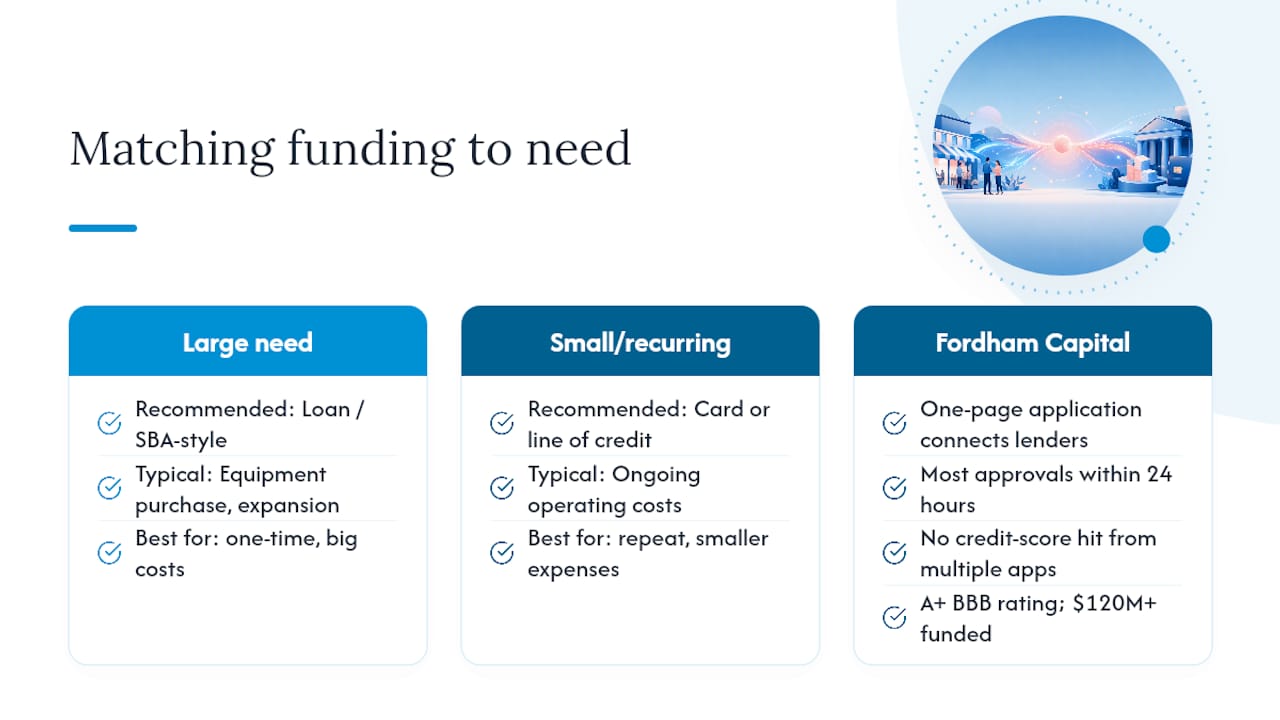
We built Fordham Capital around a simple frustration: business owners waste weeks chasing bank appointments for financing decisions that should take days. Our one-page application connects you to a network of banks and alternative lenders, and most clients see approvals within 24 hours, without the credit score hit that comes from applying everywhere separately.
An A+ BBB rating and more than $120M funded across small and medium-sized businesses tell you we’ve done this enough times to know the pattern. When a client needs a large equipment purchase or an expansion, we point them toward loan or SBA-style products. When the need is smaller and recurring, we’ll say so, and a card or line of credit is often the better complement rather than a competing choice.
— Rob
If you’ve read this far, you already know whether you’re looking at a loan-sized need or a card-sized one. Fordham Capital’s one-page application skips the runaround: no credit score impact just to see what you qualify for, and access to a network of banks and lenders who actually work with small and medium-sized businesses that big banks tend to pass over.
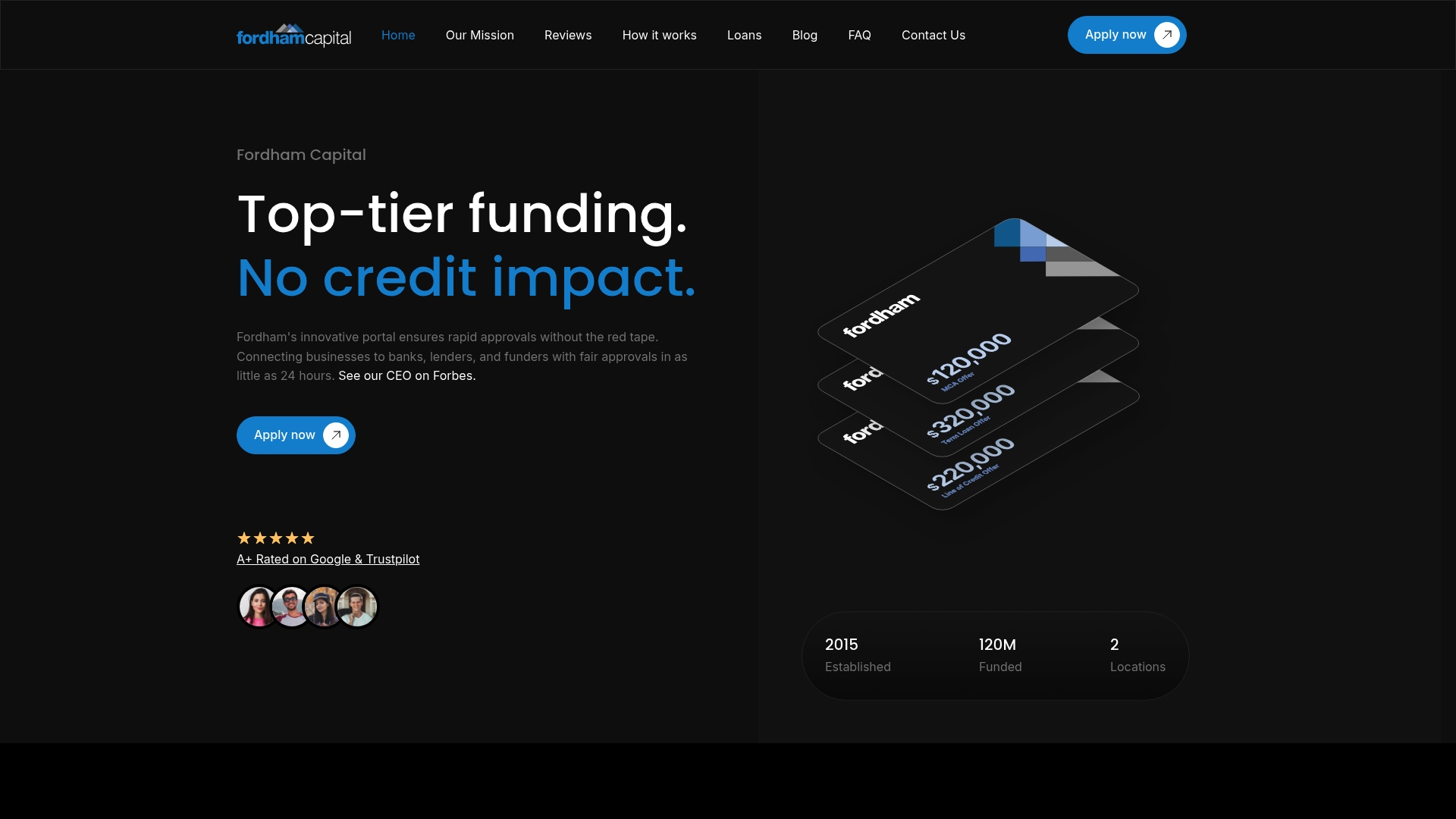
Getting started takes a few minutes:
If your business needs capital now, whether that’s an SBA-backed loan, a working capital line, or a faster alternative option, apply now and see what you qualify for within 24 hours.
This article is general information, not a substitute for advice from a qualified financial advisor. Consult a qualified financial professional about your own circumstances before acting on anything here.
At Fordham Capital, we've made the application process straightforward and reassuring. Dive in and explore your financial options with confidence, knowing there's no impact on your credit score and no obligations. We review your details and offer customized solutions based on what you're looking for.