

A business credit card is a revolving line of credit issued to a company — or to a sole proprietor operating under their own name — that you use exclusively for business purchases. Used correctly, it separates your business expenses from personal spending, gives you short-term financing without a loan application, and can actively build your company’s credit profile over time.
Three names worth knowing from the start: Experian Business tracks commercial credit behavior that card issuers report; the Credit CARD Act of 2009 sets federal consumer protections (with some notable gaps for business cards); and Fordhamcapital connects small businesses to fast funding when a card alone isn’t enough.
A business credit card is a practical tool for separating expenses, building business credit, and managing short-term cash flow — but only when you understand the personal guarantee, confirm bureau reporting, and match the card’s fee structure to your actual spending patterns.
| Point | Details |
|---|---|
| Definition and purpose | A business credit card is a revolving credit line for business purchases that separates expenses and can build business credit. |
| Personal guarantee risk | Most business cards require a personal guarantee, making the owner personally liable even for incorporated businesses. |
| Credit bureau reporting | Not all issuers report to commercial bureaus; confirm with your issuer before applying if building business credit is a goal. |
| Fees and interest | Carrying a balance at 18%–29% APR erases most reward value; pay in full monthly to keep the card cost-neutral. |
| Fordhamcapital option | When a card limit isn’t enough, Fordhamcapital’s one-page application connects businesses to fast funding with no credit score impact. |
A business credit card works like a personal card in its basic mechanics — you charge purchases, receive a monthly statement, and either pay in full or carry a balance with interest. What makes it different is who it’s designed for and how it’s structured. Credit limits tend to run higher, rewards are calibrated to business spending categories (office supplies, shipping, advertising), and you can issue cards to employees with individual spending controls.

According to Investopedia, business cards can function as either revolving credit (carry a balance month to month) or charge cards (full payment required each billing cycle). That distinction matters more than most owners realize: a charge card forces discipline but kills flexibility; a revolving card offers breathing room but invites interest charges if you’re not careful.
The four main card types you’ll encounter:
Bank-issued cards (Chase, Bank of America, Capital One) tend to offer broader rewards ecosystems and established customer service. Fintech-issued cards often win on software integration and faster onboarding, but may carry fewer protections and less issuer flexibility.
The lifecycle from application to monthly payment follows a predictable sequence, but the details inside each step are where owners get surprised.
Employee cards and controls. Most small-business cards let you add employees as authorized users at no extra cost. You can typically set per-card spending limits, restrict merchant categories, and receive alerts when a card is used. This is one of the cleaner ways to manage team expenses without issuing reimbursements.
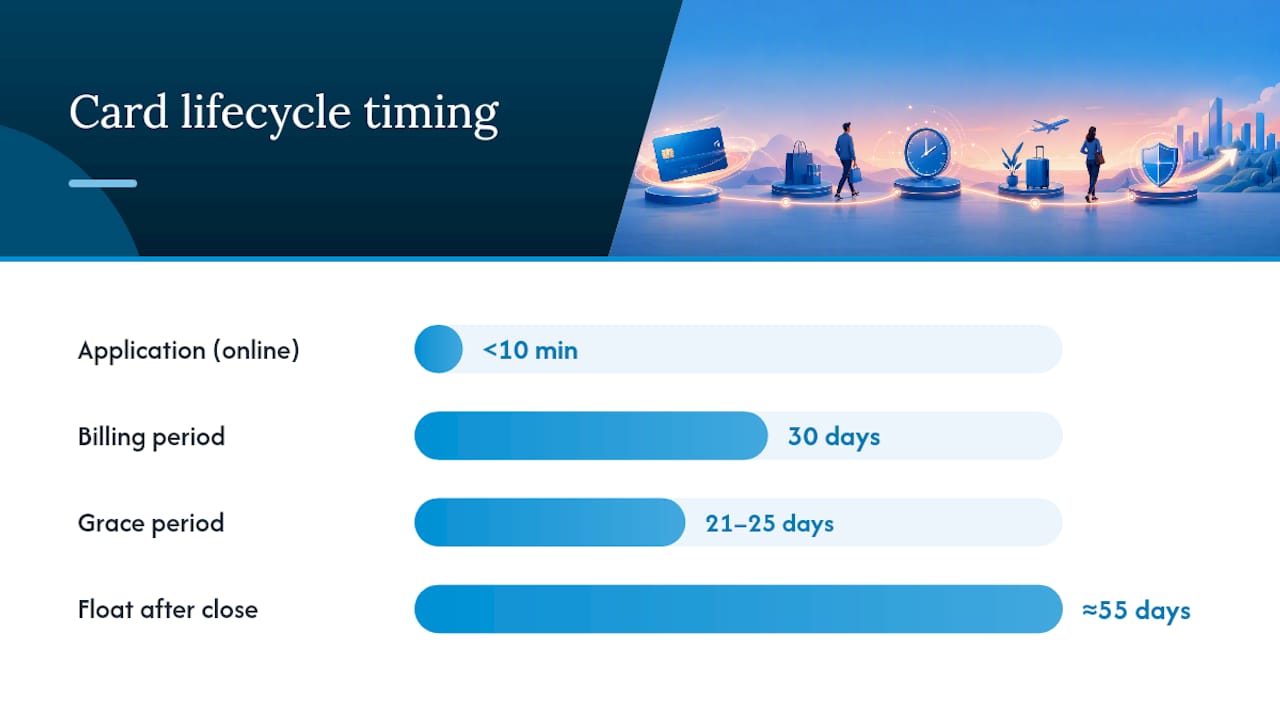
Pro Tip: The grace period — the window between your statement closing date and your payment due date, usually 21–25 days — is a free short-term loan. Charge a large vendor payment right after your statement closes, and you get nearly 55 days of float before interest kicks in. Pay in full and it costs you nothing.
Charging business expenses to a personal card feels harmless until tax season, an audit, or a credit limit problem arrives. The differences between business and personal cards go beyond branding.
| Feature | Business credit card | Personal credit card |
|---|---|---|
| Liability | Personal guarantee typically required | Cardholder liable |
| Credit reporting | May report to commercial bureaus (Experian Business, D&B, Equifax Business) | Reports to personal bureaus (Equifax, Experian, TransUnion) |
| Consumer protections | Partial CARD Act coverage; some protections excluded | Full CARD Act protections apply |
| Credit limits | Generally higher | Generally lower |
| Expense tools | Business-category rewards, employee cards, accounting integrations | Basic rewards; no employee card controls |
The CARD Act gap is the one most owners overlook. Personal cards must give 45 days’ notice before raising your APR and cannot raise rates on existing balances in most cases. Business cards are not always subject to those same rules, which means your issuer has more flexibility to change terms.
Decision points for small business owners:
The headline benefits are well known. The ones that actually move the needle for a small business are worth spelling out specifically.
When used responsibly, business credit cards help separate business and personal finances, simplify accounting, and improve a company’s access to financing. That last part — access to financing — is the long game most owners underestimate when they’re just starting out.
The benefits that matter most in practice:
Pro Tip: Match your card’s bonus categories to your three largest monthly expense categories before you apply. A card that pays 3% on advertising and 2% on travel is worth far more to a marketing-heavy business than a flat 1.5% cash-back card — even if the flat card has a lower annual fee.
No financial product is without trade-offs, and business credit cards carry a few risks that are easy to underestimate.
The personal guarantee is the biggest one. Most business credit cards require a personal guarantee, meaning you — the owner — are personally on the hook if the business can’t pay. Incorporating your business does not protect you from this. If the card goes to collections, your personal credit takes the hit and creditors can pursue your personal assets.
Common fees and costs to watch:
Weaker consumer protections. Business cards are not fully covered by the CARD Act. Issuers can raise rates on existing balances with less notice than personal card rules require. Read the terms carefully before you sign.
The credit risk most owners miss: A business card that reports to personal credit bureaus — and many do, especially for sole proprietors — can raise your personal credit utilization and lower your score even when you’re paying on time. If your card issuer reports a high balance to Experian or TransUnion mid-cycle, your score can drop before you’ve even received the statement. Paying down balances before the statement closing date, not just the due date, is the fix.
Fees vary significantly by issuer and card tier. Here’s a breakdown of the most common charges and what triggers them.
| Fee type | Typical range | What triggers it |
|---|---|---|
| Annual fee | $0–$500 | Holding the card; charged once per year |
| Purchase APR | Typical variable APR | Carrying any balance past the due date |
| Cash advance APR | 25%–30% variable | Withdrawing cash against your credit line |
| Cash advance fee | 3%–5% of amount | Each cash advance transaction |
| Foreign transaction fee | 1%–3% per transaction | Purchases billed in a foreign currency |
| Late payment fee | Typical cardholder fees | Missing the payment due date |
| Balance transfer fee | 3%–5% of balance | Moving a balance from another card |
Three usage scenarios that show how fees add up differently:
A business that pays its full balance every month pays zero interest regardless of APR. The only real cost is the annual fee, offset by any rewards earned. For this owner, a premium card with a $500 annual fee can easily pay for itself in cash back and travel credits.
A business that carries a balance — say, $8,000 month to month at 24% APR — pays roughly $160 per month in interest. Over a year, that’s nearly $1,920 in interest charges, which erases most reward value. Revolving a balance is expensive; it should be a short-term bridge, not a default.
A business that travels internationally and uses a card with a 3% foreign transaction fee on $30,000 in annual overseas purchases pays $900 per year in fees that a no-foreign-fee card would eliminate entirely.
This is where the confusion runs deepest, and where getting it wrong costs real money.
When you apply for a business card, the issuer almost always pulls your personal credit report. That hard inquiry temporarily dips your personal score by a few points. For new businesses with no commercial credit history, the owner’s personal score is the primary underwriting factor.
Once the card is open, what happens next depends on the issuer. Business credit cards may not automatically report activity to commercial business credit bureaus. Some report only to personal bureaus (Equifax, Experian, TransUnion). Some report to commercial bureaus like Experian Business, Dun & Bradstreet, and Equifax Business. Some report to both. A few report to neither.
That matters because building a business credit file — the kind that lets you qualify for vendor net terms, SBA loans, and larger credit lines without a personal guarantee — requires activity that commercial bureaus can see. If your card never reports to Dun & Bradstreet, you’re not building a business credit score no matter how perfectly you pay.
Steps to manage both credit profiles:
Pro Tip: If building business credit is a goal, choose an issuer that explicitly reports to Dun & Bradstreet and Experian Business — and confirm it in writing. Then use the card for recurring monthly expenses (subscriptions, utilities, software) so there’s consistent positive payment history hitting the commercial bureaus every month.
The application process is straightforward, but preparation makes a real difference in both approval odds and the credit limit you receive.
Eligibility checklist — what issuers typically evaluate:
Documents to have ready:
If your personal credit is a concern, understanding what lenders look for in approval decisions can help you prepare before you apply.
A business credit card is only as useful as the system you build around it. The card generates data; the system turns that data into clean books and lower tax bills.
Practical bookkeeping workflows:
Accounting integrations that save real time. Expense management features like tagging, employee controls, and accounting integrations reduce bookkeeping time and help with tax preparation. Connecting your card to platforms like QuickBooks or Xero means transactions flow in automatically, categorized by merchant type. Understanding how accounting integrations power your business tools can help you set this up correctly from the start.
Tax tips worth knowing:
When a card is the right tool:
Pro Tip: Set a calendar reminder on the 1st and 15th of each month to review employee card transactions. Catching an unusual charge within two weeks is far easier to dispute and resolve than finding it three months later during a quarterly close.
Cards are excellent for daily expenses and short-term cash flow. They’re the wrong tool for larger capital needs, longer repayment horizons, or situations where the interest cost would outpace the benefit.
Common alternatives and when they fit better:
How to combine products intelligently:
The card handles the day-to-day. The line of credit handles the swings. The loan handles the big moves.
The conventional wisdom says: get a business card, separate your finances, earn rewards, build credit. All of that is true. What gets left out is the sequence that makes it actually work.
Most owners pick a card based on the sign-up bonus. That’s the wrong starting point. The bonus is a one-time event. The card’s reward structure, reporting behavior, and fee schedule are what you live with for years. A card that pays 3% on your top spending category and reports to Dun & Bradstreet is worth more over three years than a card with a $500 welcome offer that reports only to personal bureaus and charges a 3% foreign transaction fee on your international supplier payments.
The personal guarantee deserves more attention than it gets. Owners who incorporate specifically to limit personal liability are often surprised to learn that the business card they signed for puts them personally on the hook anyway. That’s not a reason to avoid business cards — it’s a reason to read the agreement and manage the card like your personal credit depends on it, because it does.
The credit-building angle is real, but only if you verify reporting. Paying a business card on time for two years builds nothing if the issuer never tells Experian Business or Dun & Bradstreet about it. Confirm reporting before you apply, not after.
And finally: a business credit card is a cash-flow tool, not a capital solution. When you need $50,000 for equipment or $200,000 to fund a growth push, a card isn’t the answer. Knowing when to reach for a different product — a line of credit, an SBA loan, or a fast-funding marketplace — is what separates owners who scale from owners who max out their cards and wonder why growth stalled.
A business credit card handles daily expenses well. When you need capital beyond what a card limit can cover — equipment, payroll gaps, inventory for a large order, or a growth push that needs real runway — a different tool is the right call.
Fordhamcapital connects small and medium-sized businesses to a network of banks and alternative lenders through a one-page application that doesn’t affect your credit score. Approvals can come through in as little as 24 hours, with access to SBA loans, business lines of credit, and working capital financing. Fordhamcapital holds an A+ BBB rating and has helped fund over $120M for businesses that traditional banks often overlook. If your card limit is the ceiling and your growth needs more room, apply now and see what funding you qualify for. Fordhamcapital acts as an intermediary connecting you to third-party lenders — not a direct lender itself.
At Fordham Capital, we've made the application process straightforward and reassuring. Dive in and explore your financial options with confidence, knowing there's no impact on your credit score and no obligations. We review your details and offer customized solutions based on what you're looking for.


.jpg)


