Yes, an LLC can get a business loan. The LLC is a legal structure, not a barrier: lenders care about whether your business is operating, earning and able to repay. The core requirements are a real operating business, financial records that prove revenue and cash flow, an acceptable credit picture, and, in most cases, a personal guarantee from the owners. If you need to see which loan fits your numbers before you commit to a long application, Fordham Capital offers a one-page application that does not impact your credit score and connects you to a network of banks and lenders.
An LLC is a separate legal entity, so it can be the borrower. That is the main reason owners form one: the company takes on the debt and the company’s finances are underwritten. Lenders will still look at you personally, because for a young or small company your credit and experience are part of the risk picture.
How easy it is depends on the product. A traditional bank term loan or an SBA loan asks for the most paperwork and the strongest history. A line of credit or working capital financing from an alternative lender typically asks for less and moves faster. Neither is universally better. They answer different needs: a long-term purchase, a seasonal cash gap, a one-time opportunity.
Most lenders, whatever the product, are trying to answer three questions: is this a real business, does it make enough money to repay, and what happens if it does not?
You will be asked for the LLC’s legal name, industry, address and proof that it exists, usually your articles of organization and your Employer Identification Number (EIN), the tax ID the IRS issues to businesses. Many lenders also ask for the operating agreement, the document that shows who owns what share of the company. That matters because ownership determines who has to sign and who may be asked to guarantee the loan.
The FDIC says lenders assess a business’s financial health, creditworthiness and ability to repay, and may review financial statements, credit reports and scores, and cash-flow projections. In practice that translates into a few numbers:
We cover the same ground from the lender’s side in what lenders look for when approving a business loan and how lenders evaluate business health.
Lenders may look at your personal credit, the business’s credit, or both. Under SBA rules, a lender may consider the credit history of the applicant, its associates and guarantors, along with earnings or cash flow and the applicant’s equity or collateral. The SBA’s regulation sets the principle of creditworthiness but not one national minimum score, so the number you need is largely set by the individual lender and the product. For a deeper look, see our guide to business loan credit score expectations.
The Small Business Administration (SBA) does not lend directly in most cases. It guarantees a portion of loans made by banks and other lenders, which makes approved lenders more willing to say yes. To use that guarantee, your LLC has to meet the SBA’s own rules.
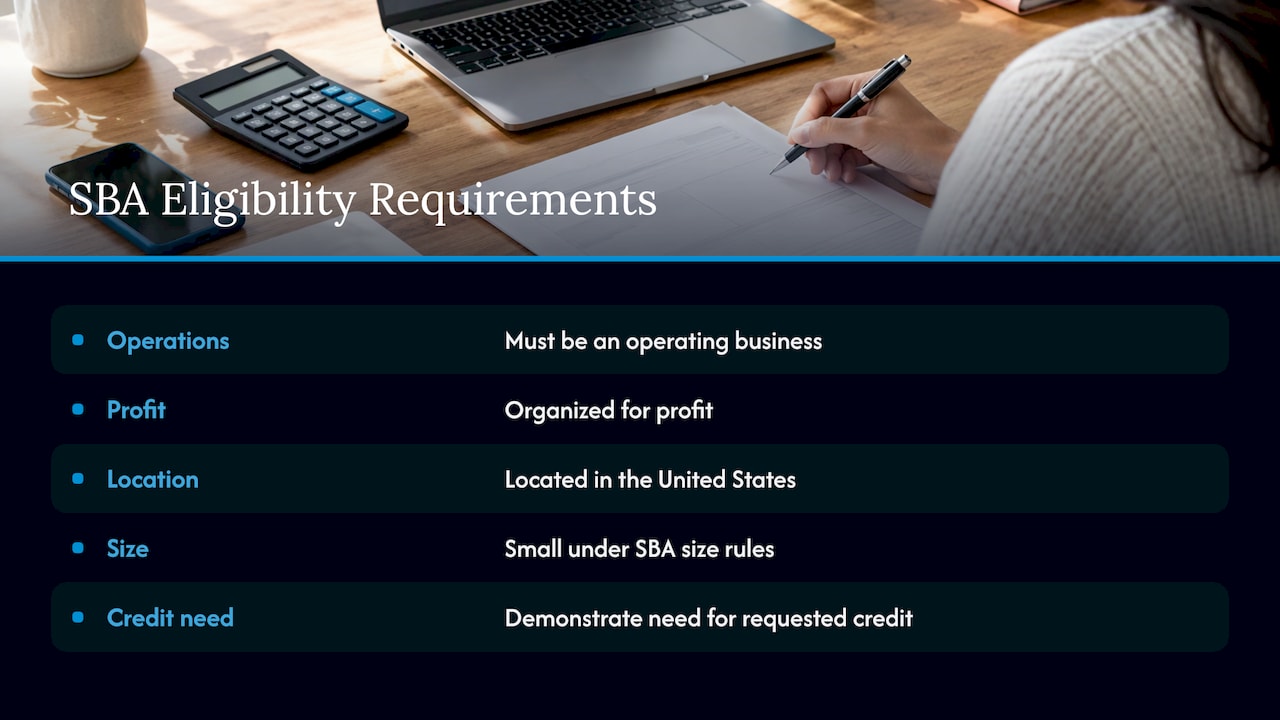
Under 13 CFR § 120.100, an applicant must be an operating business, organized for profit, located in the United States, small under SBA size requirements, and able to demonstrate a need for the credit it is asking for. The SBA’s operating manual, SOP 50 10 8 with technical updates effective June 1, 2025, confirms that these core requirements apply to both 7(a) and 504 applicants. It also treats eligibility as a condition that continues through disbursement, so a change in your business between application and closing can matter.
What this means for you: a holding LLC with no operations, or an LLC formed only to hold passive assets, may face problems that an active restaurant, contractor or retailer will not. If you are unsure which side you fall on, our walkthrough Do You Meet SBA Loan Requirements? goes through the checks.
The FDIC lists what a loan package may include: a loan application, business plan, financial statements, business tax returns, credit reports and scores, documents explaining the purpose of the loan, and collateral information when assets secure the loan. Here is how that looks for an LLC.
| Document | What it shows | Notes |
|---|---|---|
| Articles of organization | The LLC legally exists | Filed with your state |
| EIN confirmation | Your federal tax identity | Issued by the IRS |
| Operating agreement | Who owns the LLC | Drives guarantee requirements |
| Business bank statements | Real deposits and cash flow | Recent months are common |
| Profit and loss statement and balance sheet | Profitability and what you own and owe | Year-to-date versions are typical |
| Business tax returns | Reported income over time | Banks and SBA lenders weigh these heavily |
| Debt schedule | Existing obligations and payments | List lender, balance, payment |
| Use of funds | Why you need the money | Be specific and tie it to revenue |
| Personal ID and financial information | Owner identity and credit | Required for guarantors |
The FDIC advises borrowers to submit accurate, documented financial statements, explain the use of proceeds, provide realistic cash-flow projections and address any credit issues. Two habits make the biggest difference.
Keep clean books. Mixed personal and business spending is one of the quickest ways to make a healthy company look shaky on paper. Separate accounts and regular reconciliation make your statements believable. This is where bookkeeping that tracks real profit pays off: lenders trust profit figures that match the bank deposits.
Explain the story behind the numbers. A slow quarter, a one-off expense or a past late payment is easier to accept when you explain it in a sentence than when the underwriter has to guess. A short written plan helps too; see the role of a business plan in loan approval.
There is no single magic number, but these factors move your options in predictable ways.
Credit score. Higher scores open the lowest-cost products and the largest amounts. Lower scores do not end the conversation: they push you toward products that weigh revenue and cash flow more heavily, and they usually raise cost. Addressing credit problems up front, as the FDIC suggests, is better than hoping they go unnoticed. A question like “what score do I need for $30,000?” has no universal answer, because the lender’s product, your revenue and your existing debt all enter the decision.
Time in business. Banks and SBA lenders usually prefer an established history. Newer LLCs and startups often have more options with products built around current revenue than around years of tax returns. Our piece on how lenders assess startup repayment ability explains what young companies can show instead of a long history.
Revenue and cash flow. These set how much you can borrow. A lender looks at what is left after operating costs and tests whether it comfortably covers the payment. A larger request, such as $200,000, generally calls for stronger and better-documented financials, more of the full package above, and often a guarantee or collateral.
Existing debt. Other loans, cash advances and credit lines count against your capacity. Listing them honestly in a debt schedule avoids surprises late in the process.
Forming an LLC protects your personal assets from many business liabilities, but lenders can ask you to take on part of that risk by signing a personal guarantee, a written promise that you will repay if the LLC cannot.
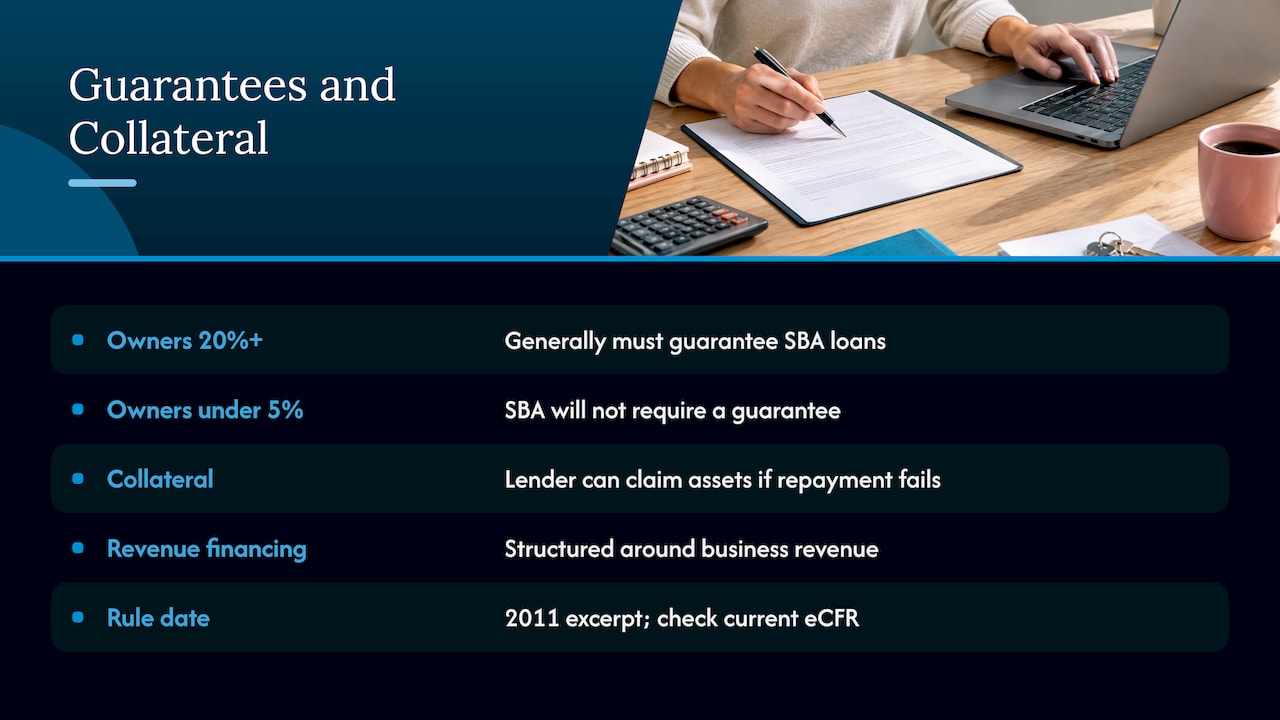
For SBA loans, the SBA’s regulations say personal guarantees are normally required: owners of 20 percent or more generally must guarantee the loan, and the SBA will not require a guarantee from anyone owning less than 5 percent. That excerpt is from the 2011 edition of the regulation, so check the current text at the eCFR before you rely on the thresholds for a specific deal.
Collateral works differently. It is an asset, such as equipment, inventory or property, that the lender can claim if repayment fails. Banks often ask for it. Some alternative financing is structured around the business’s revenue instead, which is why owners who do not want to pledge assets look at lines of credit and working capital. To go deeper, read how to reduce personal liability when borrowing for business, what is real about business loans without a personal guarantee and SBA loan collateral.
Imagine a two-year-old landscaping LLC with two owners, 60/40. It has steady summer revenue, thinner winter months, one equipment loan and a founder credit score that dipped after a late payment last year.
The owners did not need perfect numbers. They needed organized documents, a clear purpose and a product that matched their cash cycle.
| Need | Product that usually fits | What the lender weighs most |
|---|---|---|
| Large, long-term investment | SBA loan | Eligibility, credit, cash flow, guarantees |
| Ongoing flexibility and seasonal gaps | Business line of credit | Revenue, cash flow, existing debt |
| Fast cash for inventory, payroll or an opportunity | Working capital financing | Recent revenue and deposits |
The tradeoff is usually speed against cost against paperwork. The more documentation a product asks for, the longer it takes and the lower its rate can be. Faster products rely on recent revenue and cost more. Matching the product to the purpose is the best protection against overpaying.
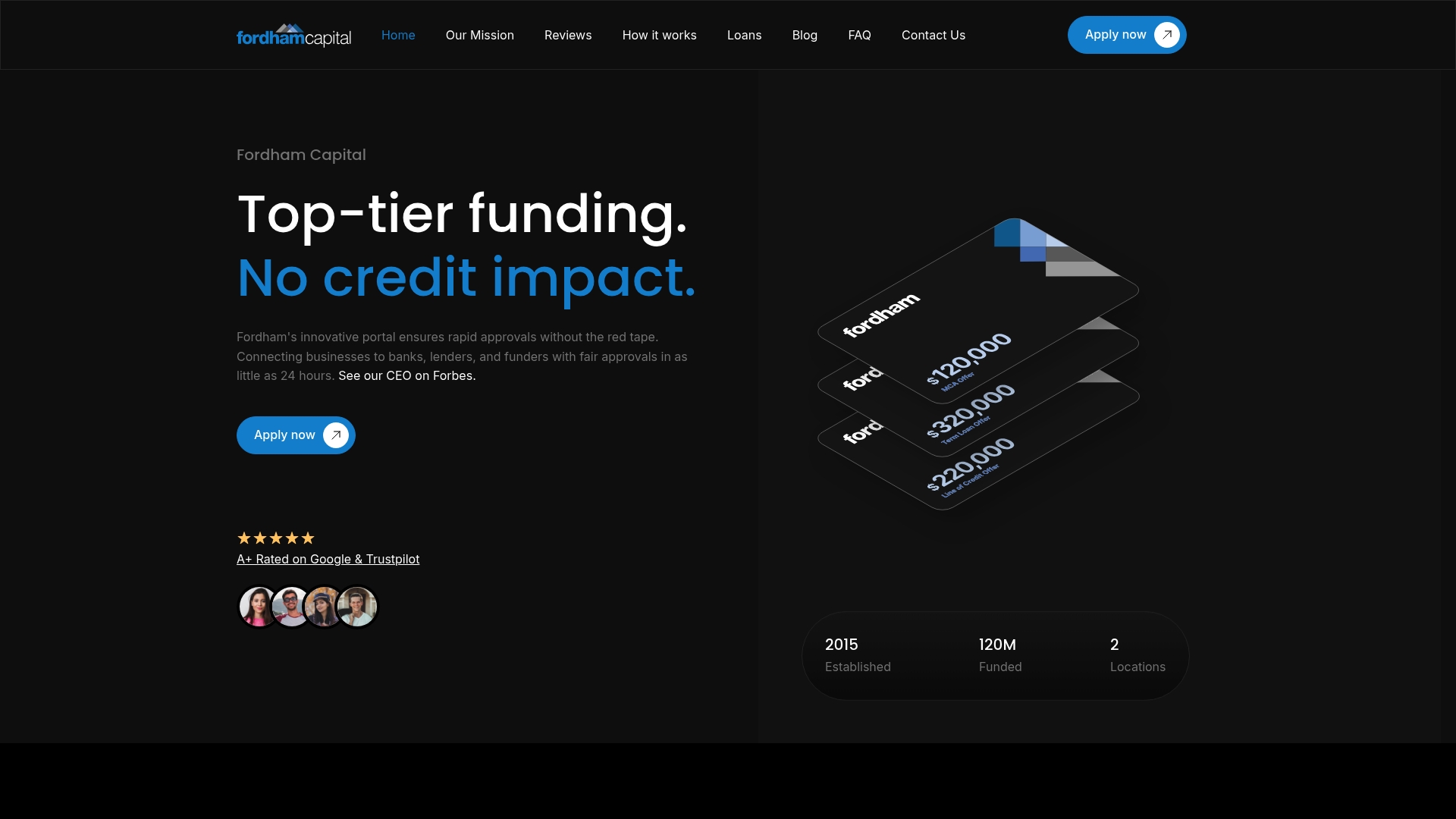
Fordham Capital is an online marketplace, not a direct lender. You complete a one-page application, it does not impact your credit score, and we connect you to a network of banks and alternative lenders. Approvals can come within 24 hours, and no collateral is required for the funding we arrange. We hold an A+ BBB rating and work with small and medium-sized businesses that traditional banks often overlook.
The products on our site are:
If you have gathered the documents above, you can start a funding application at Fordham Capital and see which option fits your LLC.
Our advisors are there to help you choose the product that fits your cash cycle instead of guessing from a rate sheet.
Most LLC owners we talk to believe the hard part is qualifying. In our view, the hard part is the process: a long bank application, weeks of waiting, and a hard credit pull before you even know your options.
That is why we built our process around a one-page application that does not impact your credit score. We believe you should see what is available before you spend a week assembling a package, and that a business should be judged on what it earns today, not only on a perfect credit file.
Our network of banks and lenders lets one application reach many sources, so an LLC that does not fit one lender’s box can be matched with another that suits it. Whether you need an SBA loan, a line of credit or working capital, our approach is to pair the product with the purpose and give you a fast, clear answer.
Get your books in order, know your numbers and tell your story plainly. The rest is matching, and that is what we do.
Rob
It depends on the product and your numbers. Lenders look at revenue, cash flow, credit, time in business and existing debt. SBA and bank loans ask for the most documentation, while lines of credit and working capital financing are usually faster to qualify for.
Often, yes. For SBA loans, owners of 20 percent or more generally must guarantee, and owners under 5 percent are not required to. Terms for other products vary by lender and by the loan agreement you sign.
It is possible. Newer companies and owners with credit blemishes tend to do better with products that weigh recent revenue and cash flow. Explaining past credit issues and showing consistent deposits helps with any lender.
Expect to provide the full package: application, business plan, financial statements, business tax returns, credit information, a clear use of funds and collateral details when assets secure the loan. Larger amounts usually come with closer review of cash flow and often a personal guarantee.
At Fordham Capital, we've made the application process straightforward and reassuring. Dive in and explore your financial options with confidence, knowing there's no impact on your credit score and no obligations. We review your details and offer customized solutions based on what you're looking for.