A draw fee is a charge a lender takes each time you withdraw money from a business line of credit, usually as a percentage of the amount you pull. Typical figures run 1% to 3% of the amount drawn, so a $50,000 draw at 2% costs $1,000 before any interest. Not every line has one, and the ones that do can still be the cheaper choice once you add up everything else. Here is how the fee works, how to calculate it and what to read in the agreement before you draw.
A business line of credit is revolving: the lender approves a limit, you take what you need, repay, and the available balance resets. A draw fee attaches to the moment of taking the money. According to Money’s business line of credit comparison, it is charged each time you withdraw from an active line, often as a percentage of the amount withdrawn.
Think of it as a small origination fee that repeats. One finance provider describes it as essentially an origination fee that borrowers will likely pay the first time they borrow, once the funds have been distributed. Whether it recurs on later draws depends on the agreement.
Two details change the math:
Business lines of credit commonly charge 1% to 3% of the amount withdrawn, and that matches the range one business-finance guide lists for the draw fee on a line of credit. The percentage depends on the lender, the product and your profile.
Here is what that looks like in dollars:
| Amount drawn | Fee at 1% | Fee at 2% | Fee at 3% |
|---|---|---|---|
| $5,000 | $50 | $100 | $150 |
| $10,000 | $100 | $200 | $300 |
| $20,000 | $200 | $400 | $600 |
| $50,000 | $500 | $1,000 | $1,500 |
The $1,000 figure for a 2% fee on a $50,000 draw is the same example the research above gives. The rest of the table is straight multiplication.
You do not need a calculator app. You need three numbers from the agreement and one from your plan.
Step four is the one most owners skip. Say you draw $50,000 at 2% and repay in 60 days. The fee is $1,000, which is 2% of the balance for about two months. Annualized, that is roughly 12% (2% divided by 60/365 of a year), and the interest comes on top. If you carry the same balance for 12 months, the same fee adds only 2% to the yearly cost. The longer you borrow per draw, the less the fee weighs. The shorter and more frequent the draws, the more it weighs.
That is why a line with a low interest rate and a draw fee can cost more than a line with a higher rate and no draw fee, if you borrow in short bursts. The Wall Street Journal’s explainer on small-business loan fees makes the same point: compare fees along with the advertised rate.
Lenders use similar-sounding names for different charges. Sorting them out is half the job of comparing offers.
| Fee | When you pay it | What it covers |
|---|---|---|
| Draw fee | Each time you withdraw | The cost of releasing funds |
| Origination fee | Once, when the line opens | Underwriting and setup |
| Annual fee | Every year | Keeping the line open |
| Maintenance or inactivity fee | When the line sits unused for a set period | Account servicing |
Money’s guide describes the annual, maintenance and inactivity fees in this way: an annual fee is paid yearly to keep the line open, and a maintenance or inactivity fee may apply when an active line is unused for a specified period.
The practical consequence: a line with no draw fee may charge an annual fee, and a line with a draw fee may charge no annual fee. You cannot judge either one from a single line of the fee schedule. For a deeper look at the setup charge, see our guide to business loan origination fees.
There is no single rule. According to the Wall Street Journal’s breakdown, some bank-style lines have no draw fee but may charge interest plus an annual or facility fee. Some online or alternative lines charge a percentage or other fee on each draw. Some products skip conventional interest and use weekly, monthly or factor-style pricing.
That last point matters when you compare. A line priced at 1% to 3% per month is not comparable to a line priced at 8% per year without converting both to the same period. Pricing varies widely by lender and by how unsecured the line is, and we walk through the logic in how lenders price unsecured business loans.
Read the agreement as if you were about to draw today. These are the lines to find:
If anything is unclear, ask the lender or an advisor to explain it in writing before you sign. A question answered before the first draw costs nothing.
Draw in planned amounts. If the fee is a percentage, drawing $30,000 once costs the same as drawing $10,000 three times. But if the schedule has a minimum fee or a flat component, fewer draws win. Plan your cash needs a month ahead where you can.
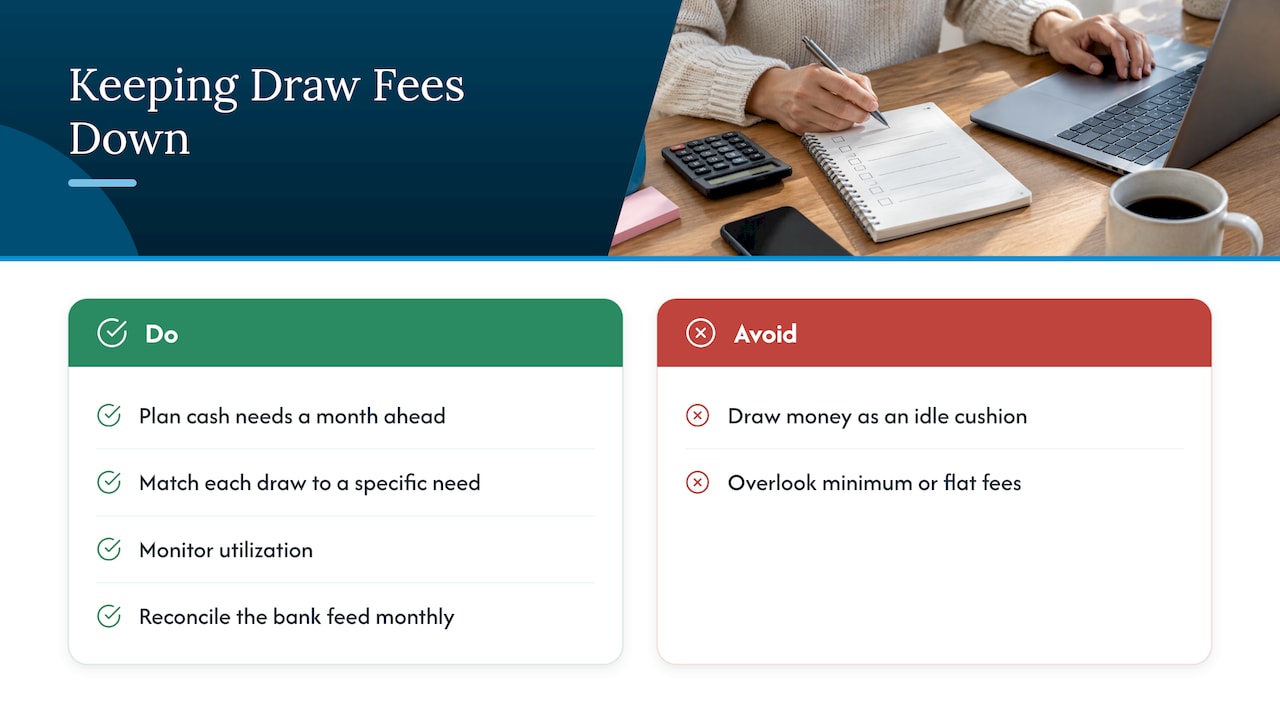
Match the draw to the need. Pull money for a specific purchase or payroll gap, not as a cushion. A 2% fee on money that sits idle in your account is a pure cost. Our guide to small business line of credit uses shows the situations where drawing makes sense.
Watch your utilization. A high balance relative to your limit affects how lenders view you for the next renewal. See line of credit utilization and how to lower it.
Track every draw as it happens. Fees show up on statements under different labels. Reconciling your bank feed monthly lets you catch a charge that does not match the agreement. Bank reconciliation tools for small businesses can import statement files and match charges against your records.
Take two hypothetical lines. These are illustrations, not offers.
You plan to draw $15,000 four times in a year, for a total of $60,000.
Line A is clearly cheaper here, assuming the interest is equal. Now change the plan: you draw $10,000 once and use it for a year. Line A costs $300, and Line B costs $200. Line B wins. Same two lines, opposite answers, because your pattern of use changed. This is why the cost of a line depends on how you borrow, and why a single headline number never settles the question.
Business owners usually come to us because a bank said no or took too long. When they start comparing lines of credit, the draw fee is the line item that surprises them most, because it hides in the fee schedule, not in the headline rate.
We built Fordham Capital as a marketplace so that you fill out one page and see options from a network of banks and lenders, rather than guessing which single lender fits. Our approach is designed around fast answers, no collateral requirements and no impact on your credit score from applying, and we have a person to walk you through what each offer costs.
Our advice is simple: ask for the full fee schedule early, run your own draw pattern through it, and pick the structure that suits how you borrow. A line you understand is a line you can use well.
Rob
If you are comparing lines, we can help you see the options side by side. Fordham Capital connects small and medium-sized businesses to a network of banks and alternative lenders through a one-page application, with no collateral required and no credit score impact from applying. Published pricing on our site shows SBA loans at 8% per year and lines of credit at 1% to 3% per month. Working capital has no published price. Final terms, including any fees, come from the lender that makes the offer.
Ready to see what you qualify for? Start your application at Fordham Capital and review the fee schedule on each offer before you accept.
They are close cousins but not identical. An origination fee is usually charged once when the line opens, while a draw fee is charged when you withdraw funds. Some providers describe a draw fee as essentially an origination fee charged as a percentage, so check whether yours repeats on each draw.
No. Some bank-style lines charge interest and an annual or facility fee but no draw fee, while some online and alternative lines charge a percentage on each draw. The agreement is the only reliable guide, so read the fee schedule for the specific product.
It depends on the lender. Some deduct the fee from the funds you receive, and others add it to what you owe. Ask which applies, because the first means you get less cash than the amount you drew.
Convert it to an all-in cost. Add the draw fee, annual fee, origination fee and interest for your expected borrowing pattern, then compare lines on that total. A fee that looks large on a 30-day balance can look small on a 12-month balance.
At Fordham Capital, we've made the application process straightforward and reassuring. Dive in and explore your financial options with confidence, knowing there's no impact on your credit score and no obligations. We review your details and offer customized solutions based on what you're looking for.