
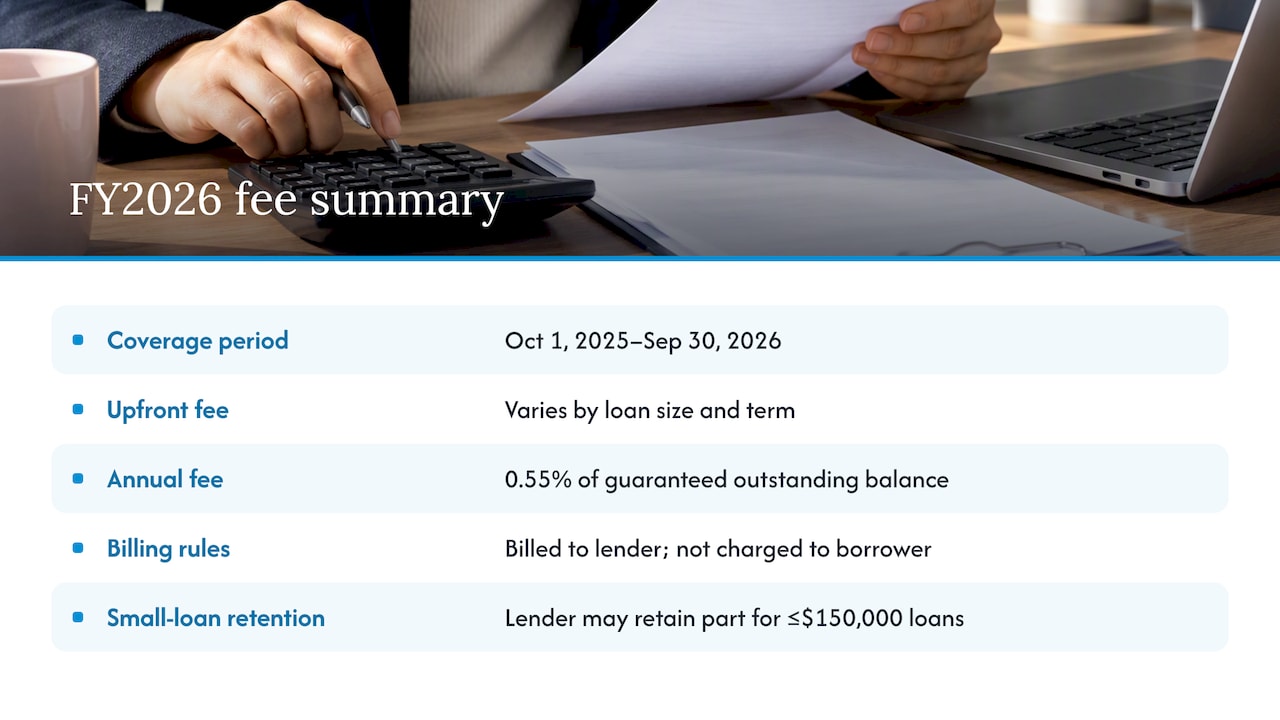
For fiscal year 2026, the SBA charges an upfront guaranty fee that ranges from 0.25% to 3.75% of the guaranteed loan portion, depending on loan size and term, plus a Lender’s Annual Service Fee of 0.55% that lenders cannot pass to borrowers. The SBA bills the upfront fee to the lender, who typically recovers it from the borrower at closing.
TL;DR:
- Manufacturers under NAICS codes 31 through 33 can qualify for a zero upfront guaranty fee on loans of $950,000 or less, relieving most costs at closing.
- Veteran-owned SBA Express borrowers may also avoid upfront fees entirely for loans under the same thresholds, pending eligibility confirmation.
- The upfront guaranty fee is calculated on the guaranteed portion of the loan, which depends on the loan amount and the SBA guarantee percentage, usually 75% or 85%.
- Lenders retain a 0.55% annual service fee of the outstanding guaranteed balance, which they cannot pass to borrowers and bills are scheduled within specific timeframes based on loan maturity.
- Borrowers should verify fee disclosures via Form 159 and confirm lender fee breakdowns early to avoid hidden or improperly disclosed charges.
The FY2026 fee structure applies to 7(a) loans approved between October 1, 2025 and September 30, 2026. For loans with maturities over 12 months, there are different upfront guaranty fee bands depending on the loan size and term, including a lower fee for short-term loans.
On top of the upfront fee, the SBA charges lenders a Lender’s Annual Service Fee of 0.55% of the outstanding balance of the guaranteed portion of each 7(a) loan. This fee is billed to the lender throughout the life of the loan, and lenders are not permitted to pass it on to borrowers. That distinction matters for anyone reviewing a loan estimate: any annual service fee line item charged directly to you is worth questioning.
For loans of $150,000 or less, lenders may retain a portion of the upfront guaranty fee rather than remitting the full amount to the SBA. This retention rule exists to offset the smaller dollar servicing lenders receive on smaller loans, and it does not change what the borrower pays at closing.
The upfront fee is not applied to your full loan amount. It applies only to the guaranteed portion, which is your loan amount multiplied by the SBA’s guarantee percentage for that loan (commonly 75% or 85%, depending on loan size and type).
That amount falls in the $150,001 to $700,000 band, so the fee is 3% of $375,000, or $11,250.
The fee is 3.5% on the first $1,000,000 ($35,000) plus 3.75% on the remaining $20,000 ($750), for a total of $35,750.
Multiple loans within 90 days: when an applicant, including affiliates, receives two or more 7(a) loans with maturities over 12 months within a 90-day window, NAGGL guidance confirms the SBA treats those loans as one combined loan for guaranty and upfront fee purposes. Working Capital Pilot (WCP) and Export Working Capital Program (EWCP) loans follow modified combination logic, which can change whether a borrower still qualifies for fee relief.
Several carve-outs can eliminate the upfront fee entirely for eligible borrowers:
Eligibility for these exceptions depends on precise NAICS classification, loan size thresholds, and timing relative to other loans the same borrower or its affiliates have taken out.
Pro Tip: Before signing a term sheet, ask your lender to confirm your NAICS code and run the fee calculation both with and without aggregation, so you know exactly which fee band applies.
Lenders must remit the upfront guaranty fee to the SBA on a set schedule under 13 CFR §120.220:
If a loan is approved but never disbursed, the borrower is generally entitled to a refund of any fee already collected, and the lender can request cancellation and refund of the amount it remitted to the SBA.
Beyond the guaranty fee, lenders may charge reasonable packaging, document preparation, and pro rata technology fees. They may not, however, pass along the Lender’s Annual Service Fee, which remains the lender’s own cost of doing business with the SBA.
Any fee paid to a third-party agent, such as a loan packager or consultant, must be disclosed on SBA Form 159. The form requires signatures from the borrower, lender, and agent, and any compensation exceeding $2,500 requires supporting documentation to be uploaded with the loan file.
Watch for these red flags:
Pro Tip: Ask your lender directly: “Can I see the completed Form 159 and a breakdown of every fee before I sign?” A lender confident in its disclosures will hand it over without pushback.
Ask early whether you qualify for manufacturer or veteran fee relief, and request a signed Form 159 if any third party is involved in your application.
Fordham Capital emphasizes upfront clarity with a streamlined application and extensive experience providing funding to small and medium-sized businesses. Working with an experienced originator who documents fee disclosures in writing, rather than leaving them to a verbal promise, is one of the simplest ways to avoid surprise charges at closing.
— Rob
Fordham Capital connects small business owners to a network of banks and alternative lenders offering SBA Loans at 8% per year, Lines of Credit at 1% to 3% per month, and Working Capital financing, all through a single one-page application that does not affect your credit score.
If you want help estimating how a guaranty fee will land on your specific loan size, or confirming that a lender’s disclosures match what the SBA actually requires, our team can walk through the numbers with you before you sign anything.
Start with our SBA loan page to see what you qualify for and get a same-day response. For a broader look at qualification standards, see our guide on SBA loan requirements.
Confirm any lender’s fee quote against the primary sources: the SBA’s FY2026 fee notice, the 7(a) fee calculator, 13 CFR §120.220, and Form 159 guidance. Bookmark these before you compare lender quotes.
This article is general information, not a substitute for advice from a qualified financial advisor. Consult a qualified financial professional about your own circumstances before acting on anything here.
For fiscal year 2026, the upfront guaranty fee ranges from 0.25% for short-term loans to as much as 3.75% of the guaranteed portion for larger, longer-term 7(a) loans, according to the SBA’s FY2026 fee notice.
It is a separate requirement from the guaranty fee schedule covered above.
You do not pay the SBA directly. Your lender remits the fee to the SBA on your behalf, within 10 business days for short-term loans or 90 days for longer-term loans under 13 CFR §120.220, then typically recovers its cost from you at closing.
This requirement applies regardless of the loan’s size or guaranty fee band.
The clearest paths are to qualify as a manufacturer under NAICS codes 31 through 33 for loans of $950,000 or less, or to qualify as a veteran-owned business for an SBA Express loan, both of which can bring the upfront fee to 0% under the FY2026 exceptions. Confirming eligibility and loan timing with your lender before closing is the best way to lock in any available relief.
At Fordham Capital, we've made the application process straightforward and reassuring. Dive in and explore your financial options with confidence, knowing there's no impact on your credit score and no obligations. We review your details and offer customized solutions based on what you're looking for.