A business loan covenant is a promise you make to a lender: do certain things, or avoid certain things, for as long as the loan is outstanding. Break the promise and the lender may be able to treat the loan as in default, even if every payment arrived on time. The way to stay safe is simple. Read the covenant section before you sign, know which ones are tested by numbers, and track those numbers all year. If you are comparing funding options, our one-page application connects you with a network of banks and lenders, so you can see offers and their terms side by side before you accept anything.
The Minnesota Department of Employment and Economic Development describes a covenant as a borrower’s promise to take or not take specified actions throughout the life of the loan. The same guide explains that covenants help the lender monitor the loan and assure a return, and that failing to comply can trigger a default.
That last point surprises many owners. You can be current on every payment and still be in default because a ratio slipped, an insurance policy lapsed or a required report was late. Covenants sit in the loan agreement, not in the marketing material, so they are easy to skim past when you are focused on the rate and the payment.
Lenders include them for a practical reason. A loan may run for years, and a lot can change in that time. Covenants give the lender a way to see trouble coming and a seat at the table before it becomes a missed payment.
The Minnesota guide names affirmative, negative and financial covenants as the three general categories. A 2024 presentation by the law firm Duane Morris for the Association of Corporate Counsel uses the same three groups and adds that financial covenants can be affirmative or negative in how they operate.
| Type | What it requires | Everyday example |
|---|---|---|
| Affirmative | You must do something | Notify the lender of specified events, keep insurance in place, allow inspection of books and records |
| Negative | You must not do something | Take on additional debt, sell key assets, pay out cash beyond an agreed limit |
| Financial | You must meet a measurable test | Stay under a maximum leverage ratio or above a minimum coverage ratio |
The notification, insurance and inspection examples in the affirmative row come from the Duane Morris presentation. The negative examples are typical restrictions on borrowing, asset sales and distributions.
These are the least dramatic and the most often missed. The Minnesota guide lists common themes: paying taxes and other obligations, maintaining corporate existence and keeping property needed to run the business in good condition. It also points to preserving collateral and complying with applicable law.
None of that is hard if someone owns it. The failure is usually administrative: a renewal that slips, an insurance certificate nobody sent, a financial statement due on the 45th day that nobody had on the calendar.
Negative covenants protect the lender’s position by restricting moves that could weaken your ability to repay. Typical examples include limits on taking on more debt, selling or pledging assets, merging, or paying large distributions to owners. They matter most when you are growing, because growth often involves exactly these moves: financing a truck, buying a competitor’s customer list, opening a second location.
Financial covenants tie your loan to your performance. They are the ones most likely to catch an owner off guard, because they can be breached by a bad quarter rather than a bad decision.
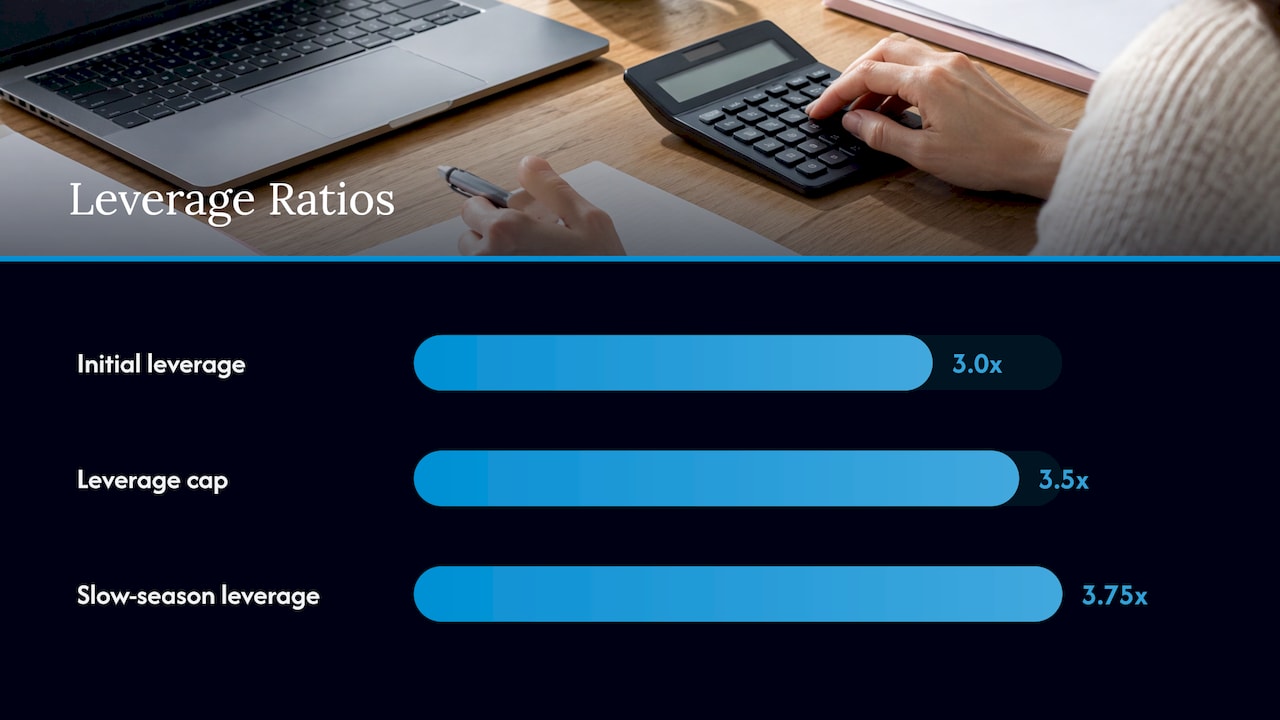
Law firm Proskauer’s overview of financial covenants explains the three most common tests. A leverage ratio sets a maximum ceiling. Interest coverage, which divides EBITDA by interest expense, has a minimum floor. Fixed-charge coverage divides EBITDA, sometimes adjusted, by specified fixed charges, and also has a minimum floor.
Here is a hypothetical example to make the mechanics concrete. The numbers are illustrative, not from any real agreement.
That is the difference between a test that runs on a schedule and one triggered by an action. A scheduled test can be failed by declining cash flow alone. An action-triggered restriction, such as a cap on new borrowing, only bites when you do the thing.
Coverage works the other way around. If your agreement requires debt service coverage of at least 1.25x, you need $1.25 of operating income for every $1.00 of debt payments. At $250,000 of income and $200,000 of annual payments, you sit exactly at the line. Our guide on hitting 1.25x DSCR in small business loan underwriting walks through how that ratio is built and why it shows up in so many approvals.
Proskauer also notes that these tests act as early-warning indicators. Leverage, interest coverage and fixed-charge coverage can show deterioration before a missed payment and open a restructuring conversation. Seen that way, a covenant is also a dashboard you can use on your own business.
Monitoring is mostly paperwork on a schedule. The Minnesota guide says borrowers may have to submit periodic borrowing certificates stating that they comply with the financial covenants. Expect quarterly or annual financial statements, and for some structures, more frequent reporting.
Lines of credit tied to receivables and inventory are monitored more closely. SBA best-practice guidance for CAPline working capital loans says lenders should collect and test financial statements consistently and on time, and that borrowing-base CAPlines require monthly reports with receivables aging and inventory support. The same guidance says CAPlines above $1,000,000 call for an annual field examination that includes physically verifying and sampling receivables and inventory.

The practical lesson: the more your loan depends on assets that change daily, the more often you will be asked to prove your numbers. Build the reporting calendar the day you sign.
The consequences depend on the agreement, but the range is wide. According to the Minnesota guide, a covenant failure can trigger a default that allows the lender to terminate the loan, accelerate the entire balance and foreclose on pledged collateral.
Duane Morris draws a useful distinction. A “default” may only become an “event of default” after a specified cure period or notice, and it is the event of default that unlocks the lender’s remedies. The remedies it lists include cancelling future advances, imposing default interest, accelerating unpaid obligations, foreclosure and setoff against your deposit accounts.
Setoff deserves attention if your operating cash sits at the same bank as the loan. The lender may be able to reach those deposits.
The cheapest time to fix a covenant is before the agreement is signed. The Minnesota guide advises working with personal legal counsel and using the document to frame questions for counsel, bankers, accountants and other advisers. That is sound advice for any loan.
Use this checklist when you read the draft:
For a wider look at the rest of the agreement, our checklist on business loan agreement terms to check before you sign covers fees, prepayment and default language.
CFO.com treats covenant compliance as part of regular forecasting rather than a quarterly reconciliation. Rolling forecasts give you time to adjust operations, speed up collections, defer spending or contact your banker. For a small business, that can be a simple spreadsheet:
How lenders read your numbers also shapes what terms you are offered in the first place. Our pieces on what lenders look for in loan approvals and how lenders evaluate business health show which metrics they weigh, which are often the same metrics a covenant later tests. Revenue is one of them, covered in how business revenue affects loan eligibility.
Covenants vary from lender to lender and product to product, so the best way to avoid a bad fit is to see more than one offer. Fordham Capital is an online marketplace, not a direct lender. You complete one short application, and we connect you with our network of banks and alternative lenders. Our process is designed to deliver approvals within 24 hours, with no credit score impact and no collateral required.
The products on our site include SBA loans at 8% per year, business lines of credit at 1-3% per month, and working capital financing, which has no published price. Each lender sets its own agreement, so read the covenants in any offer with your attorney and accountant before you accept. You can start on fordhamcapital.com and an advisor can walk you through the offers you receive.
Our view on covenants
Most owners we talk with focus on the rate and the monthly payment, and the covenant section gets a quick skim. We think that order is backwards. A covenant decides how much freedom you have to run the business for the next several years, and a tight one can cost more than a point of interest.
That is why we built our process around choice. One application reaches a wide network of banks and lenders, so you are not forced to accept the first set of terms that arrives. Fast answers matter because a business that needs capital cannot wait weeks, but fast should never mean unread.
Our advice is practical. Run every ratio against your own last four quarters. Ask what the cure period is. Put the reporting dates on a calendar the day you sign. Then pick the offer that fits the way your business really earns money, not the way it earns in its best month.
Rob
Common examples include paying taxes and other obligations on time, maintaining corporate existence and keeping the property needed to operate the business, carrying insurance, and giving the lender notice of specified events. Financial examples include a maximum leverage ratio and a minimum coverage ratio. Negative examples include limits on extra debt or asset sales.
Affirmative, negative and financial. Affirmative covenants require you to take actions, negative covenants require you to refrain from actions, and financial covenants require you to meet measurable tests such as leverage or coverage ratios. Financial covenants can also act in an affirmative or negative way, depending on how they are written.
Not in the same form. Larger and longer loans tend to carry more detailed financial tests, while shorter products may rely mostly on standard obligations such as keeping the business in good standing and paying what is due. Every lender writes its own agreement, so read the covenant and default sections of each offer and have your attorney review them.
It depends on the agreement. A breach may be a default, which can become an event of default after a cure period or notice. Remedies can include cancelling future advances, default interest, acceleration of the balance, foreclosure and setoff against deposits. Contact your lender early and involve your attorney before signing any waiver.
At Fordham Capital, we've made the application process straightforward and reassuring. Dive in and explore your financial options with confidence, knowing there's no impact on your credit score and no obligations. We review your details and offer customized solutions based on what you're looking for.