An angel investor gives you money in exchange for a piece of your company. A business loan gives you money that you repay with interest, and you keep full ownership. The right choice depends on whether your business can carry monthly payments, how much control you want to keep, and how early your company is.
This guide compares the two on the points that decide the outcome: repayment, ownership, control, cost, and who qualifies. It also shows when a business uses both.
| Factor | Angel investor | Business loan |
|---|---|---|
| What you give | A share of the company, or convertible debt | Interest and fees |
| Repayment | Generally none on a fixed schedule; investors look for a return when the company grows and exits | Regular payments over a set term |
| Ownership | Diluted | Unchanged |
| Control | May include board seat, approval rights or vetoes | Lender does not run the business |
| Collateral | Not applicable | May be required, depending on the loan |
| Typical stage | Pre-seed, seed, Series A | Established, revenue-generating companies |
| Speed | Pitching, screening, due diligence, negotiation | Depends on lender and product |
The sections below explain each row.
The SEC describes angel investors as high-net-worth individuals who usually invest their own money in early funding rounds such as pre-seed, seed and Series A. They typically take equity or convertible debt in return. The Angel Capital Association adds that angels generally receive an equity share and commonly see returns when the company grows and later sells or merges.
That last point matters. An angel is not lending you money. They are betting that your company will be worth far more in a few years, and they expect to be paid from that outcome.
Angel groups usually run applicants through several stages. The Angel Capital Association lists an application, pre-screening, formal screening, an investment meeting, due diligence, and a negotiated term sheet. Expect weeks or months of conversations, not a quick decision, and expect to give up equity at the end of it.

Founders who want to understand what each early round looks like can read this early-stage funding rounds list. Accelerators are another route to early capital, and some offer perks such as Y Combinator and Techstars deals for the founders they accept.
The two are often confused. The SEC explains that angels generally invest their own money and tend to join early rounds. Venture capital funds are private funds that invest in rapidly growing companies, monitor those investments, and seek exits for their own investors. If your business is a steady, profitable shop, service company or distributor, neither is likely to be a natural match for the way you grow, and a loan is usually the more direct tool.
SCORE’s financing guide lists angel investments at $100,000 to several million dollars. It names advice from the investor as an advantage, and equity dilution and possible investor involvement as disadvantages.
A business loan is debt. The borrower receives capital and repays principal and interest on an agreed schedule while keeping ownership of the business. FindLaw makes the same point from the legal side: the borrower remains the owner, and the lender gets no share of profits and no say in running the company. Default is the exception, since pledged collateral can be at risk.
For an owner who built the company and wants to keep every decision, that clarity is the main draw. You borrow, you repay, and when the balance hits zero the relationship ends.
If you are weighing secured against unsecured credit, our guide on unsecured vs. secured lines of credit walks through the trade-offs.
Debt requires repaying principal with interest over a set period, and that can restrict cash flow. Equity avoids fixed repayment and shares the downside with investors, at the price of dilution. FindLaw notes that equity investors typically do not have to be repaid if the business fails.
The practical question is simple: can your monthly revenue cover the payment with room to spare? If yes, debt keeps your cap table clean. If your business has no revenue yet, a fixed payment may be hard to carry.
With a loan, your ownership percentage does not change. With an angel round, it does, and each later round can dilute it again. A 10% to 25% stake is a common range for angel deals in some markets, but the figure varies a lot by deal, so treat any single number as a rough guide.
Control is more than a percentage. The Angel Capital Association explains that angel terms can include board representation, approval rights or vetoes, so an investor with a small stake can still have a real voice in operational decisions. Read those negotiated rights closely before you sign.
The sticker price of debt is easy to read: an interest rate and fees. Equity looks free until the company succeeds, then the share you gave away may be worth far more than interest would have been.
Two things are worth knowing about the cost of a loan:
Our published pricing, for reference: SBA loans through our network are listed at 8% per year, and lines of credit at 1-3% per month. Working capital has no published price. Your actual offer depends on the lender and your business profile.
Angels look at the team, the market, and the chance of a large exit. Revenue is helpful but not always required. What they want is a story in which their stake could multiply. If your business is built for steady profit rather than a big sale, that story is harder to tell.
Lenders look at your ability to repay. The FDIC says banks rank financial position, credit information, location, collateral and guarantees, industry, and qualitative factors such as the business plan or management experience. In its 2024 survey, 74% to 82% of small banks ranked financial position as the most important factor across loan sizes.
The FDIC also describes underwriting through the five Cs: character, capacity, capital, collateral and conditions. Loan packages often include financial statements and tax returns, and lenders frequently pull credit reports. Capacity covers cash flow, revenue and profitability.
To see how lenders weigh these, read business loan approval factors, our breakdown of the 1.25x DSCR benchmark, and what credit score you need to qualify.
Some loans need it. The FDIC notes that lenders may evaluate or require collateral and, depending on the business, may look at owners’ personal assets. Unsecured funding shifts the weight onto the owner’s creditworthiness, and the SBA notes lenders may charge more because their risk is greater. That is why many owners look for financing that does not tie up equipment, inventory or property. See why collateral requirements block business loans and why collateral-free loans suit businesses.
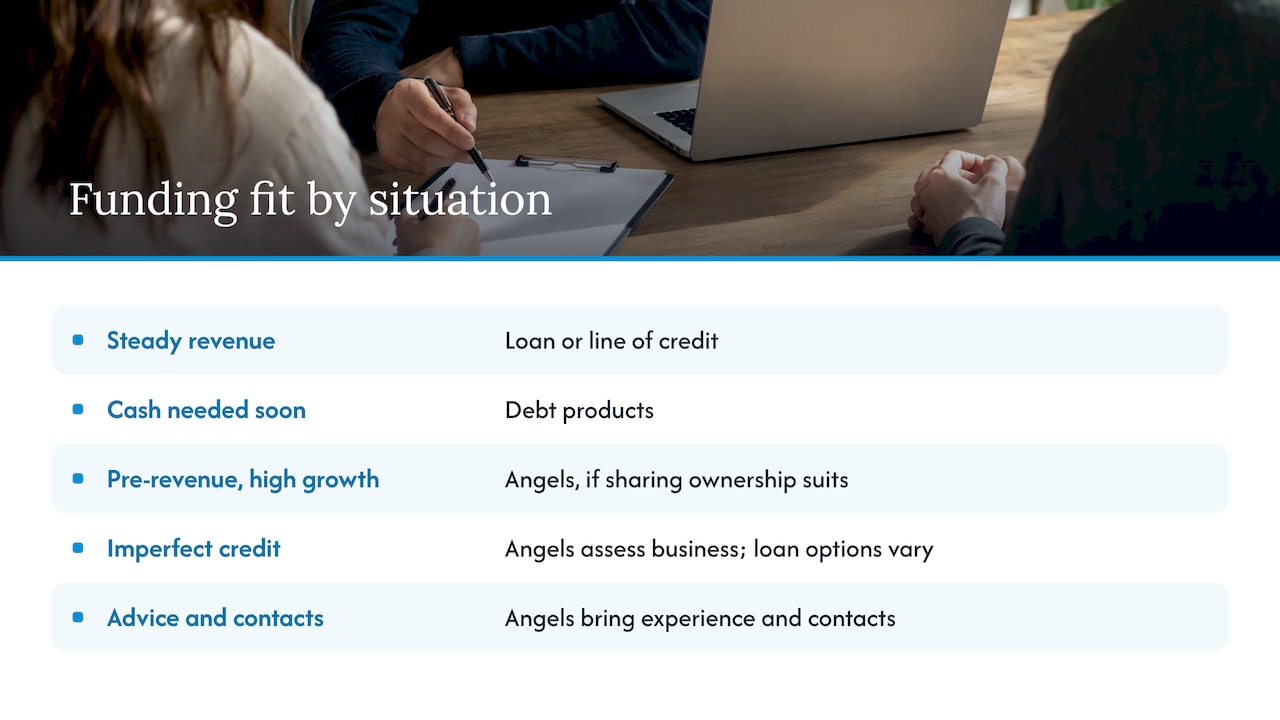
You have steady revenue and want to keep control. A loan or line of credit fits. Traditional lending generally suits an established company that can show stable cash flow and afford recurring payments. You keep your ownership and your decisions.
You need cash for a specific purpose within days or weeks. Payroll, inventory, equipment repair or a big order. Debt products are built for this. An angel process, with screening and due diligence, is not.
You are pre-revenue with a high-growth idea. This is where angels operate. A loan may be hard to carry with no income, so equity can make sense if you are comfortable sharing ownership.
Your credit is imperfect. Angels do not run a credit check the way a lender does, but they do examine the business closely. Loan options exist across a range of credit profiles, and a marketplace can show you which lenders may be a fit. The SBA notes that qualifying for an unsecured line of credit generally takes favorable credit scores and low credit utilization, so knowing your numbers first helps.
You want advice and introductions. Angels often bring experience and contacts. That is a real advantage of equity. If you want mentorship without selling a stake, you can look for advisors separately.
For more on how early businesses stack capital, see our early-stage capital examples and why investor funding differs from business loans.
Many companies end up with both equity and debt. The University of California San Diego toolkit says founders should weigh cash-flow capacity, repayment with interest, collateral, personal guarantees, covenants, dilution and control before combining them. In practice:
Often a founder raises equity to build the product, then uses debt once revenue is predictable, so that growth capital does not cost more ownership.
Our perspective
We talk to owners every week who ask this exact question, and the pattern is consistent. The owner who already has sales and a clear use for the money rarely wants a partner. They want capital, a clear payment, and their company left alone.
That is why we built Fordham Capital around debt-style funding: one short application, access to a wide network of banks and lenders, and an approach designed so that applying does not affect your credit score. We act as an intermediary, not a lender, so you can see offers from several sources instead of knocking on one door.
Equity has its place for businesses that are not yet ready to carry payments. But when you have revenue, we believe keeping 100% of your company while you grow is a strong position to be in.
Rob
If you have revenue and want capital while keeping full ownership, Fordham Capital connects small and medium-sized businesses with banks and alternative lenders through a one-page application. Our SBA loan is listed at 8% per year, our line of credit at 1-3% per month, and we also arrange working capital financing. Our application is designed to avoid any impact on your credit score, and our funding options are designed to work without collateral. We hold an A+ BBB rating.
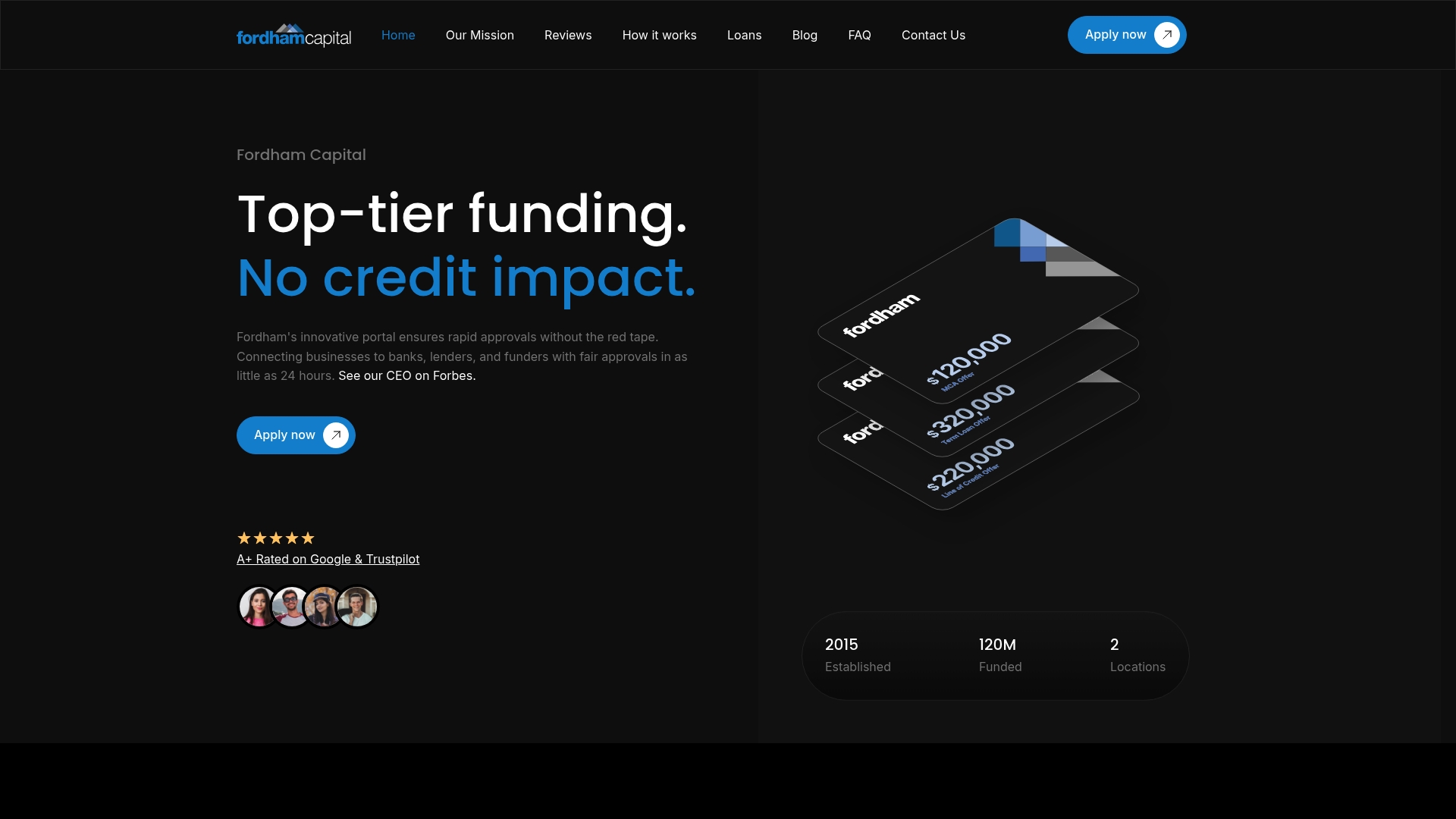
See your funding options at Fordham Capital and find out what you may qualify for, often with a response within 24 hours.
Neither wins in every case. An angel investor suits an early, high-growth company that cannot yet carry payments and is willing to share ownership. A loan suits a business with revenue that wants to keep ownership and control.
Not on a monthly schedule. Angels take equity or convertible debt and expect a return when the company grows and is sold or merges. In exchange you give up part of the company and may accept investor approval rights.
Sometimes. Lenders weigh financial position, cash flow, credit and collateral, and different lenders weigh them differently. A marketplace can match you to lenders whose requirements fit your profile, and it helps to review your credit and financials before you apply.
No. According to the SEC, angels generally invest their own money in early rounds, while venture capital funds are private funds that invest in rapidly growing companies and seek exits for their own investors.
At Fordham Capital, we've made the application process straightforward and reassuring. Dive in and explore your financial options with confidence, knowing there's no impact on your credit score and no obligations. We review your details and offer customized solutions based on what you're looking for.