Working capital loan rates are not one number. The rate you are quoted depends on the type of financing, how the lender prices it (a yearly rate, a monthly rate or a flat fee), and how often you repay. The fastest way to know what you will pay is to see offers from several lenders side by side. Fordham Capital does that with one short application that is designed not to affect your credit score, and it connects you with a network of banks and lenders. Our published pricing starts from the reference points below: 8% per year for an SBA loan and 1-3% per month for a line of credit.
This guide explains how to read those numbers, what moves them, and how to compare offers that look nothing alike.
A working capital loan pays for the everyday costs of running a business: payroll, inventory, rent, supplier invoices, a slow month. The Federal Reserve Banks’ 2026 Report on Employer Firms found that 56% of firms seeking financing did so to meet operating expenses, so this is the most common reason small businesses borrow.
Because the product is so common, lenders have built several versions of it, and each one prices differently:
The same $50,000 can therefore be described as “8% a year,” “1.5% a month” or “a $6,000 fee.” None of those can be compared until you turn them into dollars over the same period. We show how in the worked examples further down.
Fordham Capital is an online marketplace, not a direct lender. We connect small and medium-sized businesses with banks and alternative lenders, and the lender that funds you sets the final terms in its offer. These are the pricing reference points on our site:
| Product | Published price | How it is expressed |
|---|---|---|
| SBA loan | 8% per year | Yearly rate |
| Line of credit | 1-3% per month | Monthly rate on the amount drawn |
| Working capital | Set in the lender’s offer | Stated in the offer you receive |
The 8% yearly SBA figure and the 1-3% monthly line-of-credit figure look far apart, but they measure time differently. Multiply a monthly rate by 12 for a rough simple-interest yearly equivalent: 1% a month is about 12% a year, and 3% a month is about 36% a year. What you get in return is speed and flexibility, since a line of credit can be drawn when you need it and you pay interest only on what you use.
If you want the lowest published rate, the SBA route deserves a look. The rules are public. Under the SBA’s regulations in 13 CFR Part 120, 7(a) variable rates are negotiated between you and the lender but capped above a base rate. The permitted spread ranges from 3.0 to 6.5 percentage points, depending on loan size. The rule also limits how often a variable rate can move: no more than monthly, with the first change allowed on the first calendar day of the month after the loan is first disbursed.
Three points follow from that:
SBA proceeds can also fund working capital, inventory, supplies and raw materials, subject to program terms, according to the same regulation (§120.120). If you want the detail on the current base rate, read our guide to SBA rates after the March 1 base rate rule. For what the money may and may not be used for, see what you can do with SBA loan proceeds.
Lenders price risk. The inputs they weigh are the same across most products, though each lender weighs them differently:
This is why we advise owners to avoid anchoring on an average rate from an article. Your numbers decide your offer. What you can do is make those numbers look as strong as they are: clean bank statements, current tax filings and a clear statement of what the money is for.
People often ask whether 20% interest on a business loan is high. There is no universal answer, because the figure means different things on different products. 20% a year on a multi-year term loan is a different cost from 20% charged as a flat fee on a six-month advance. The latter works out to a much higher yearly rate, because you repay the principal quickly and the fee does not shrink.
A fairer test is to ask three questions:
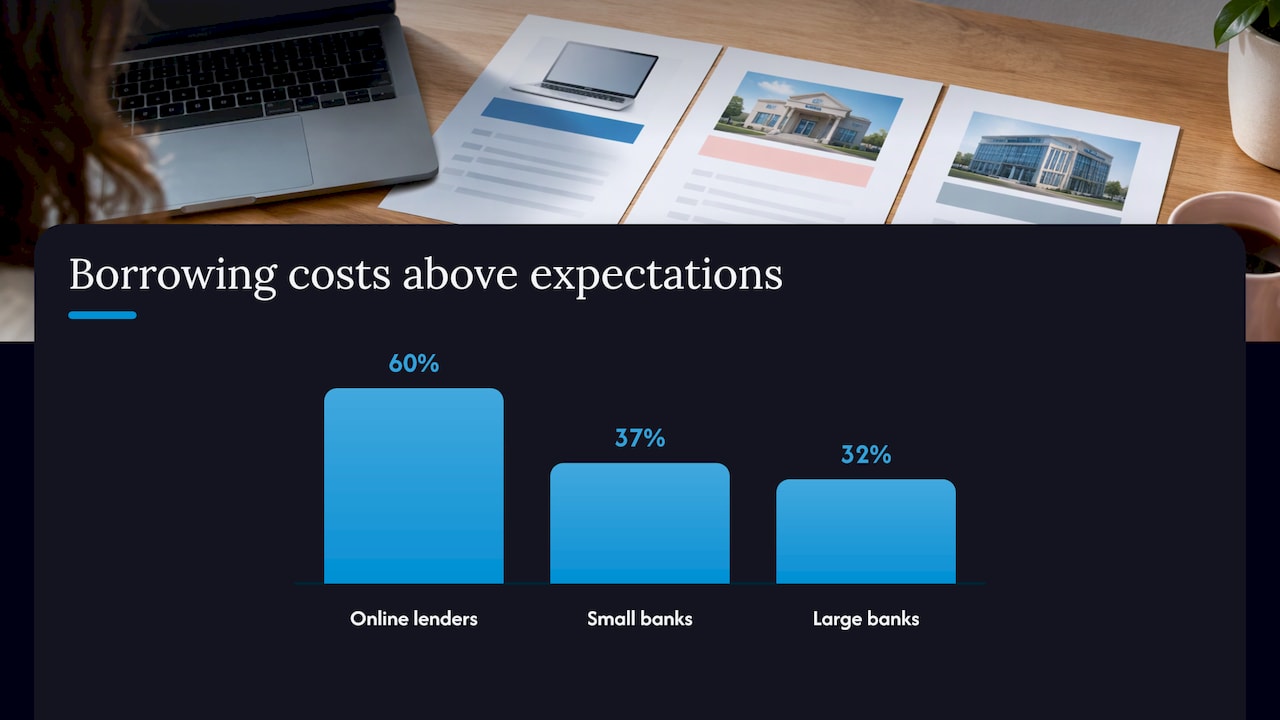
The Federal Reserve Banks’ survey backs up why this matters. In its 2026 report, 60% of online-lender borrowers said actual borrowing costs were higher than they expected, compared with 37% at small banks and 32% at large banks. Among online-lender applicants, 46% named high interest rates as a challenge and 38% named unfavorable repayment terms. The lesson is to price the whole offer, not the headline.
The examples below use simple interest to keep the arithmetic visible. They use our published reference rates and are illustrations, not quotes. Actual repayment depends on the lender’s terms, the schedule and any fees.
Example 1: SBA loan at 8% per year. You borrow $100,000. One year of interest at 8% is $8,000, or about $667 a month, before any packaging or servicing fees. Because SBA loans are usually repaid over a longer term, the interest portion falls as you pay down the balance.
Example 2: line of credit at 1-3% per month. You draw $40,000 for 60 days to buy inventory ahead of a busy season.
| Monthly rate | Interest per month | Interest over 2 months |
|---|---|---|
| 1% | $400 | $800 |
| 2% | $800 | $1,600 |
| 3% | $1,200 | $2,400 |
If the inventory turns into $60,000 of sales within those two months, even the top of the range is a small share of the revenue it generated. If you repay the draw sooner, you pay less, since interest runs only on what you have drawn and only while you have drawn it.
Example 3: a flat fee. An offer of $50,000 repaid as $58,000 over six months costs $8,000. That is 16% of the amount, but because you are repaying throughout the six months, the yearly equivalent is considerably higher. This is the type of offer where you should ask for the total repayment and the payment schedule in writing before you compare it with a yearly rate.

Use the same checklist on every offer, whoever makes it:
If you are unsure whether SBA financing or a conventional route fits, our comparison of SBA loans and conventional loans and the overview of SBA 7(a) versus 504 set out the differences. For a plain-language primer on the product itself, start with what a working capital loan is.
A lower score does not shut you out of working capital. It changes which lenders will fund you and what they charge. Lenders that focus on revenue and cash flow tend to put more weight on your deposits than on your score, and some offers need no collateral. Fordham Capital’s application is built for this situation: it is one page, it is designed to avoid a credit score impact, and it reaches a wide network of banks and lenders, so one application can surface more than one kind of offer.
Before you apply anywhere, two habits help your pricing: keep business and personal accounts separate, and have your recent bank statements ready. If you are weighing SBA eligibility, our walkthrough of SBA loan requirements shows what lenders look for.
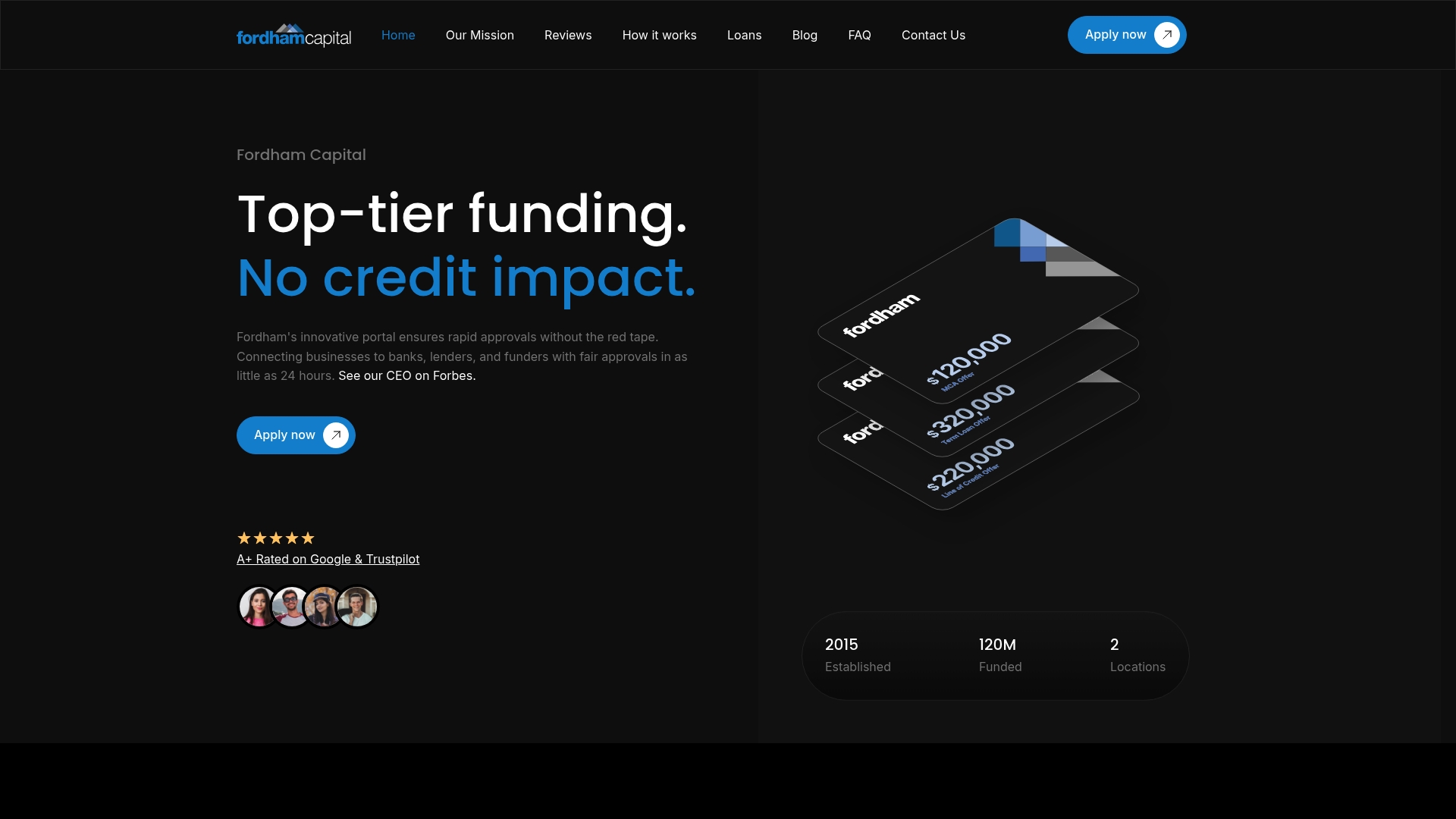
The hard part of comparing working capital loan rates is that each lender quotes in a different format, and you rarely see more than one or two offers. Fordham Capital is a marketplace that connects small and medium-sized businesses with banks and alternative lenders through a one-page application. We offer SBA loans, lines of credit and working capital financing, and approvals can come within 24 hours. No collateral is required, and the application is designed not to affect your credit score. We hold an A+ rating with the BBB and have funded over $120M.
If you want to see what your own numbers qualify for, you can start your application at Fordham Capital. A personal advisor supports the process, so you can ask how any offer compares in total dollars before you accept.
Most owners ask us for “the rate,” and the honest answer is that the rate is the second question. The first is what the money has to do and how fast the business needs it. A line of credit at 1-3% a month can be the right tool for a short inventory run, and an SBA loan at 8% a year can be the right tool for a long-term need. The mistake is choosing on the headline figure alone.
That is why we built the process around a single page and a network. You should not have to fill out ten applications, or hurt your credit score along the way, just to see what is available to you. Banks are slow and often overlook smaller businesses. Our approach is to put your application in front of many lenders, give you the offers in dollars, and let you pick the one that fits your cash flow.
Our advice is simple: ask for the total repayment, the schedule and the fees on every offer, and set them next to what the funding will earn you. When the numbers work, move quickly. In a lot of cases, speed is what turns a financing cost into a profitable decision.
Rob
It depends on the product. Our published pricing is 8% per year for an SBA loan and 1-3% per month for a line of credit. Rates on working capital financing are set in the lender’s offer, and they move with your revenue, time in business, credit and repayment terms. Compare offers by the total dollars you repay.
Yes, if the rate is variable. A variable rate follows a stated base rate, and on SBA guaranteed loans it can change no more often than monthly, according to 13 CFR Part 120. A fixed rate stays as written in your agreement. Read the note for the benchmark and the adjustment schedule.
Only after you convert them. As a rough guide, multiply the monthly rate by 12 for a simple yearly equivalent, so 1% a month is about 12% a year. Then add fees and compare the total repaid on the same amount over the same period.
Often, yes. Some lenders in our network fund without collateral and weigh your revenue and cash flow alongside your credit. Our one-page application is designed not to affect your credit score, so you can see what is available before you commit.
At Fordham Capital, we've made the application process straightforward and reassuring. Dive in and explore your financial options with confidence, knowing there's no impact on your credit score and no obligations. We review your details and offer customized solutions based on what you're looking for.