A revolving business line of credit gives your company a borrowing limit that you draw on when you need cash, repay, and draw on again. You pay interest only on what you use, and the limit refills as you repay. At Fordham Capital, you can start with a one-page application. Our network of banks and lenders is built for small and mid-sized businesses that traditional banks tend to overlook, and approvals can come within 24 hours, with no credit score impact and no collateral required.
This guide explains the mechanics in plain terms, shows what a line costs using a worked example, covers what lenders look for (including with imperfect credit or a young company), and walks through the application step by step.
The Office of the Comptroller of the Currency (OCC), the federal regulator of national banks, describes a business line of credit this way: the lender sets a borrowing limit, you take draws as needed instead of receiving a lump sum, and the terms are revolving and subject to credit review and annual renewal. The FDIC puts the cycle in one line: a business borrows up to a set limit, repays, and borrows again, and minimum monthly payments are typically required.
Think of a $50,000 limit. You draw $12,000 to cover a supplier invoice. Your available credit drops to $38,000. When you repay $12,000, you are back at $50,000. Interest accrues on the drawn balance, not on the full limit.

The word “revolving” is sometimes used loosely, but in commercial banking two structures exist. A Texas SBDC commercial-lending guide explains that a regular line of credit is a short-term, typically one-year facility that may need to be paid down to zero for 30 days each year to show it finances short-term working capital. A revolving line is longer-term and usually sized by a formula, commonly around 50% of inventory cost and 75% of qualified accounts receivable, and renewed annually.
In practice, owners searching for a revolving line want the draw-repay-redraw flexibility. When we match you with a lender, the structure is part of the offer you review.
A term loan pays out one lump sum that you repay on a fixed schedule. It fits a single purchase with a known price, such as equipment. A line fits costs that repeat or arrive unpredictably. A business credit card is also revolving, but its limits are usually smaller and it works only where cards are accepted. A line can be drawn as cash and sent to a supplier, a payroll account or a tax payment. If you are weighing the first two, our guide on term loan or line of credit goes through the SBA rules for each.
The OCC says lines help pay recurring operating costs, support cyclical or seasonal cash flows, and cover emergencies. The FDIC lists short-term expenses, cash-flow management, inventory and emergencies. Here is how that looks in real businesses:
We cover more scenarios in our article on small business line of credit uses.
Costs vary by lender and by how the lender sees your business. The FDIC notes that interest rates may be fixed or variable depending on the lender’s assessment of your creditworthiness, and that revolving options typically carry expiration dates and minimum periodic payments.
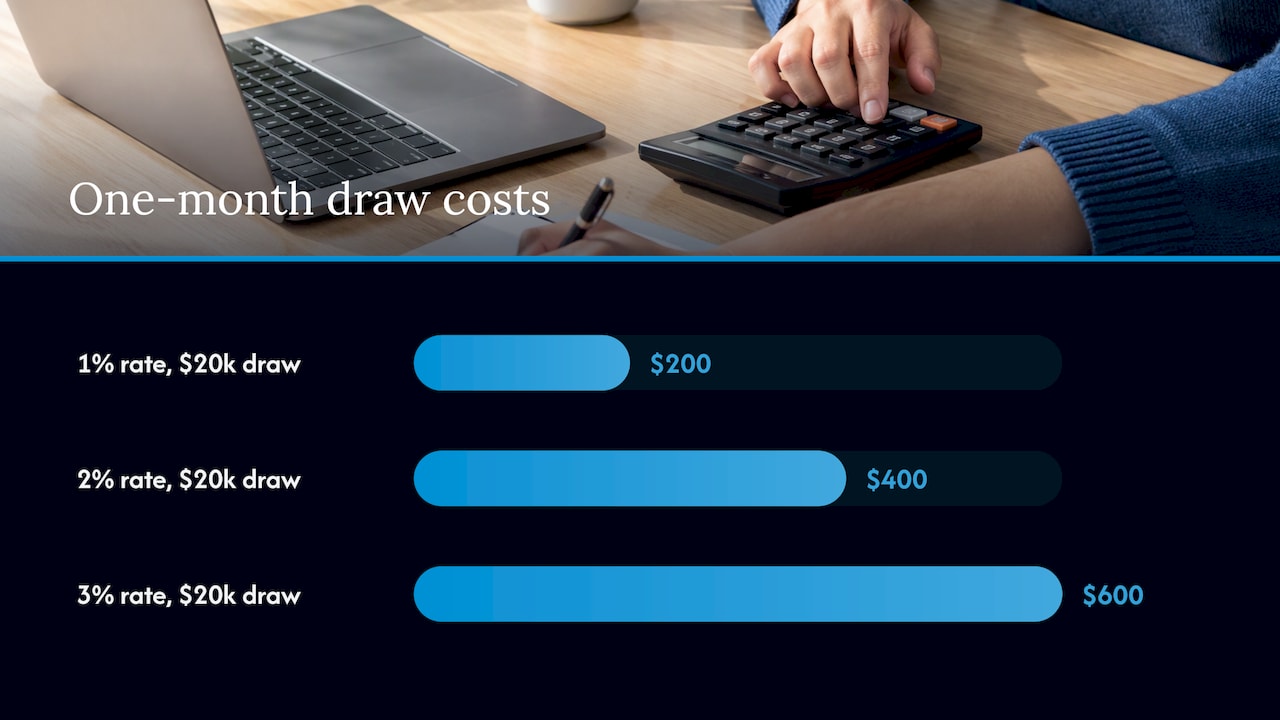
Our published pricing for a Line of Credit is 1-3% per month. Here is what that means on a $20,000 draw held for one month:
| Monthly rate | Cost on a $20,000 draw for one month |
|---|---|
| 1% | $200 |
| 2% | $400 |
| 3% | $600 |
The cost scales with how long you hold the balance, so the practical rule is to draw for a purpose that returns cash quickly. A draw that bridges a 30-day receivable costs a month of interest. A draw that funds a long-term asset can sit for many months, and for that need a different product may fit better. For multi-year needs, our SBA Loan is published at 8% per year, and SBA terms must be the shortest appropriate for your repayment ability, generally ten years or less unless real estate or long-life equipment is financed.
To see how a draw fits your monthly budget, run your numbers through a loan repayment calculator before you accept anything. Compare your repayment against the cash the draw will generate, not just against the interest.
Banks offer both secured and unsecured lines, according to the OCC, and the FDIC notes lines are often unsecured, though some lenders require collateral. Our offering is built around no collateral required, which means you are not pledging equipment, inventory or property to open the line. Our article on unsecured versus secured lines of credit explains the difference in detail.
One point applies to the SBA route specifically: federal rules say SBA normally requires personal guarantees from owners holding 20 percent or more of the business. If you consider an SBA product, expect to be asked for one.
The SBA also does not lend directly. It guarantees part of a loan made by a bank or other lender. For revolving needs, the SBA program is called CapLines, which finances short-term and revolving working capital, with each of its four lines going up to $5 million. Our post on the SBA CAPLines program shows how your lender shapes that process.
The FDIC’s small business curriculum says underwriting rests on the five Cs: character, capacity, capital, collateral and conditions. Loan officers look for accurate, documented financial statements and a clear explanation of how the money will help the business. The OCC adds that lenders consider business and owner credit reports from the national credit bureaus, and that start-ups generally carry higher non-repayment risk than established businesses with documented performance.
That sounds daunting, but it simply tells you what to prepare. For federal SBA programs, the rules require the borrower to be creditworthy, and lenders may weigh credit score and history, cash flow, and any equity or collateral. Inadequate collateral alone is not supposed to be the sole reason for denial.
For most owners, the useful preparation looks like this:
If you are early-stage, see how lenders view a young company in what lenders check for a startup line of credit. If your credit is the concern, our guide to the business loan credit score explains how scores figure in, and business loan approval factors lays out the rest of the lender’s checklist.
The Consumer Financial Protection Bureau explains that when you apply for a credit card or line of credit, the lender’s review is a hard inquiry that appears on your credit report and may affect your score, while account-management checks are soft inquiries that do not. Applying to several lenders one by one can stack hard inquiries.
This is a reason we built our process the way we did. Our application has no credit score impact, and a single one-page form reaches our network of banks and alternative lenders instead of making you apply lender by lender. You see what is available before committing.
Add up the largest gap you expect between money going out and money coming in. A line sized to that gap is easier to approve and cheaper to carry than one sized to a round number.
Have ready your legal business name, time in business, monthly revenue, and recent bank statements. Lenders can only move as fast as the file allows.
Our application is a single page. We route it through our network of banks and lenders, and approvals can arrive within 24 hours. Instead of preparing separate packages for separate lenders, you do the work once.
Look at the rate and whether it is quoted monthly or annually, how long the draw period runs, the minimum payment, and the renewal terms. Our guide on how to choose the right lender shows what to compare. Our advisors work with you through this stage.
The OCC warns that failing to repay can put business or personal assets at risk, and that too much debt can make it harder to borrow later. The safe habit is simple: draw for items that produce revenue or fix a timing gap, set repayment dates when you draw, and keep a cushion of unused limit for emergencies.
Lines are reviewed annually. Keep statements current and use the line steadily, since a line used and repaid on time shows the lender the pattern it wants to see.
You do not need to guess whether you qualify. Our article on business loan prequalification walks through how to check eligibility early, so you apply when your numbers are ready.
Most owners we talk to do not need more theory about credit. They need cash to arrive before the invoice does, and they want to get there without putting equipment or property on the table.
That is why we built Fordham Capital around a one-page application and a wide network of banks and lenders. One form, many possible answers, and no hit to your credit score while you look. We serve small and mid-sized businesses that conventional banks often pass over, and we are proud of our A+ BBB rating.
A revolving line is the right tool when your needs repeat or arrive without warning. Size it to a real gap, draw it for something that returns cash, and repay it on schedule. Used that way, it becomes the most flexible part of a business’s finances.
Rob
If you need working capital that you can draw on again and again, our Line of Credit is published at 1-3% per month, and our network also includes SBA Loans at 8% per year and Working Capital financing. Apply once on a single page, with no credit score impact and no collateral required, and receive an approval decision within 24 hours.
Start at Fordham Capital and tell us what the funds are for.
Both are revolving, so repaid credit becomes available again. A line of credit is usually larger and can be drawn as cash for suppliers, payroll or other costs, while a card works where cards are accepted. Many owners use a line for the big, irregular costs.
Lenders consider credit history, but they also weigh cash flow and documented financials. Pulling your business and personal reports before you apply lets you fix errors. Our network is built for owners that traditional banks often turn away, and our application does not affect your credit score.
Banks offer both secured and unsecured lines, and the FDIC notes that many lines are unsecured. With Fordham Capital, no collateral is required. If you go the SBA route, owners with 20 percent or more ownership are normally asked for a personal guarantee.
Our one-page application can lead to an approval within 24 hours. Final timing for funds depends on the lender and on how complete your documents are, so having bank statements and revenue records ready helps.
Interest applies only to the balance you draw. Our Line of Credit is published at 1-3% per month, so a $20,000 draw held for a month costs between $200 and $600 in interest. Your own rate depends on the lender’s assessment of your business.
At Fordham Capital, we've made the application process straightforward and reassuring. Dive in and explore your financial options with confidence, knowing there's no impact on your credit score and no obligations. We review your details and offer customized solutions based on what you're looking for.