An SBA loan is a bank loan partly backed by the federal government, built for long-term growth and large purchases. Revenue-based financing (RBF) is cash you receive up front and repay as a share of your revenue, built for speed and flexibility. Choose SBA when you can wait and want the lowest cost over the longest term. Choose RBF when revenue is steady, timing matters and you want payments that move with sales.
That is the short version. The details decide which one fits your business, so this guide covers how each works, what they cost, who qualifies, how fast the money arrives and what to review before you sign.
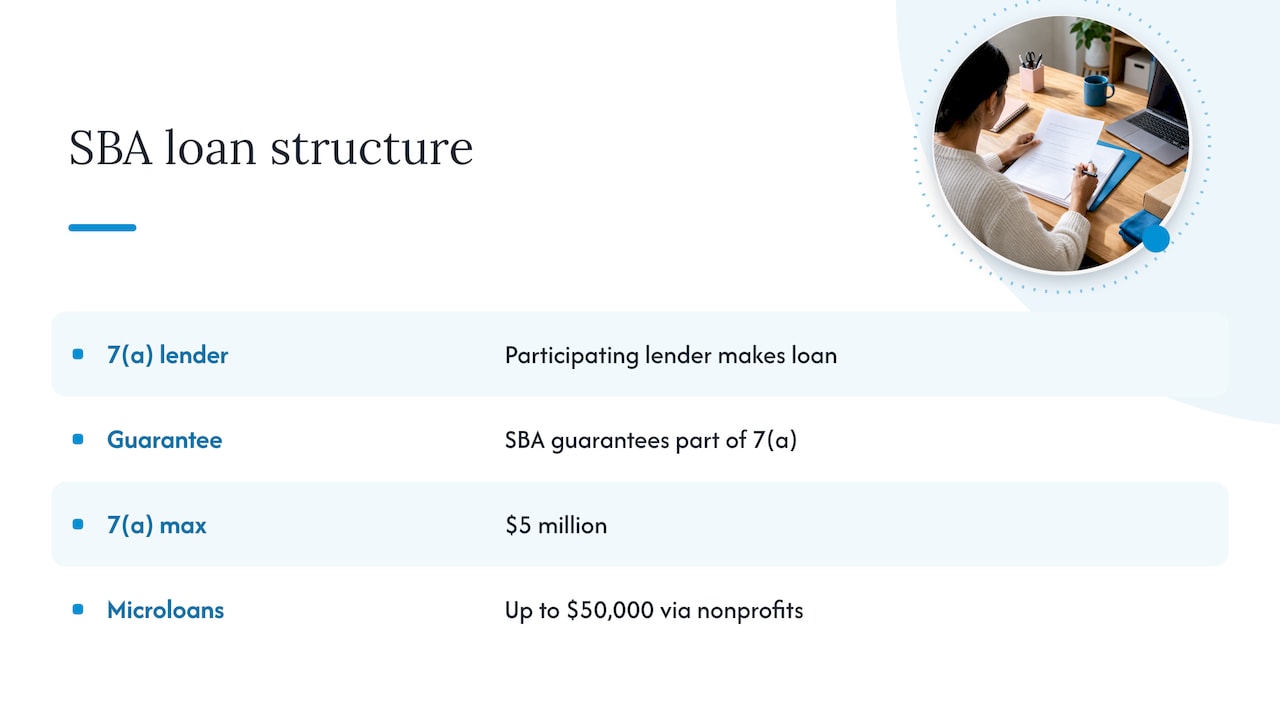
The Small Business Administration does not lend you the money in its flagship program. In the 7(a) program, a participating lender makes the loan and the SBA guarantees part of it. That guarantee is what lets lenders approve borrowers and terms they might otherwise pass on.
The 7(a) loan can be used for working capital, refinancing business debt, buying machinery and equipment, purchasing or improving real estate, furniture, fixtures and supplies, and changes of ownership. The maximum is $5 million. For a closer look at what is and is not allowed, see our guide to what you can do with SBA loan proceeds.
There are other SBA products too. Microloans go up to $50,000 and run through nonprofit intermediaries, often for startups and owners who would not qualify for a conventional bank loan. If you are weighing the main 7(a) against its faster cousin, read SBA Express vs 7(a).
With revenue-based financing, a provider advances cash up front and you repay it from your revenue instead of a fixed monthly debt schedule. Repayments can be daily or monthly, depending on the agreement.
Most deals use a multiplier. As one example, a $1 million advance with a 1.5 multiplier means repaying $1.5 million. The structure varies: some agreements take a percentage of monthly revenue, others a daily percentage of card sales.
The core idea is alignment. Payments shrink when sales dip and grow when sales rise, which is why RBF is described as more flexible than fixed-repayment loans. We go deeper in how revenue-based financing works for SMBs and in our look at keeping equity while risking cash flow.
| Factor | SBA loan (7(a)) | Revenue-based financing |
|---|---|---|
| Who funds it | Bank or SBA-participating lender with a federal guarantee | Alternative provider or lender |
| Maximum size | Up to $5 million per 7(a) loan | Set by the provider, usually tied to your revenue |
| Repayment | Scheduled payments over a term | A share of revenue, daily or monthly |
| Cost structure | Interest rate, negotiated within SBA maximums | Multiplier or fixed total repayment |
| Typical timeline | 30 to 90 days | Days |
| Typical term | 10 years or less, up to 25 for real estate | Until the agreed total is repaid |
| Best for | Equipment, real estate, acquisitions, long-term growth | Recurring revenue, quick working capital |
| Personal guarantee | Required for owners of 20% or more | Depends on the agreement |
Terms for SBA come from the SBA’s program terms: the rate is negotiated between borrower and lender but cannot exceed the SBA maximum, and maturity is generally ten years or less, with up to 25 years for real estate. The RBF column describes the common structure, and each provider’s contract is what governs your deal.
The two products price money differently, so comparing them takes one extra step.
An SBA loan quotes an interest rate. The lender and borrower negotiate it, subject to the SBA’s published maximums. Because the term is long, the monthly payment is low relative to the amount borrowed, and the total cost depends on how long you hold the loan.
RBF quotes a multiplier. A 1.3 multiplier on $100,000 means you repay $130,000 in total, whether it takes six months or eighteen. That makes the effective annual cost depend on speed: the faster your revenue pays it back, the higher the annualized rate. The reverse also holds, so slower sales stretch the repayment without raising the total.
To compare fairly, convert both to the same yardstick:
A worked example: you receive $100,000 and repay $130,000 over nine months. The cost is $30,000, or 30% of the advance over 0.75 years, roughly 40% a year. A $100,000 term loan at a single-digit rate repaid over five years costs far less per year, but you waited longer to get it and took on a fixed payment from day one. Neither number is good or bad by itself. The question is what the money earns for you and when you need it.
For reference, the rates published on our site are 8% per year for SBA loans and 1% to 3% per month for lines of credit. Working capital pricing depends on the lender and your profile, so no rate is published.
SBA 7(a) eligibility is specific. The business must be an operating, for-profit company located in the US, small under SBA size standards, not in an ineligible category, unable to get the credit it needs on reasonable terms elsewhere, and creditworthy with a reasonable ability to repay.
Lenders also look at time in business and credit. One industry guide puts the typical SBA profile at two years in business and a credit score around 680 or higher. Treat that as a common benchmark, since each lender sets its own standards. Our walkthrough, Do You Meet SBA Loan Requirements?, goes through the checklist.
For SBA loans, federal rules generally require a personal guarantee from anyone holding 20% or more of the business. The SBA or the lender can also ask other owners or entities to guarantee, based on credit or other reasons. If you own 20% or more, plan on signing.
RBF providers focus on revenue consistency more than on years in business or a credit score. They want to see how much comes in each month and how predictable it is. That is why RBF is particularly well suited to recurring revenue: SaaS companies, subscription boxes and agencies with retainer income. A business with lumpy or seasonal sales can still qualify with some providers, but the payment pattern needs a closer read.
The timelines differ by an order of magnitude. SBA loans commonly take 30 to 90 days from application to funding, because of documentation, underwriting and the guarantee process. RBF can fund in days.
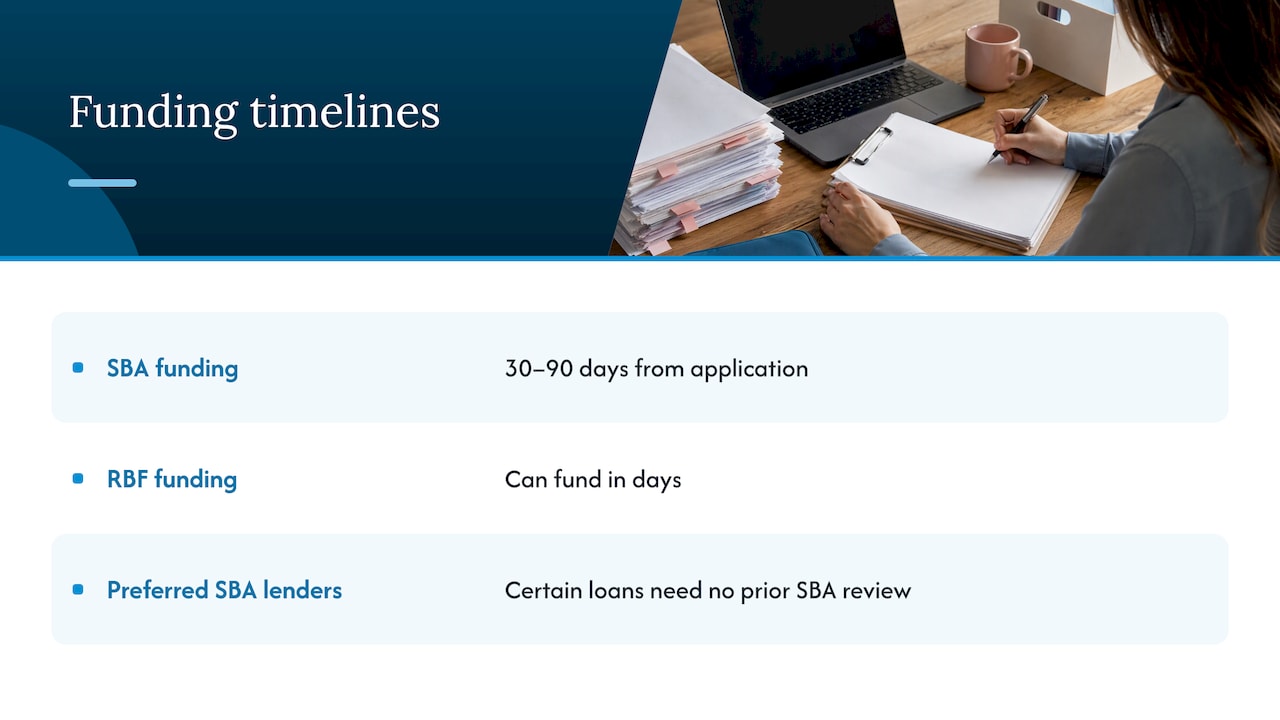
Speed within SBA depends heavily on your lender. Under the SBA’s Preferred Lender Program, participating lenders can underwrite, approve and close certain loans without prior SBA review, which can cut time. If the clock matters, ask any SBA lender whether they hold preferred status. We cover practical tactics in SBA loan turnaround time and how to move faster.
If you need cash this month, an SBA loan alone probably will not arrive in time. If you can plan ahead by a quarter, applying early for SBA and bridging with something shorter can work together.
The main commitments with an SBA loan are paperwork, the personal guarantee and a fixed monthly payment regardless of sales. Prepare by gathering tax returns, financial statements and a clear use-of-funds plan before you apply. Because payments are fixed, test them against your slowest month.
The main commitment with RBF is the total repayment amount, which is set from the start. Because payments scale with revenue, a strong quarter pays the balance down quickly and costs more on an annualized basis. Because daily or weekly remittances come out of cash flow, model your margins after the remittance, not before it.
A useful rule from capital planning: stack capital cheapest-first, starting with free supplier terms, then grants and tax credits, then a low-cost line, and use RBF at the margin. Every dollar of non-dilutive capital you use is a dollar of equity you do not sell.
Read the contract line by line. Before funding, confirm these points in writing:
Have your accountant or a business attorney review the contract. They can run your projected revenue through the payment terms and tell you how long repayment will take.
Most owners we meet do not need a lecture on the “best” product. They need the right match for the next twelve months. If you are buying equipment, a building or another company, and you have a few months to plan, SBA financing is often the strongest foundation because of its long terms and size.
If a contract, a seasonal order or a growth window will not wait, speed matters more. That is why we built a one-page application and a network of banks and alternative lenders: so you see options side by side instead of knocking on one door at a time, and your credit score is not affected by the first step.
The smartest owners we see use both. They line up an SBA loan for the long-term backbone and use faster working capital for the moments in between. Our team of advisors walks through the numbers with you, and our track record is part of why owners come back: an A+ BBB rating and more than $120 million funded.
Rob
A common pattern: apply for the SBA loan now for the long-term project, and use short-term working capital to fund the first phase while you wait. Once the SBA funds arrive, you can repay or refinance the shorter obligation, since refinancing business debt is an eligible use of 7(a) proceeds.
If you are buying a business or property, one more route is worth knowing: negotiating directly with the seller. Practicing a seller financing call script helps you handle the conversation before you commit to outside funding.
For a wider map of the options beyond banks, see our guide to types of non-bank business financing. If working capital is the main goal, SBA CAPLines is another program to examine.
We are an online marketplace, not a direct lender. You complete one short application, and we connect you with banks and alternative lenders in our network for SBA loans, business lines of credit and working capital financing. Our process is designed to deliver approvals within 24 hours, with no impact on your credit score and no collateral required, and advisors are available to explain each offer.
Ready to see what you qualify for? Start your one-page application at Fordham Capital and compare your options before you decide.
RBF stands for revenue-based financing. A provider gives you cash up front, and you repay it as a percentage of your revenue until you have paid back an agreed total. Payments typically rise and fall with your sales.
Usually the stated rate on an SBA loan is lower, because the federal guarantee and long term spread the cost. RBF costs are set as a multiplier, so the annualized cost depends on how fast you repay. Compare total dollars repaid and repayment time for each offer, as in the worked example above.
Yes, businesses often use one for long-term investment and the other for short-term needs. Check each agreement for restrictions on additional financing, and confirm that your combined payments fit your cash flow.
Generally yes for anyone who owns 20% or more of the business. The SBA or the lender may ask additional owners or entities to guarantee as well, depending on credit and other factors.
SBA loans commonly take 30 to 90 days, while RBF can arrive in days. Applying through a marketplace like ours puts your request in front of multiple lenders at once, so you can pick the offer that matches your timeline.
At Fordham Capital, we've made the application process straightforward and reassuring. Dive in and explore your financial options with confidence, knowing there's no impact on your credit score and no obligations. We review your details and offer customized solutions based on what you're looking for.