
Yes, your small or medium business can access unsecured financing without pledging equipment, real estate, or inventory. The product type, cost, and documentation requirements vary significantly by lender, but the path is real and well-traveled. SMEs represent a large majority of all businesses globally, which is exactly why lenders, government programs, and fintech platforms have built entire product lines around them. Here is what to do right now, before you talk to a single lender:
Pro Tip: Lead every lender conversation with verified recurring revenue — consistent monthly deposits or recurring invoices. That single data point often shortens underwriting on unsecured offers more than any other document you can provide.
Qualified SMEs can access no-collateral financing through SBA-guaranteed programs, online lenders, and invoice-based products, but cost and speed vary sharply by lender type, and personal guarantees are common even when no asset is pledged.
| Point | Details |
|---|---|
| Start with documents | Pull 12 months of bank statements and your most recent tax return before contacting any lender. |
| Check both credit profiles | Your personal score and business credit file are evaluated separately; errors in either can cost you approval or pricing. |
| Prioritize recurring revenue proof | Consistent monthly deposits are the single strongest signal for unsecured underwriting across lender types. |
| Convert factor rates before comparing | An MCA factor rate of 1.3 is not an APR; annualize it against your repayment term before comparing to any bank offer. |
| Fordhamcapital for speed | Fordhamcapital’s one-page application reaches multiple lenders simultaneously, with approvals in under 24 hours and no credit impact during pre-qualification. |
“No-collateral” or unsecured financing means the lender does not require you to pledge a specific asset (real estate, equipment, inventory) as security for the loan. That sounds clean, but the reality is more nuanced. Traditional lenders commonly require collateral, and truly unsecured loans are rarer than most guides suggest. Even when no named asset is pledged, lenders frequently file a UCC-1 lien against general business assets or require a personal guarantee. You are not always off the hook personally; you are just not handing over a specific deed.
That distinction matters for how you evaluate offers. A personal guarantee means your personal credit and assets are on the line if the business defaults. A UCC lien gives the lender a claim against business assets broadly. Neither is the same as a traditional mortgage-style pledge, but neither is truly consequence-free either. Understanding why collateral requirements block business loans helps you negotiate from a more informed position.
The general rule: higher perceived risk to the lender means higher cost to you. Government guarantees, like those the SBA provides through approved lenders, reduce lender risk and therefore reduce your rate. Online lenders and MCAs absorb more risk and price accordingly.
The no-collateral loan process has five distinct phases. Skipping any one of them is the most common reason owners get rejected or accept bad terms.
Step 1: Prepare your documentation package
Gather these before you contact a single lender:
Step 2: Pre-qualify across at least two lender channels
Do not apply to one lender and wait. Run soft-pull pre-qualifications simultaneously across an SBA-affiliated lender (use the SBA Lender Match tool) and at least one online lender or marketplace. This gives you a real comparison and protects your credit score during the search phase.
Step 3: Submit a concise, complete application
Online lenders and fintech platforms approve faster with more flexible requirements than banks, but they typically charge higher rates. Banks and SBA-backed routes are usually cheaper but slower and require more documentation. Match your channel to your timeline. If you need capital in under two weeks, an online lender or marketplace is the realistic path. If you have 30–60 days, an SBA route or bank line of credit is worth the paperwork.
Step 4: Evaluate and negotiate the offer
When offers arrive, compare them on these dimensions in this order:
Step 5: Accept, fund, and manage the relationship
Once funded, pay on time every cycle. This is not just good debt hygiene; it is a credit-building strategy. Lenders report payment behavior to business credit bureaus, and a clean repayment history on a small facility is the fastest path to a larger, cheaper one next time. For practical guidance on how unsecured lending approval works for SMBs, the documentation and underwriting expectations are consistent across most lender types.
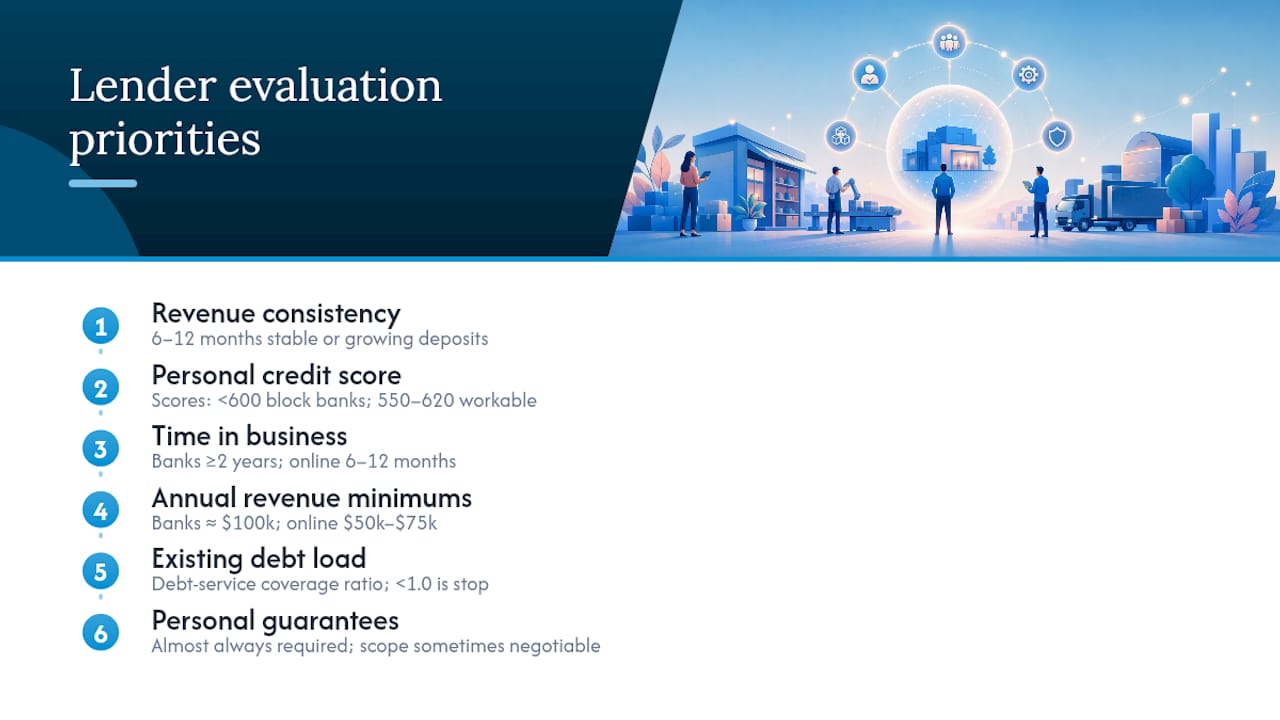
Without collateral to fall back on, lenders lean harder on cash flow signals and credit history. Here is what they look at, roughly in order of weight:
Revenue consistency: Monthly deposits that are stable or growing matter more than a single strong month. Lenders want to see 6–12 months of consistent inflows.
Personal credit score: For most unsecured SME products, your personal score is the primary credit signal, especially if the business is under three years old. Scores below 600 will close most bank doors; online lenders often work with scores in the 550–620 range at higher rates. Scores above 680 open meaningfully better pricing.
Time in business: Most bank products require at least two years. Online lenders and alternative platforms often accept 6–12 months. Startups under six months old are largely limited to business credit cards, microloans, or equity routes.
Annual revenue minimums: Banks typically want $100,000 or more in annual revenue for unsecured lines. Online lenders often set minimums at $50,000–$75,000. These are not universal thresholds; they vary by lender and product.
Existing debt load: High existing debt-service obligations reduce the cash flow available to repay a new facility. Lenders calculate a debt-service coverage ratio; a ratio below 1.0 is a hard stop at most institutions.
Personal guarantees: Almost every unsecured SME loan will require one. The guarantee means the lender can pursue your personal assets if the business defaults. You can sometimes negotiate the scope (limited vs. unlimited guarantee) but rarely eliminate it entirely. Knowing this upfront lets you protect your credit score during business borrowing by limiting the number of hard pulls during your search.
Key signal: Invoice quality matters specifically for factoring. Lenders look at debtor creditworthiness, invoice aging, and concentration risk (how many customers make up your receivables). A single customer representing 80% of your AR is a red flag for most factors.
Pro Tip: Package your personal and business financials together in one clean PDF before any lender conversation. Include a one-page summary at the front showing monthly revenue, existing obligations, and the specific use of the requested funds. This reduces back-and-forth and signals that you understand what lenders need.
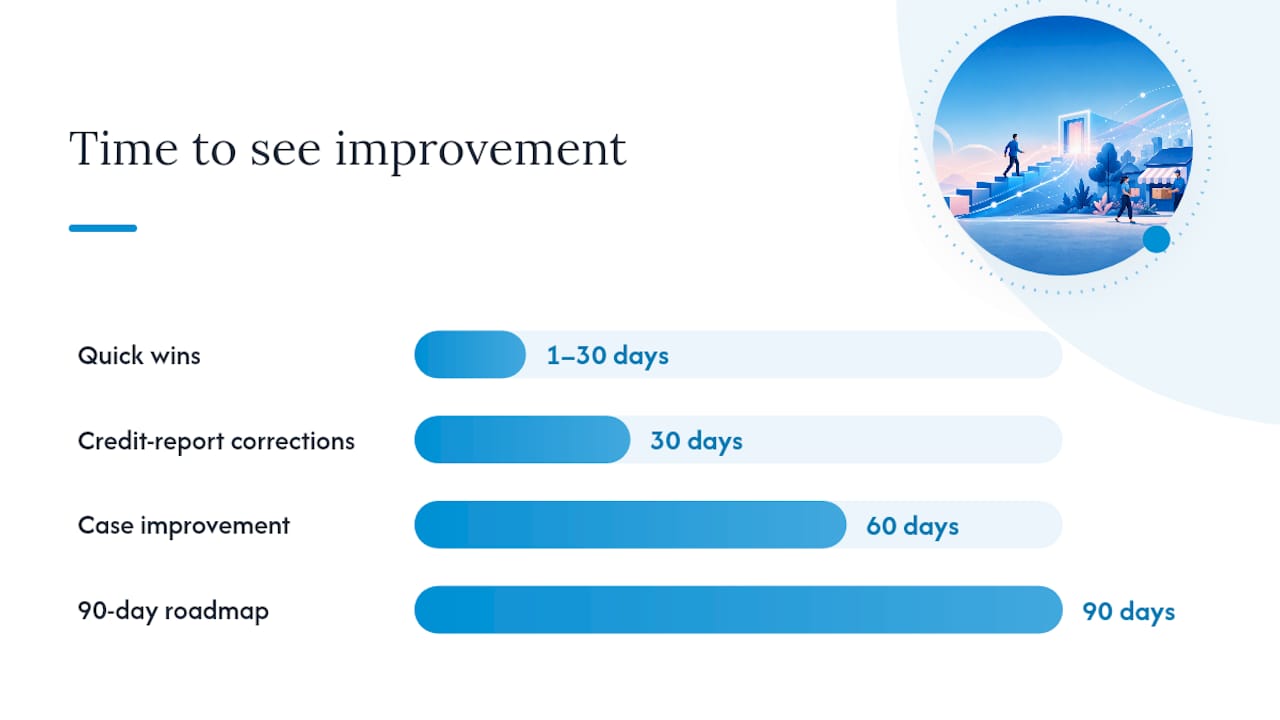
Some improvements take a weekend. Others take 90 days. Both matter.
Quick wins (1–30 days):
90-day roadmap:
Consider a scenario where a business owner with a 610 personal credit score and 14 months in business initially received only MCA offers at expensive factor rates. After 60 days of consolidating deposits, correcting a reporting error on the Dun & Bradstreet file, and completing two on-time payments on a small vendor line, the same owner qualified for an unsecured business line of credit at a meaningfully lower annualized rate. The improvement came from documentation and credit hygiene, not revenue growth.
For a deeper look at how to get business funding without collateral, the preparation steps above align with what most lenders actually verify during underwriting.
A note on factor rates: An MCA with a factor rate of 1.3 on a $50,000 advance means you repay $65,000 total. That is not an APR. To compare it to a loan’s APR, you need to annualize the cost based on the repayment term. Always convert before comparing.
The 24–72 hour window for online lenders is real for well-documented applications. SBA routes genuinely take 30–90 days in most cases, though some SBA Express products can move faster. Invoice factoring can fund the same day when the factor already knows your debtor.
Not every fast approval is a good one. These are the warning signs that an offer deserves a hard look before you accept:
Questions to ask every lender before signing:
Pro Tip: Request the full draft agreement or a written term sheet and give yourself 24–48 hours to have your accountant or a business attorney review the key clauses — especially the guarantee language, the default definition, and any automatic renewal provision. A one-hour review fee is cheap insurance against a multi-year obligation you did not fully understand.
The research on this point is consistent. Experts recommend treating small working-capital accounts as credit-building instruments; consistent on-time payments and clear deposit histories help businesses access larger and cheaper financing over time. This is not abstract advice. Lenders use payment history as a direct input to pricing decisions on unsecured facilities.
A three-step program that produces measurable credit improvements within six months:
The World Bank’s work on SME finance also highlights how alternative finance channels, including crowdfunding and embedded finance platforms, are creating new entry points for businesses that do not yet have the credit profile for traditional bank products. For businesses in early stages, these routes can serve as both capital sources and credit-building opportunities simultaneously. You can also explore alternative fundraising approaches used in other markets to understand how non-bank channels are structured globally.
Most guides on this topic present unsecured financing as a clean binary: either you qualify or you do not. The reality is that approval is a spectrum, and most rejections are timing problems, not permanent disqualifications.
The advice to “build your credit first” is correct but incomplete. What lenders actually want is evidence of cash flow predictability. A business with a 640 credit score and 18 months of stable, documented monthly deposits will often outperform a business with a 720 score and erratic revenue on an unsecured application. The score matters, but the deposit pattern matters more for alternative lenders.
The second thing most guides understate is the cost of speed. An MCA or same-day online advance is not free money with a fast timeline. The annualized cost can be three to five times what a bank line would charge. That is sometimes the right trade, especially when the capital generates a return that exceeds the cost. But owners who take fast capital without modeling the repayment impact on monthly cash flow often find themselves in a refinancing cycle that compounds the original cost.
The practical priority order: exhaust SBA-guaranteed options first if your timeline allows. Move to bank unsecured lines second. Use online lenders and alternative products for speed when the timeline is tight and the return on capital justifies the higher cost. Never treat an MCA as a long-term capital strategy.
Most business owners spend weeks collecting documents, submitting to one lender at a time, and waiting on decisions that may never come. Fordhamcapital cuts that process down to a single one-page application that reaches a network of banks and alternative lenders simultaneously, with no hard credit pull during pre-qualification.
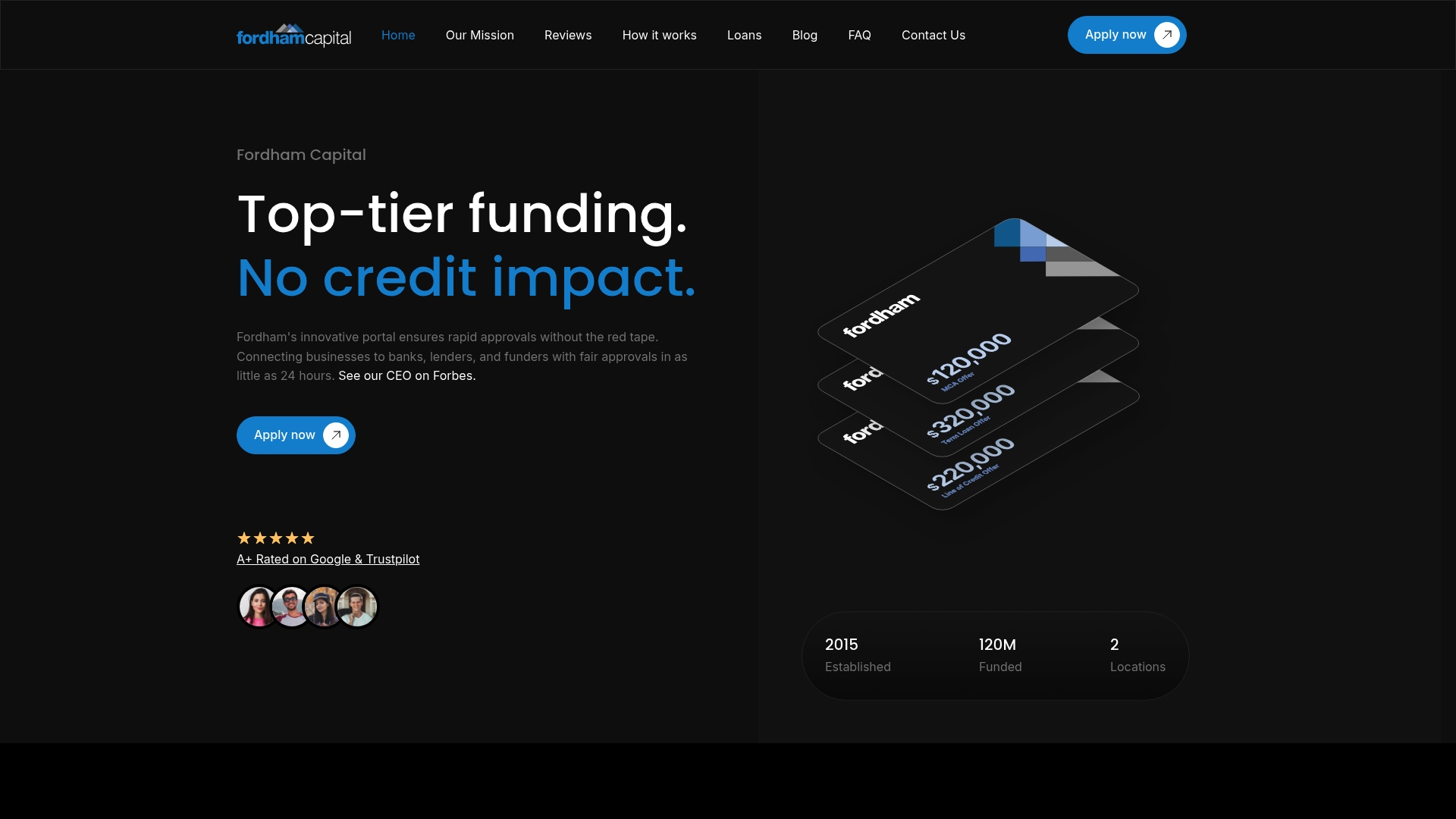
The platform has funded over $120 million for SMEs and holds an A+ BBB rating. Fordhamcapital operates as a marketplace intermediary, earning referral and origination fees when a lender in its network funds your business. That model means the platform is motivated to match you to an offer that actually closes, not just to generate applications. Before you click Apply, have your last three months of bank statements and your one-page loan purpose summary ready. Approvals typically arrive within 24 hours of a complete submission.
Start your application at Fordhamcapital and get matched to unsecured funding options without affecting your credit score.
Verify APR, fees, and recourse terms directly with any lender via a written term sheet before accepting an offer.
This article is general information, not a substitute for advice from a qualified financial advisor. Consult a qualified financial professional about your own circumstances before acting on anything here.
At Fordham Capital, we've made the application process straightforward and reassuring. Dive in and explore your financial options with confidence, knowing there's no impact on your credit score and no obligations. We review your details and offer customized solutions based on what you're looking for.