DSCR, the debt service coverage ratio, is your yearly operating cash flow divided by your yearly loan payments. A result of 1.25 means your business earns $1.25 for every $1.00 it owes in principal and interest. For SBA 7(a) loans the written floor is lower than many owners fear, and lenders outside the SBA set their own targets. Knowing your number before you apply lets you pick the right product and avoid wasted applications. If you want a read on which funding fits your numbers, Fordham Capital’s one-page application connects you with a network of banks and lenders without affecting your credit score.
A lender wants to know one thing before it approves you: will the business generate enough cash to make every payment? DSCR answers that in a single number.
The formula:
DSCR = net operating income ÷ total debt service
A ratio of exactly 1.00 means every dollar of operating income goes to lenders. Below 1.00, the business cannot cover its payments from operations. Above 1.00, there is a cushion, and the bigger the cushion, the more comfortable a lender is.
Say your bakery earns $150,000 in net operating income over the year. You already pay $60,000 a year on an equipment loan, and you want a new loan that adds $60,000 in annual payments.
Now suppose the new loan is larger and adds $90,000 a year. Debt service becomes $150,000, and DSCR drops to 1.00. Same business, same income, very different answer. That is why DSCR depends as much on the size and term of the loan as on your profits.
There is no single national cutoff. What you face depends on the lender and the product.
The SBA’s Standard Operating Procedure 50 10 6, effective October 1, 2020, requires a DSCR of at least 1.15 on a historical or projected cash flow basis, and 1:1 on a global basis for 7(a) loans. “Global” means the combined picture of the business and its owners’ related obligations.
For 7(a) Small Loans, SBA Procedural Notice 5000-875701, published January 16, 2026 and effective March 1, 2026, calls for a DSCR of at least 1.1:1, measured as operating cash flow (EBITDA) divided by debt service, including future required payments on all business debts and the new SBA loan.
These are SBA minimums. A participating bank can ask for more, and many do, which is why you will often hear 1.25 quoted. Our guide on hitting 1.25x DSCR for small business loan underwriting walks through how that benchmark shows up in practice.

Traditional banks typically want a comfortable cushion because they price for low risk. Alternative lenders often put more weight on recent revenue and bank deposits than on a formal ratio. Microlenders are the most flexible: according to ICIC’s lending training material, microlenders use 3 to 4 months of financial information, relying on bank statements when accurate profit and loss statements are not available, and some will use projections for start-ups or businesses that are not yet profitable.
| Lender type | Typical look-back | What they lean on |
|---|---|---|
| SBA 7(a) lender | 2 to 3 years plus projections | Historical and projected DSCR |
| Conventional bank | 2 to 3 years | Tax returns, P&L, a cushion above the minimum |
| Alternative lender | Recent months | Bank deposits, revenue trends |
| Microlender | 3 to 4 months | Bank statements, sometimes projections |
The same ICIC material notes that most small business lenders use 2 to 3 years of historical business and financial information built from a profit and loss statement, with balance sheet analysis added mainly on very large loans.
Where it goes wrong: owners forget existing payments, use revenue instead of income, or compare a monthly payment to an annual income figure. Keep the periods matched.
DSCR is one input. Underwriters also weigh time in business, credit history, industry, collateral and the quality of your statements. Our overview of what lenders look for in business loan approvals and how lenders evaluate business health lays out the full picture, and why banks reject small business loans shows the common stumbling blocks, DSCR among them.
For SBA applicants there is also a scoring step. See how the SBSS score for SBA loans changed in 2026, and whether you meet SBA loan requirements.
You can move the ratio from either side of the fraction.
Going back to the bakery with the $90,000 new payment: stretching the term so the new payment falls to $60,000 puts DSCR back at 1.25 with no change in income.
A good ratio with messy books still looks risky. Reconcile your accounts monthly, keep bank statements and tax returns consistent, and be ready to explain any dip.
A low ratio narrows your options but does not close them. A few routes people take:
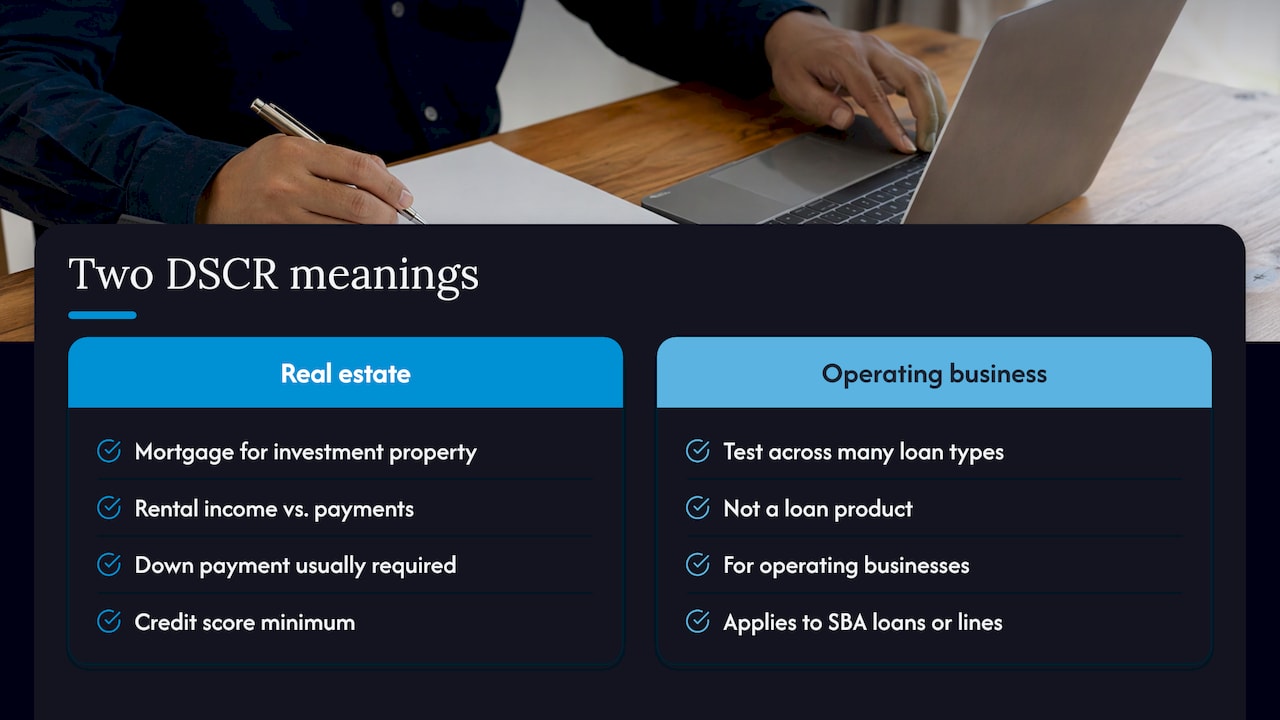
No. In real estate, a “DSCR loan” is a mortgage for investment property approved mainly on the property’s rental income against its payments, usually with a down payment and a credit score minimum. That product is for property investors. For an operating business, DSCR is a test applied to many loan types, not a loan product by itself. If you run a business and want working capital, an SBA loan or a line of credit, the ratio described above is the one that matters.
Once you know your ratio, the next question is which product suits it. Fordham Capital is an online platform that connects small and medium-sized businesses with a network of banks and alternative lenders for SBA loans, business lines of credit and working capital financing. The application is one page, it does not affect your credit score, and no collateral is required. Listed pricing on our site is 8% per year for SBA loans and 1-3% per month for lines of credit; working capital has no published price. Approvals can come within 24 hours.
See your SBA, line of credit and working capital options
Every week owners come to us worried about one number. We would rather they understand it than fear it. DSCR is arithmetic, and arithmetic can be planned around.
Our view is that a fast funding process should not mean a blind one. We built Fordham Capital around a one-page application and a wide network of banks and lenders, because one lender’s decline often says more about that lender’s rules than about your business. Our advisors give personalized support, and we aim to be transparent about what each product costs.
If you know your ratio, you can choose a payment structure that fits it. That is how businesses grow without straining their cash.
Rob
Many lenders look for 1.25 or higher, which means your income is 125% of your debt payments. SBA 7(a) rules set a lower written minimum of 1.15 on a historical or projected basis, per SOP 50 10 6. Higher is better because it gives the lender a cushion.
A ratio under 1.0 means operating income does not cover payments, so most lenders will hesitate. Some products weigh recent revenue or projections more heavily. Reducing the loan amount or lengthening the term can bring the ratio up before you apply.
It depends on the rate and term. For example, at 8% interest over 10 years, standard amortization gives a payment of roughly $12,133 a month, or about $145,600 a year. To meet a 1.25 DSCR, you would need about $182,000 in annual operating income. Your lender’s quote will set the exact figure.
No. DSCR is calculated from your financial statements, not from a credit report. Credit history is a separate factor in underwriting, though lenders usually look at both.
At Fordham Capital, we've made the application process straightforward and reassuring. Dive in and explore your financial options with confidence, knowing there's no impact on your credit score and no obligations. We review your details and offer customized solutions based on what you're looking for.