A business loan term sheet is a short summary of the financing a lender is willing to consider: amount, rate, repayment period, fees and conditions. It comes before full underwriting, so it is a starting point rather than a promise to lend. Read it carefully anyway, because a few clauses can bind you even if the loan never closes. At Fordham Capital, we connect small businesses to a network of banks and alternative lenders through a one-page application, so the offers you compare reach you without the paperwork piling up first.
Think of it as the lender’s outline of the deal. Lenders provide it to prospective borrowers before underwriting, and the terms are meant as the basis on which the lender will consider financing you. Generally, neither side has a financial or legal obligation based on it.
Underwriting means the lender’s review of your financials, credit and business to decide whether to approve the loan. Until it is done, the numbers on the term sheet can still move. That is why many term sheets carry language saying the terms are proposals and subject to change.
For a small business owner, the term sheet is the first place where a vague “yes, we can probably fund you” becomes specific enough to compare. It is also the cheapest moment to ask questions or push back.
Layouts differ by lender and loan type, but most cover the same ground. Typical items include loan size, interest rate, term, prepayment option or penalty, covenants, closing deliverables, and required guarantees and collateral.
Here is a plain-language walk through the usual sections.
| Section | What it tells you | What to look for |
|---|---|---|
| Borrower and lender | Who is on each side | Correct legal entity name |
| Facility type and amount | Term loan, line of credit, SBA loan; how much | Whether the full amount is available at closing or drawn over time |
| Interest rate | Fixed or variable, and the index it follows | Reset frequency and how the rate is calculated |
| Term and repayment | Length of the loan and payment schedule | Balloon payments, amortization period |
| Fees | Origination, underwriting, commitment, legal, closing | The full list, not just the headline rate |
| Prepayment | What happens if you pay early | Penalties or make-whole formulas |
| Collateral and guarantees | What backs the loan and who stands behind it | Scope of any personal guarantee |
| Covenants | Rules you must follow while the loan is open | Reporting duties and financial tests |
| Conditions to closing | What must happen before funding | Documents, insurance, approvals |
| Binding provisions | Clauses that apply now | Expenses, exclusivity, confidentiality |
A real government example shows how specific the numbers become. In one 2020 SBA Loan Authorization and Agreement, monthly installments were $352 beginning 12 months from the note date, the balance was payable 30 years from the note date, and interest accrued at 3.75% per annum only on funds actually advanced. It also required hazard insurance of at least 80% of insurable value within 12 months. Those are the kinds of line items you should be able to find, and explain, in any offer you receive.
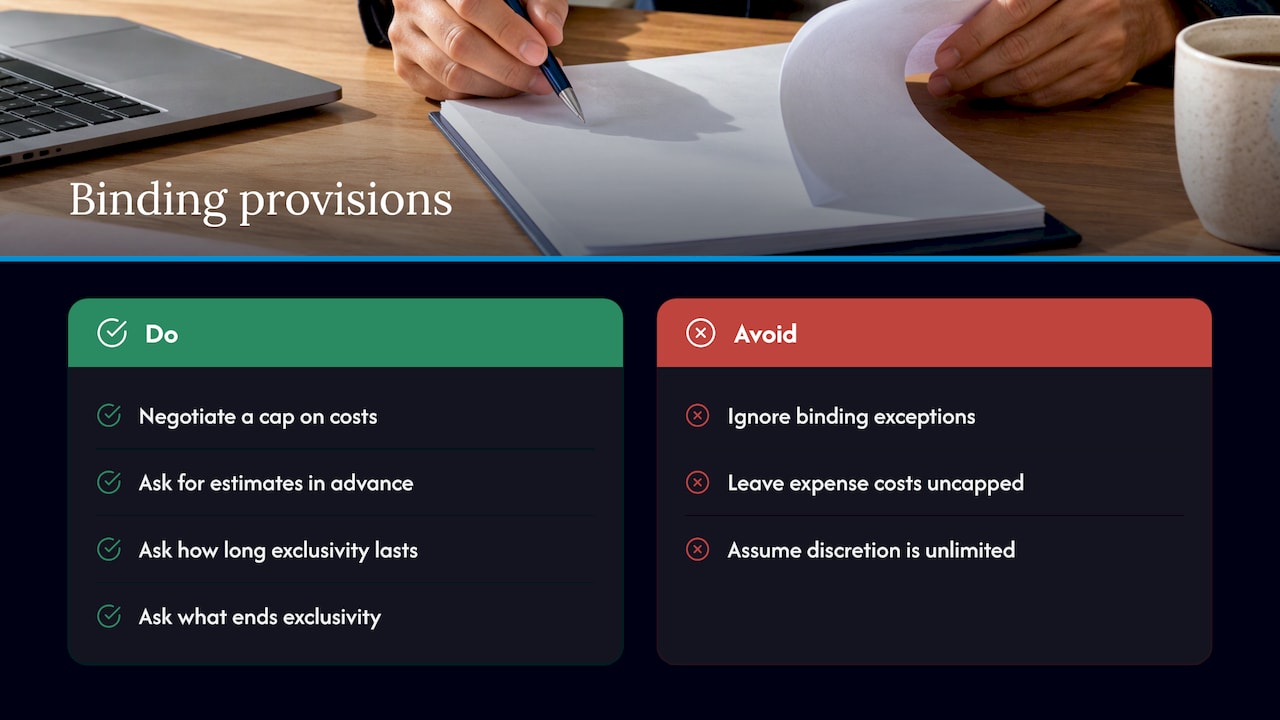
Mostly no, with exceptions that matter. A term sheet is generally non-binding as to the loan itself, but some provisions are expressly binding: confidentiality, expense reimbursement, exclusivity, and sometimes indemnification. Duane Morris describes term sheets as non-binding with certain exceptions.
The expense clause deserves the most attention. It can obligate you to pay the lender’s legal, appraisal, field examination, environmental and search costs whether or not the loan closes. The same source advises negotiating a cap on those costs and asking for estimates in advance.
Exclusivity is the other one to watch. If it stops you from talking to other lenders for a set period, you lose the ability to compare while the clock runs. Ask how long it lasts and what ends it.
One more point: if a term sheet leaves a matter to the lender’s discretion, that does not mean unlimited discretion. The lender must still act in good faith and in a commercially reasonable manner.
The two documents sit at different points in the process.
| Term sheet | Commitment letter | |
|---|---|---|
| Timing | Very beginning, before underwriting is complete | After underwriting and credit approval |
| Binding? | Generally no, with exceptions | Yes, subject to conditions |
| Terms | Not final | Close or identical to the loan documents |
| Expenses | Usually only if a binding clause says so | Borrower generally reimburses out-of-pocket costs, possibly a break-up fee |
This table reflects Duane Morris’s July 2024 presentation and Poyner Spruill’s refresher. In practice, the term sheet tells you whether it is worth continuing. The commitment letter is where you are actually committing, so the fee and reimbursement terms there carry real weight.
A good commitment letter is specific. It should state closing fees, late charges, default rates, prepayment fees and the scope of guarantees. Anything left vague should be clarified before you sign, because unclear terms are often read against the lender only after a dispute has started.
When financing conversations involve several people and several documents, keeping a written record of what was said and agreed helps avoid conflicting assurances, a point also made in this overview of what happens to an application after you submit it.
You do not need a law degree to read a term sheet, but you do need a system. Work from the biggest money items down.
Confirm the facility type matches your need. A term loan funds a one-time purchase; a line of credit covers ongoing cash flow. Our guides on term loans and choosing between a term loan and a line of credit help with that decision.
Look past the interest rate. Check the index and how often the rate resets, the APR, and every fee: origination, underwriting, commitment, syndication, legal and closing. Then check prepayment penalties or make-whole calculations, which can make paying off early expensive.
A worked example: you are offered $100,000 with a 2% origination fee and $3,000 in legal costs. You receive less than you borrowed, yet you repay the full amount plus interest. Always calculate what lands in your account against what you owe.
Ask whether payments fully amortize (pay the loan down to zero) or leave a balloon, a large final payment. A balloon can mean refinancing at a time you do not control.
Covenants are promises you make while the loan is open. They protect the lender by monitoring your business, limiting some actions and requiring others. Check reporting frequency and any financial tests, and make sure you can meet them in a slow quarter. Our guide to business loan covenants explains how to stay compliant.
See what assets are pledged, the lien position, and whether one asset secures several loans. Check how far a personal guarantee reaches.
An event of default lets the lender use remedies. Duane Morris separates a default from an event of default, which arises only if a problem is not cured in time, and lists remedies such as acceleration, default interest and set-off against deposit accounts. Typical triggers include payment default, covenant breach, cross-default, change of control and material adverse change, with default interest commonly 2 to 5 percent above the contract rate.
Two reasonable asks from the same source: cross-acceleration instead of cross-default (so another debt only matters if the lender actually accelerates it), and a narrow definition of material adverse change.
List every document, insurance policy and approval needed before funding. Missing items are a common cause of slow closings; see common delays in business loan approvals. For the full agreement stage, use our checklist of business loan agreement terms.
A single term sheet shows you one lender’s view of your business. Two or three show you what is actually negotiable: rate, fees, collateral, even covenants. The catch is time. Applying separately to several lenders means repeating the same forms and waiting on each one.
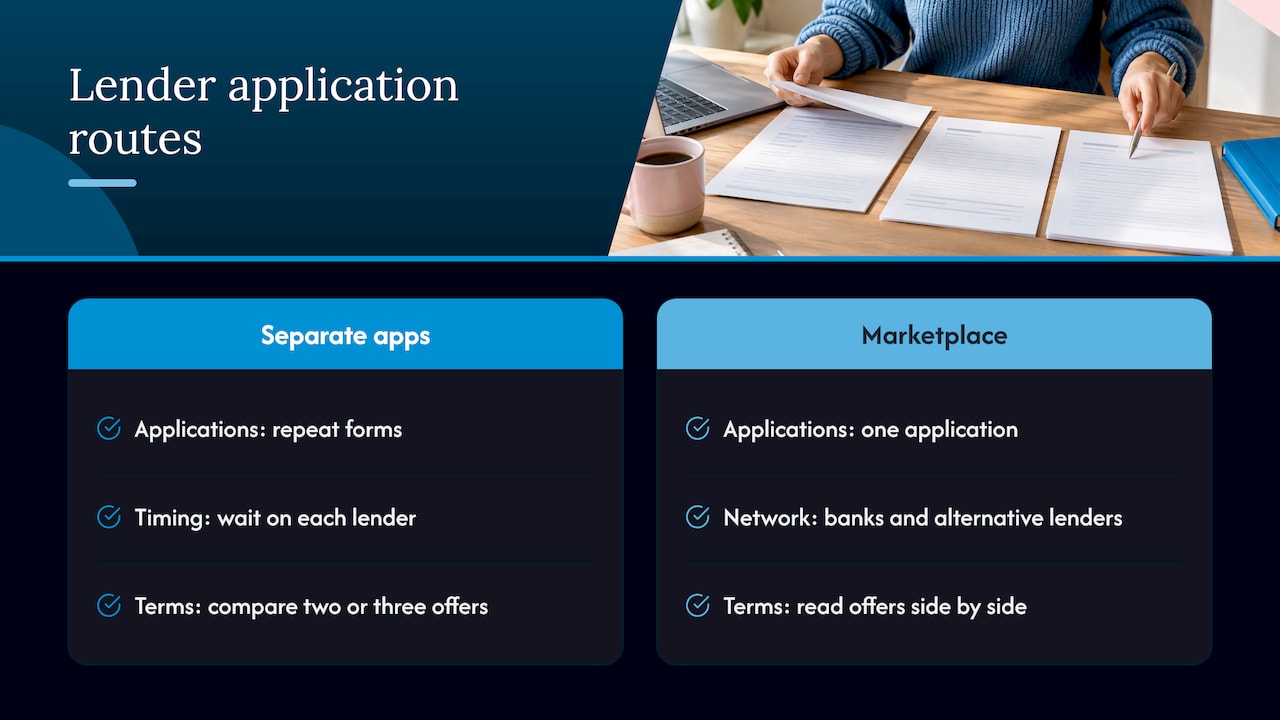
That is the problem a marketplace solves. Fordham Capital is an intermediary, not a direct lender: you complete one application and we connect you with banks and alternative lenders in our network. Our approach has no credit score impact and requires no collateral, and approvals can come within 24 hours. You then have real offers to read side by side with the checklist above. If you want to prepare first, our commercial loan application checklist and guide to what lenders look for show what to have ready.
Most owners we talk to focus on one number, the rate, and skip the paragraphs that decide how the deal actually feels month to month: fees, expense clauses, covenants and what happens after a missed payment.
We built Fordham Capital around a simple idea: a fast, one-page application, access to a wide network of banks and lenders, and an advisor who walks you through what you receive. Businesses that banks overlook, including those with imperfect credit or no collateral, deserve offers they understand before they sign.
Use the term sheet as a conversation, not a verdict. Ask what each line costs you, ask for a cap on expenses, and ask what is binding today. With 15+ years of experience and an A+ BBB rating, we are glad to help you through that first read.
Rob
If you are ready to see real terms, Fordham Capital offers SBA loans (listed at 8% per year), lines of credit (listed at 1-3% per month) and working capital financing. One short application gets your request in front of multiple lenders, with no impact on your credit score and no collateral required. Apply at Fordham Capital.
It is a summary of the main proposed terms of a financing, given before full underwriting. It lists items such as amount, rate, term, fees and collateral. The loan terms are generally non-binding, though some clauses, like expense reimbursement, can bind you.
Yes. The term sheet is the best time to negotiate because nothing is final. Priorities include loan size and structure, pricing and fees, covenants, events of default and cure periods, and collateral and guarantees, as outlined by MC Law.
No. A commitment letter is issued after underwriting and is binding on both sides, subject to conditions. A term sheet is an earlier, generally non-binding outline.
The loan terms do not force either side to proceed, but binding clauses still apply. The main risk is paying the lender’s expenses, so ask for a cap and for cost estimates before you sign.
At Fordham Capital, we've made the application process straightforward and reassuring. Dive in and explore your financial options with confidence, knowing there's no impact on your credit score and no obligations. We review your details and offer customized solutions based on what you're looking for.