You build business credit by putting accounts in your company’s name, paying them on time, and making sure those payments are reported to at least one business credit bureau. That is the whole mechanism, and it takes months, not days. If you need capital now, you do not have to wait for the file to mature: we match small businesses with banks and alternative lenders through a one-page application that does not affect your credit score, while you build the profile that unlocks better terms later.
Business credit is your company’s record of handling debts and financial obligations, reported to business credit reporting agencies, including supplier accounts that give trade credit. Personal credit is the same idea for you as an individual, reported to the consumer bureaus.
Why bother with a second file? The FDIC lists several advantages in its Money Smart for Small Business program: protection of personal assets, better organization, business growth, higher credit limits, better financing terms and a more professional image. The same guide warns that skipping this work can put personal assets at risk as business liabilities grow and may limit your ability to borrow as capital needs increase.
One caution for new owners: business accounts can still show up on your personal report. The CFPB notes that business accounts may be reported to consumer credit reporting agencies, with notice to the borrower, which can happen when you take personal liability for a business product or guarantee a commercial account. Personal and business finances can also collide in other ways, such as when a family business is divided in a divorce. A clean separation protects you in both cases.
The order below follows the guidance from SCORE: a legal structure, a D-U-N-S Number, accounts that report, a business credit card, on-time payment and monitoring.

An LLC or corporation gives the business its own identity. A sole proprietorship ties the business to you personally, which makes a separate credit file harder to build. Register in your state and keep the exact legal name you filed.
An Employer Identification Number is the IRS tax ID for your company. Use it, not your Social Security number, wherever you can. Then open a business checking account and run all business income and spending through it. Mixing personal and business funds is one of the common mistakes the FDIC says delays progress.
Use the same legal name, address and phone number on your registration, bank account, tax filings and every credit application. Inconsistencies can split your information across several files, so a bureau may never see the full picture. The FDIC names this as another common mistake.
A D-U-N-S Number is a nine-digit identifier that Dun & Bradstreet assigns to a business. It is how that bureau finds and tracks your company. Registering is part of the standard sequence SCORE recommends. The bureau also lets you view and update basic information on your file for free, according to the FDIC.
This is the step where most plans fail. The CFPB says building business credit takes active tradelines in the business’s name, paid on time and reported to at least one business credit bureau. A tradeline is simply a credit account, such as a loan, line of credit, card or vendor account. The products can come from banks, credit unions, nonprofits, online lenders or vendors.
The catch is that a net-30 vendor account (you get 30 days to pay an invoice) that does not report to any bureau builds nothing, as the FDIC points out. Before you open any account, confirm it reports, and to which bureau. The CFPB also advises having at least one tradeline, preferably more, and choosing products at the right time for your goals.
SCORE calls paying on time the single most important thing you can do to build strong credit, and recommends autopay or payment reminders. Set up autopay for at least the minimum so one busy week never costs you a late mark.
Check each bureau for what it holds and fix errors early. More on that below.
The FDIC names three main business credit bureaus in the US, each with a different focus:
| Bureau | What it focuses on |
|---|---|
| Dun & Bradstreet | Trade credit performance with vendors and suppliers |
| Equifax Business | Small businesses’ experience with bank and nonbank lines of credit and loans |
| Experian Business | Bank and nonbank lender data, vendor and supplier data, and public records |
PayNet and LexisNexis Risk Solutions also produce business credit reports, according to the same FDIC guide. Because the bureaus collect different data, a mix of vendor accounts and lender accounts gives the most complete picture.
The CFPB is plain about timing: it takes multiple months to years of payments to show history. Sources that promise a strong profile in 30 days are describing the setup, not the track record. What you can do fast is the groundwork: entity, EIN, bank account, D-U-N-S Number, consistent details and your first reporting accounts. What you cannot rush is the payment history itself.
A realistic first-year picture looks like this:
Yes. A new LLC starts with an empty file, which is normal. Follow the steps above, and expect that early accounts may be small or may require a personal guarantee, meaning you promise to repay personally if the business cannot. The FDIC describes personal and business credit as a spectrum: businesses move from relying on the owner’s credit toward their own credit as they gain age, size and sophistication. Starting is the point, not perfection.
Business credit does not come with the consumer protections you may expect. The FDIC states that Fair Credit Reporting Act and FACTA rights, including free annual reports and standardized dispute rights, do not extend to business credit reporting. To correct an error, you dispute it in writing with the bureau and with the company that furnished the data, and you attach supporting documents.
In practice:
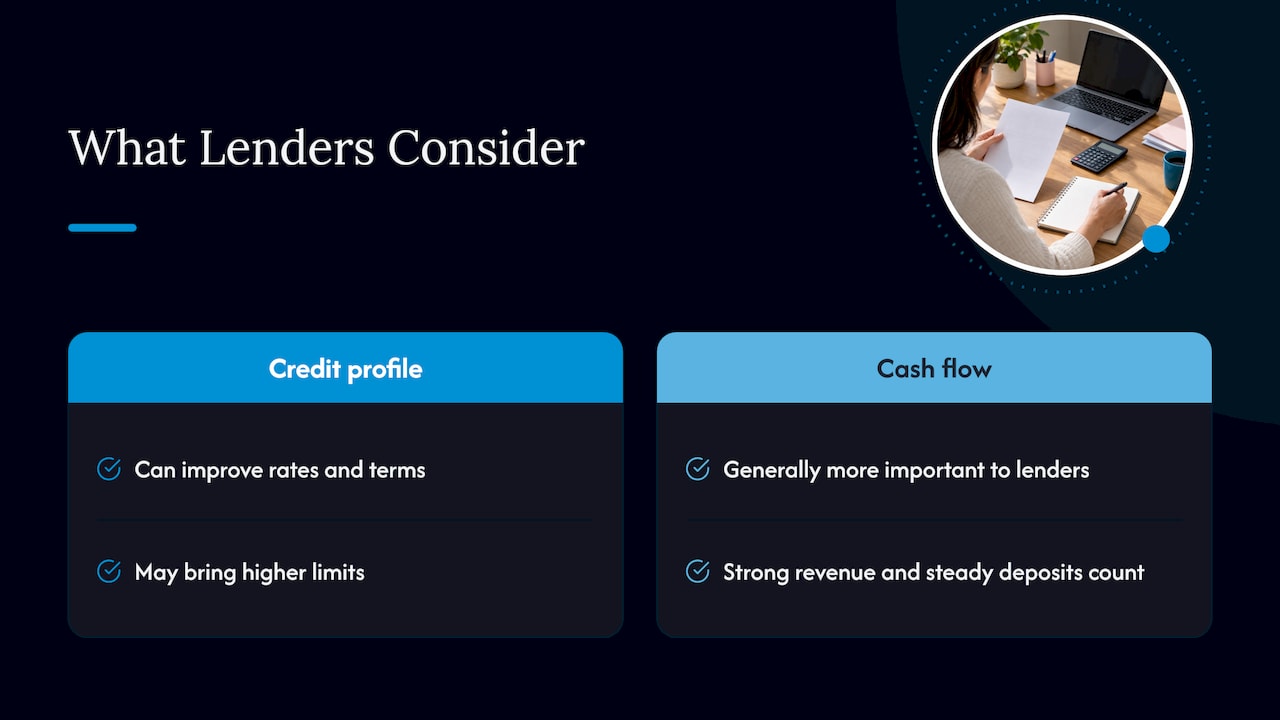
The FDIC says that with good business credit, businesses can often negotiate better interest rates and payment terms, lowering borrowing costs, and that business accounts may carry higher limits than personal ones. It also says that failing to establish business credit may limit your ability to borrow.
But the score is not the only thing lenders read. The FDIC’s instructor guide notes that many lenders use proprietary scores and that cash flow is generally a more important factor, because lenders want confidence that you can cover the debt you request. That is good news for owners with a thin file: strong revenue and steady deposits count. For more on what lenders weigh, see our guide to business loan approval factors.
The law protects you in the process, too. The Equal Credit Opportunity Act applies to business credit as well as personal credit. Lenders cannot discriminate based on race, color, religion, national origin, sex, marital status, age or public assistance, and they must notify you promptly of a denial and give reasons if you ask within 60 days.
Building credit and getting capital are two parallel tracks. If a supplier deadline, a hire or an equipment need is on the calendar, a thin or imperfect file does not have to stop you. Our overview of the bad credit business financing checklist shows how to prepare, and our piece on protecting your credit score while borrowing explains how to keep applications from hurting the profile you are building.
How you borrow also affects your file. Compare structures before you commit; our guide on term loans versus lines of credit is a good starting point. A line of credit used lightly and repaid on schedule is a classic way to add positive history, as long as the account is one that reports.
We talk to owners every week who think they must fix their credit first and borrow second. We see it differently. Credit history and capital grow together: a well-timed funded account, repaid as agreed, is part of how a business earns a stronger profile.
Our model is built for businesses that traditional banks tend to overlook. One short application, access to a wide network of banks and lenders, and decisions that can come within 24 hours, without a hit to your credit score and without collateral.
Our advice is simple. Do the free groundwork now: entity, EIN, bank account, consistent details, a D-U-N-S Number. Then use funding as a tool, pay it on time, and let the record speak for you at your next, larger request.
Rob
Fordham Capital is an online platform that connects small and medium-sized businesses with banks and alternative lenders. You complete a one-page application, there is no credit score impact and no collateral is required, and approvals can come within 24 hours. Fordham Capital also holds an A+ rating with the Better Business Bureau.
The options on our site are an SBA loan at 8% per year, a line of credit at 1-3% per month, and working capital financing. Final terms come from the lender that approves you.
If you are ready to put capital to work, start your application at Fordham Capital.
The fastest honest route is to finish the setup in your first weeks and then open accounts that report to a bureau. Pay each one on time. The CFPB says payment history takes months to years to show, so speed comes from starting early and avoiding mistakes, not from shortcuts.
Sometimes, but a new company with no history often has to offer one at first. As the file matures and the business shows steady cash flow, lenders lean less on the owner’s personal credit. Keep your business details consistent and your payments on time to move along that spectrum.
Checking your own file is a standard monitoring step and is recommended by Dun & Bradstreet for businesses that have or are establishing credit. A funding application with us does not impact your credit score.
Not always. The FDIC notes that cash flow is generally a more important factor than the score, and many lenders use their own scoring. Stronger business credit can still bring better rates and terms over time.
At Fordham Capital, we've made the application process straightforward and reassuring. Dive in and explore your financial options with confidence, knowing there's no impact on your credit score and no obligations. We review your details and offer customized solutions based on what you're looking for.