Buy now, pay later (BNPL) splits a purchase into a few fixed installments, usually starting at checkout. Net terms give you one invoice and a set number of days to pay it, such as net 30. For most business purchases, net terms are the cheaper and simpler fit when a supplier offers them. BNPL is the faster fallback when you need to spread a cost and no trade credit is available. Neither one funds growth on its own, and that is where a line of credit or working capital comes in.
If you are a small business owner deciding how to pay for inventory, equipment or services without draining cash, this guide compares the two on the points that matter: repayment, fees, credit impact, qualification and risk.
Net terms, also called trade credit or payment terms, are the agreed window in which a buyer must settle an invoice. The number after “net” is the number of calendar days from the invoice date. Net 7, 15, 30, 45, 60 and 90 are all in use, and net 30 is the most common standard for U.S. B2B invoices.
You receive the goods or service first, put them to work, and pay from the revenue they help generate. The supplier carries the risk, so the supplier decides who gets terms.
Some terms add an incentive. A 2/10 net 30 term gives the buyer a 2% discount for paying within 10 days, with the full amount due in 30. Paying early on a term like that is one of the cheapest sources of return a small business has.
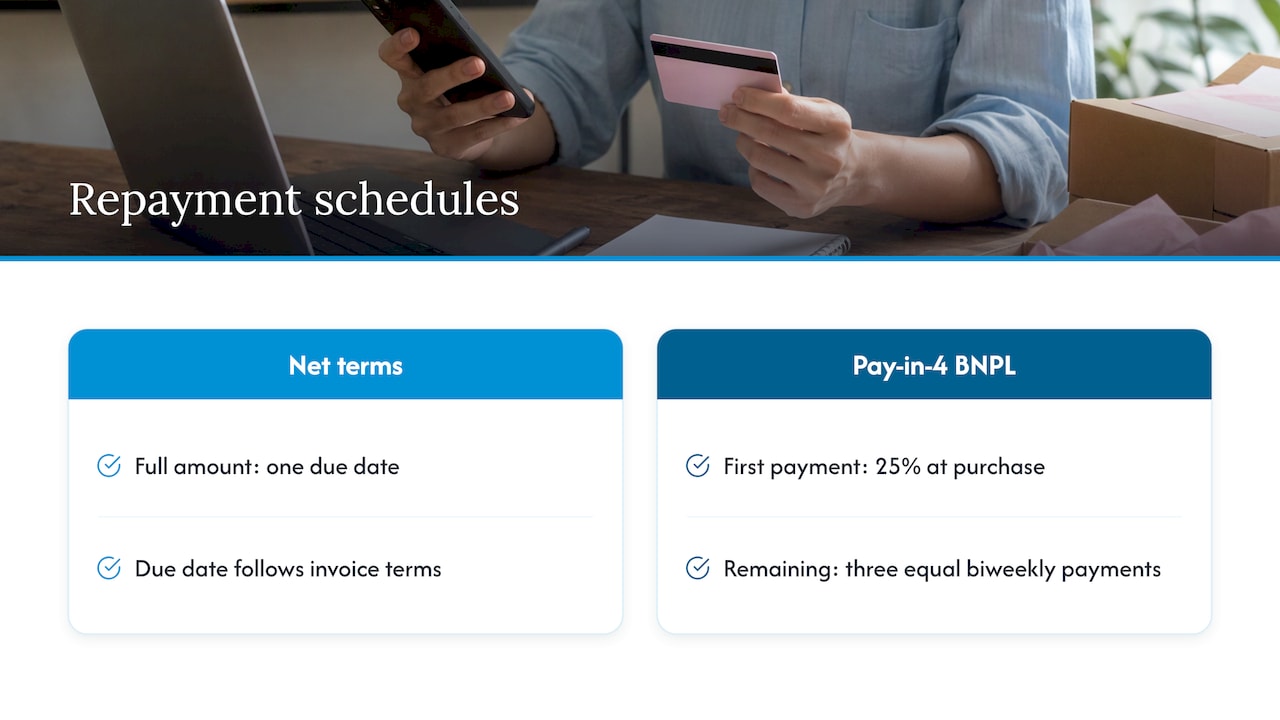
BNPL is short-term financing tied to one purchase. The CFPB describes the typical consumer version as four fixed biweekly or monthly payments, with approval in minutes and no interest or finance charges. The Kansas City Fed describes the common Pay-in-4 structure as 25% at purchase, then three equal payments every two weeks, usually after a soft credit check.
Larger purchases work differently. Monthly installment products for bigger tickets may run longer and charge interest or other fees. So “BNPL” is not one product. Each provider has its own terms, and you have to read them.
BNPL started as a consumer checkout tool, and it is now spreading into B2B. Some suppliers also pair bulk pricing with financing programs, such as commercial discounts and financing on larger equipment orders, so it is worth asking a vendor what payment options sit behind a quote.
| Factor | Net terms | BNPL |
|---|---|---|
| Who extends the credit | The supplier | A third-party provider at checkout, or sometimes the seller |
| Repayment shape | One payment, or staggered partial payments on some terms | Several fixed installments |
| Typical timeframe | 7 to 90 days | Weeks to months |
| Cost if paid on time | Usually none; possible early-pay discount | Often none on short plans; interest possible on longer plans |
| Cost if late | Late fees or interest per your agreement; strained supplier relationship | Late fees are common; possible account blocks or collections |
| Approval | Supplier review, often with a trade application | Often minutes, frequently a soft check |
| Best for | Recurring inventory and services from regular vendors | One-off purchases or suppliers that offer no terms |
With net terms, you owe the full amount by one date. Net terms typically count weekends and holidays when working out the due date unless the invoice says otherwise, so a net 30 invoice dated the 1st is due on the 31st, not 30 business days later. Check the invoice, because the clock starts on the invoice date, not the delivery date, unless the agreement says so. Some terms also allow staggered payments, such as partial payments across several intervals.
With BNPL, the first payment is due now and the rest follow on a fixed rhythm. Miss one and the consequences depend on the provider. The CFPB says most BNPL providers charge late fees even when they do not charge interest, and missed payments can lead to blocked future use, collections, and overdraft or NSF fees if an automatic payment fails.
The fees are usually modest per event. In research the CFPB cited, 4.1% of Pay-in-4 loans were assessed late fees, with an average assessed fee of $9.70 and an average collected fee of $5.70. Late fees generally do not compound the way credit-card interest does, but lenders may require autopay and re-present failed payments, which can trigger bank fees.
The practical difference: BNPL penalizes a missed installment with a fee and possible account action. A missed net term payment tends to cost you something harder to price, which is the supplier’s willingness to ship on credit next time.
BNPL approval usually leans on a soft check. The Kansas City Fed notes that eligibility and limits can change as your repayment record builds. The CFPB reports that most BNPL credit was not reported to consumer credit bureaus and generally did not affect consumer scores, although some companies do report late payments. Those findings describe consumer BNPL, so confirm how a specific business-facing provider reports before you rely on it.
Net terms work on the supplier’s own review. Many suppliers report payment history to commercial credit agencies, which can help you build a business credit profile when you pay on time, but practices differ by supplier. If you want to understand how borrowing affects scores, our guide on protecting your credit score during business borrowing walks through it.
The requirements are set by each supplier or provider, so there is no single list. These are the items that come up most often:
References carry real weight with suppliers. Our piece on the role of business references in lending explains how to line them up, and it applies to trade credit applications too. Underwriting logic is similar across credit types, so the factors lenders look at when approving a business loan are a useful checklist for tightening your profile.
Sometimes the issue is not the payment shape, it is the amount or the speed. A supplier wants cash on delivery, a big order is bigger than any single vendor will finance, or you want to buy from several vendors at once. That is a funding question, not a payment-terms question. A business line of credit or term loan lets you pay suppliers on your terms and take advantage of early-pay discounts, and a loan vs a credit card comparison can help you pick the structure.
Stacking. Soft-check approval makes it easy to open several plans. The Kansas City Fed warns that this can allow multiple simultaneous purchases and financial overextension. NACM adds that BNPL can create “phantom debt” that conventional business-credit assessments do not see, and can encourage loan stacking across providers. Keep a single list of every installment and invoice due date, and add them up weekly.
Protections. BNPL may lack the dispute protections of a credit card, and on a return you can stay responsible for payments until the provider processes the merchant’s refund. In 2024 the CFPB took the position that certain digital-account Pay-in-4 products are credit cards under Regulation Z, with disclosures, dispute handling and refund duties, and business-purpose coverage is tied to how business credit cards are regulated. Product structure matters legally, so do not assume every “pay later” product gives you the same rights.
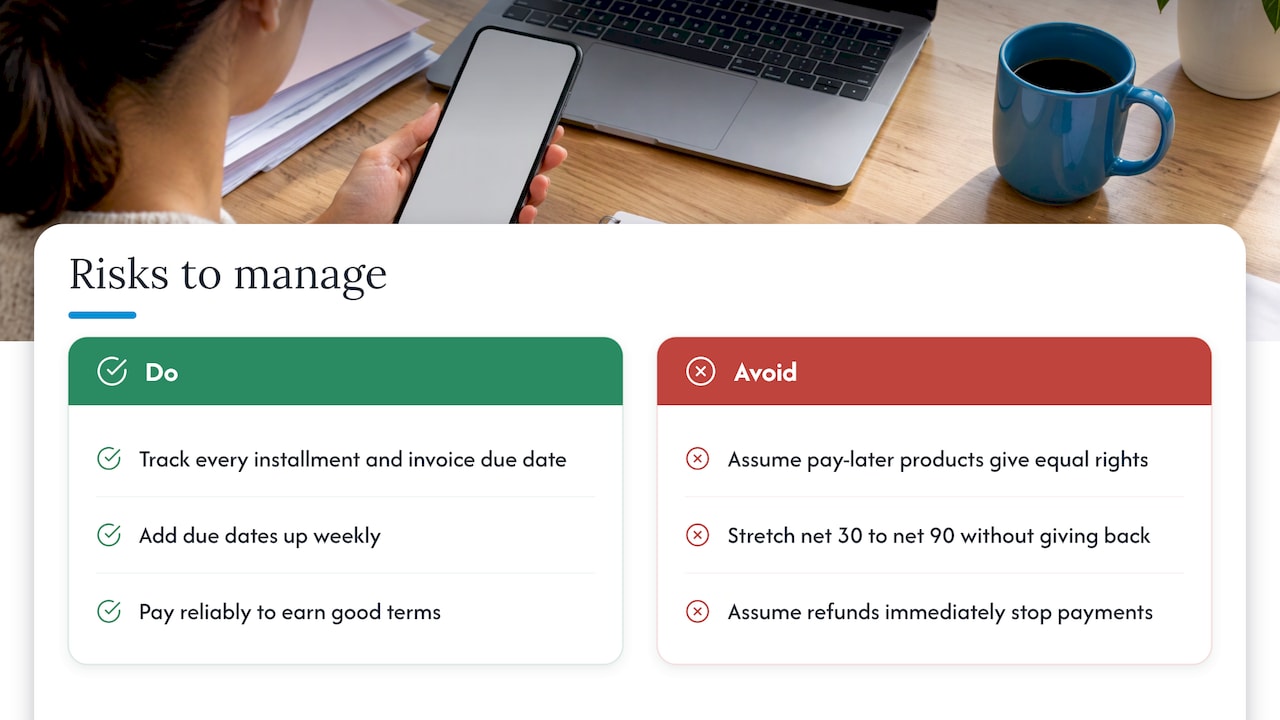
Strained suppliers. If you are on the receiving end of terms, stretch them with care. Pushing a small supplier from net 30 to net 90 without giving anything back is effectively borrowing from their balance sheet, and suppliers may respond with higher prices, deposits or lower priority. Good terms are earned through reliable payment.
The CFPB’s guidance makes the point well: “interest-free” does not mean cost-free, so read the late-fee, autopay and return rules every time.
Business owners often ask us which payment shape is “better,” when the real question is whether the purchase pays for itself before the bill is due.
In our experience, small and medium-sized businesses are the ones most often turned away by traditional banks, and also the ones most likely to be told “no terms” by a new supplier. That is where timing breaks. A deposit is due, the inventory ships, and the revenue is still weeks away.
Our approach is to treat payment terms as one tool and funding as another. When a supplier offers net 30 or an early-pay discount, take it. When they do not, or when the order is too big for one vendor to finance, we connect you to a network of banks and alternative lenders through a one-page application, so you can pay on your own schedule and keep your relationships healthy. Our process is designed to avoid a credit impact at the application stage, and no collateral is required.
Speed matters, and so does transparency. We would rather you know your options and your costs before you commit.
Rob
If a supplier will not extend credit or your order is bigger than a vendor will carry, Fordham Capital can help. We are a marketplace, not a direct lender: you complete one short application and we connect you with banks and alternative lenders in our network. Our approach is built around approvals that can come within 24 hours, with no credit score impact from applying and no collateral required.
The options listed on our site include SBA loans at 8% per year, business lines of credit at 1-3% per month, and working capital financing. Final rates and terms are set by the lender and depend on your business. See SBA loans, lines of credit and working capital, or read how net 30 business credit works for small businesses if you are weighing trade credit as part of your plan.
No. Net 30 is one payment due 30 calendar days after the invoice date, extended by the supplier. BNPL is a set of installments, often four, usually arranged through a provider at checkout. Net 30 is typically free if paid on time, while BNPL may add late fees or interest on longer plans.
Approval for BNPL often uses a soft check, and the CFPB found most BNPL credit was not reported to consumer bureaus, though some companies report late payments. Net terms depend on whether your supplier reports to commercial credit agencies. In both cases, late payments are the main risk to your credit profile.
Often not at first. Many suppliers ask for a trade application and references, and may require prepayment on early orders. Paying on time builds the record that unlocks terms, and a line of credit can cover the gap in the meantime.
Usually net terms with an early-payment discount, such as 2/10 net 30, if you have the cash to pay within 10 days. Paying within the discount window earns 2% against paying on day 30. Otherwise, compare total cost, including late-fee exposure, across your options.
Be cautious with the structure: larger purchases may use monthly installments that can charge interest or fees. Compare the total repayment amount with a lender’s quote for a loan or line of credit, and confirm the payments fit your monthly cash flow before you commit.
At Fordham Capital, we've made the application process straightforward and reassuring. Dive in and explore your financial options with confidence, knowing there's no impact on your credit score and no obligations. We review your details and offer customized solutions based on what you're looking for.