A secured business loan is backed by an asset the lender can claim if you stop paying. An unsecured loan is not tied to a specific asset, so approval rests on your business’s cash flow and track record instead. If you need capital quickly and do not want to put equipment, property or inventory on the line, unsecured funding is usually the cleaner path. At Fordham Capital we connect small and medium-sized businesses to banks and alternative lenders through a one-page application that has no collateral requirement and does not affect your credit score.
This guide shows exactly how the two types differ, what a lender can ask for in each case, what a $100,000 loan can cost, and how to decide.
The FDIC’s small business financing guide describes the split plainly: some financing requires collateral, meaning an asset the borrower pledges, while other financing is unsecured and relies on the borrower’s creditworthiness alone.
Secured loan. You pledge something of value. Common examples are commercial real estate, vehicles and equipment, accounts receivable (money customers owe you) and inventory. If the loan is not repaid, the lender has a legal claim on that asset.
Unsecured loan. No specific asset is pledged. The lender looks at your revenue, bank activity, time in business and repayment history to decide whether the business can carry the payments.

The same FDIC guide notes that lenders generally view seizing collateral as undesirable and prefer to work with borrowers who run into repayment trouble. Collateral is a safety net for the lender, not the outcome anyone is aiming for.
| Factor | Secured business loan | Unsecured business loan |
|---|---|---|
| What backs the loan | A pledged asset | The business’s cash flow and credit profile |
| Paperwork | Asset description, security agreement, often a lien filing, sometimes a valuation | Financial statements or bank data, plus the application |
| Typical speed | Slower, because the collateral has to be documented | Faster, because there is no asset to document |
| Risk to your assets | The pledged asset can be claimed if the loan goes unpaid | No specific asset is pledged |
| Common forms | Term loans against equipment or real estate, asset-based lines | Business lines of credit, working capital financing |
| Best for | Large, long-term purchases such as property or heavy machinery | Short-term needs: payroll, inventory, marketing, seasonal gaps |
The categories overlap in practice. A line of credit can be offered either way, and an SBA loan can be structured with or without collateral depending on the lender and the amount. For lines specifically, our comparison of unsecured vs secured lines of credit goes deeper.
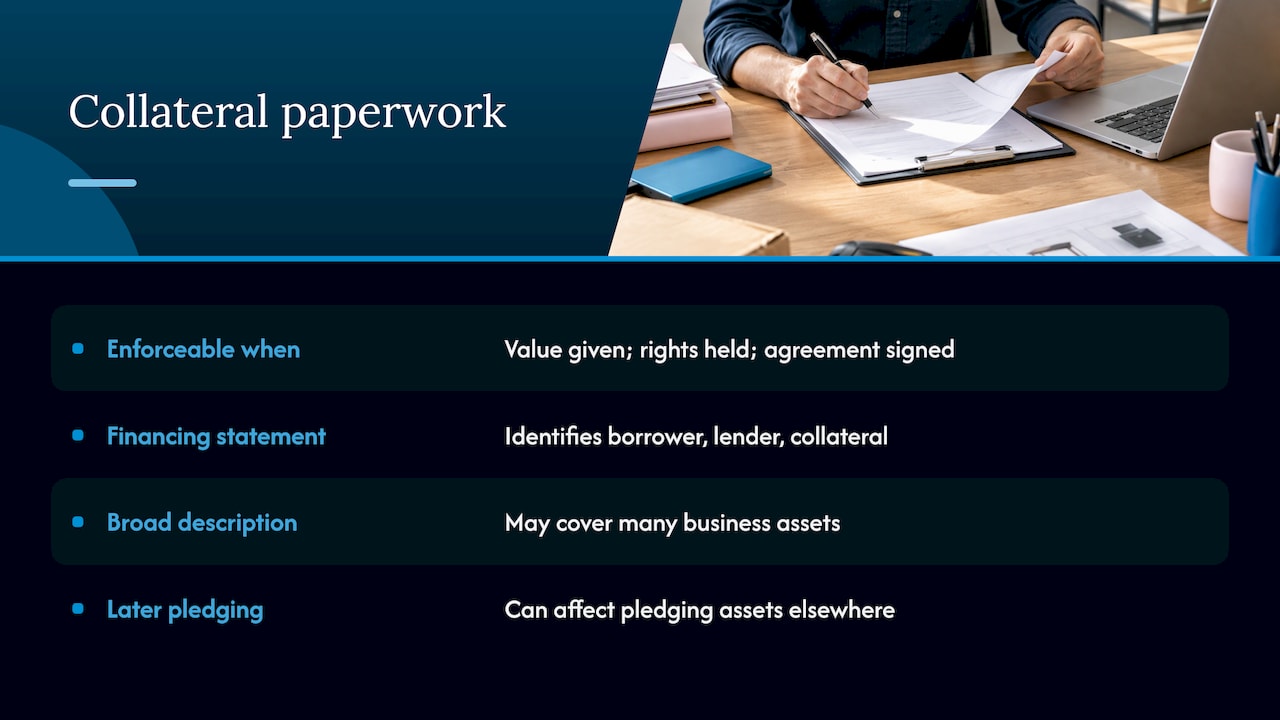
Pledging collateral is a legal process, not a handshake. Under UCC § 9-203, a security interest becomes enforceable when the lender gives value, the borrower has rights in the collateral, and the borrower signs a security agreement that describes it. (The Uniform Commercial Code is the set of commercial rules each state adopts.)
Lenders then usually publicize their claim by filing a financing statement. Under UCC § 9-502, that filing generally has to identify the borrower, the lender and the collateral. A broad description can cover many of your business assets at once, which is why the wording of a security agreement deserves a careful read before you sign. It can also affect how easily you can pledge the same assets to another lender later.
A personal guarantee is your promise, as an individual, to repay if the business cannot. It is not collateral, but it can appear on loans of either type. For SBA-backed loans, 13 CFR § 120.160 states that holders of at least a 20% ownership interest generally must personally guarantee the loan, and that the SBA or its lender may require other individuals or entities to give full or limited guarantees as well.
For owners weighing the federal program against ordinary bank financing, this comparison of SBA versus conventional loans covers how the guarantee picture changes between them.
Before accepting any offer, ask the lender in writing: Is there a lien on business assets? Is there a personal guarantee, and is it full or limited? Those two answers tell you what you are really putting at stake.
Because lenders weigh the five factors the FDIC lists (character, capacity, capital, collateral and conditions), a business short on collateral can still show strength elsewhere. Capacity, the ability of the business’s income to cover payments, carries most of the weight for unsecured funding.
In practice that means lenders look at:
Our guide to what lenders look for in business loan approvals walks through each factor, and how unsecured approval works for small businesses shows what the process looks like when no asset is involved.
If your credit is less than perfect, that does not automatically close the door. Collateral-light and collateral-free products exist for businesses whose strength is revenue rather than assets, and checking what you qualify for through Fordham Capital does not impact your credit score.
Every secured loan has an extra track running alongside underwriting: identifying the asset, describing it in a security agreement, filing a lien and, for property or equipment, often confirming its value. Each step adds days or weeks.
An unsecured request skips that track. With Fordham Capital, the application is one page, and approvals can come within 24 hours. For a payroll gap, a supplier discount that expires, or a seasonal inventory buy, that timing is often the whole point of the loan. Our post on why collateral requirements block business loans explains how asset requirements keep many otherwise healthy businesses from getting funded at all.
Cost depends on the product, not only on whether it is secured. Lenders price for risk, and the structure of the repayment matters as much as the headline number. Here is an illustration using the pricing published on our site.
| Product | Published pricing | Simple illustration on $100,000 |
|---|---|---|
| SBA loan | 8% per year | About $8,000 in interest over a year, before fees and before the balance shrinks with repayments |
| Line of credit | 1-3% per month | $1,000 to $3,000 a month on a fully drawn $100,000, less if you draw only part of the line |
| Working capital | No published price | Depends on the offer you receive |
These are simple arithmetic examples, not quotes. Your actual terms depend on the lender and your business profile. Three habits keep the comparison honest:
Our breakdown of how lenders price unsecured business loans goes through the factors that move an offer up or down.
Some purchases suit secured financing, for example buying a building or a major piece of equipment that itself becomes the collateral. If you pledge an asset, pick one you can afford to see tied up and that is not essential to daily operations. The same logic applies to any form of pledged value; this walkthrough on choosing a collateral asset shows how that thinking works with a different asset class.
For most day-to-day operating needs, though, keeping your equipment, receivables and inventory free is the simpler route.
If you want the longer view on why more owners are skipping pledged assets, read why collateral-free loans suit businesses in 2026. And if you are looking at SBA financing specifically, SBA loan collateral for U.S. businesses covers what applies there.
Most owners we talk to ask the wrong first question. They ask which type of loan is cheaper, when the better question is what the loan puts at risk and how fast they need the money.
Our approach is built around the second question. A one-page application and a network of banks and lenders mean you do not have to knock on one door at a time, and no collateral requirement means your equipment, inventory and receivables stay yours. Approvals can come within 24 hours, and checking does not touch your credit score.
We have funded over $120M and our clients have gone on to generate more than $500M in revenue. We hold an A+ BBB rating, and that comes from doing the plain things well: explaining the terms, answering questions and matching you with funding that fits the business you actually run.
Rob
Fordham Capital is an online platform that connects small and medium-sized businesses with banks and alternative lenders. You complete one page, no collateral is required, and your credit score is not impacted when you apply. Options include SBA loans at 8% per year, business lines of credit at 1-3% per month, and working capital financing. An advisor supports you through the process.
See what you qualify for at Fordham Capital.
A secured loan is backed by a pledged asset the lender can claim if repayment stops. An unsecured loan has no specific asset behind it, so the lender relies on your business’s income and credit profile. Both can involve a personal guarantee, so read the terms before signing.
Often yes. Lenders weigh several factors, including your revenue and capacity to repay, not only a credit score. With Fordham Capital you can apply through a one-page form without a credit score impact and see which funding options are available.
Not necessarily. A guarantee is a separate promise from the owner, and many lenders ask for one. On SBA-backed loans, owners of at least 20% of the business generally must guarantee the loan under 13 CFR § 120.160. Ask every lender whether a guarantee applies and how far it extends.
Without an asset to document and file against, the process is shorter. Through Fordham Capital, approvals can arrive within 24 hours of a one-page application, with funding timing depending on the lender and offer.
It depends on the product and term. As a simple illustration, 8% per year on $100,000 is about $8,000 in interest over a year before fees, and a line of credit at 1-3% per month on a fully drawn $100,000 is $1,000 to $3,000 per month. Always compare the total repayment amount.
At Fordham Capital, we've made the application process straightforward and reassuring. Dive in and explore your financial options with confidence, knowing there's no impact on your credit score and no obligations. We review your details and offer customized solutions based on what you're looking for.