
A business installment loan gives you a lump sum that you repay in scheduled payments until it is gone. Business revolving credit, usually a line of credit, gives you a limit you can draw from, repay and draw from again. For most small businesses with uneven cash flow, a revolving line of credit is the more flexible everyday tool, and an installment loan fits a single, defined purchase. At Fordham Capital we connect owners to both through one short application, with a line of credit priced at 1-3% per month and SBA loans at 8% per year.
The FDIC describes two main loan categories. An installment loan is repaid in equal payments over a specific period, usually several years, while a revolving loan or line of credit lets you borrow up to a pre-approved limit with payments that vary by how much you owe. Either type can be secured by collateral (an asset the lender can claim if you do not repay) or unsecured.
For a business, that translates into two very different experiences.
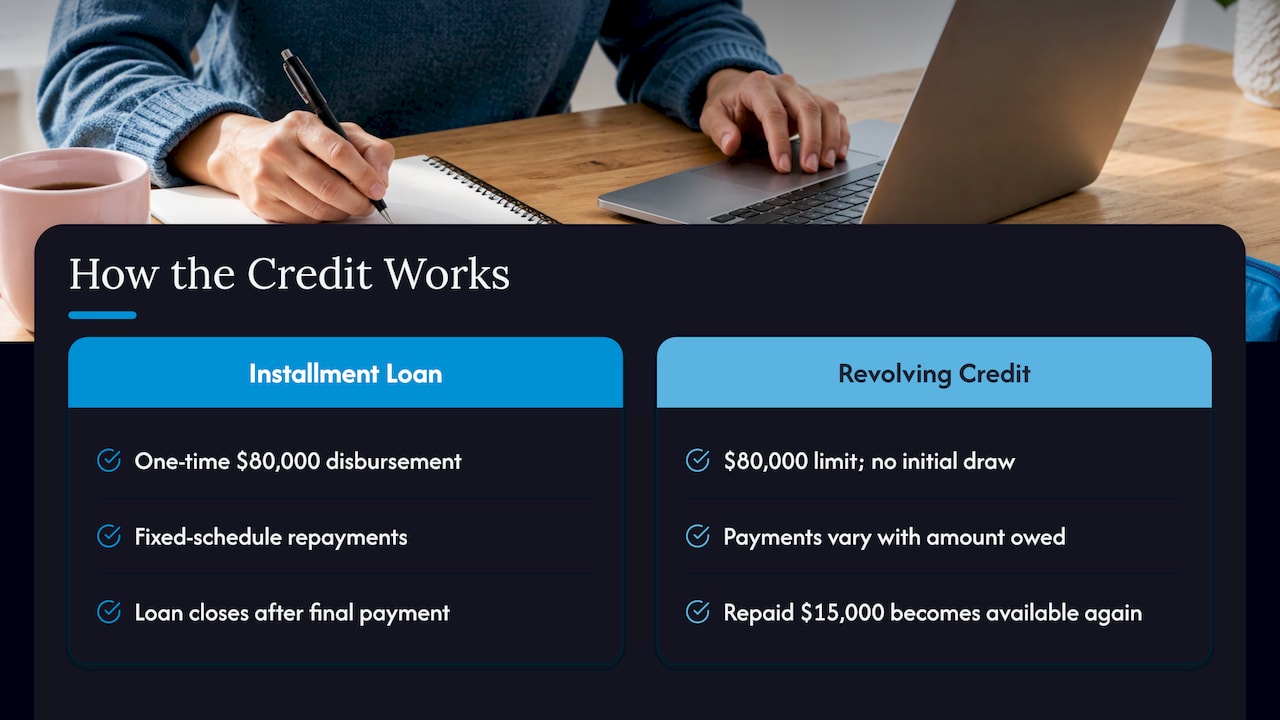
Installment loan. You borrow, say, $80,000 for a new oven or a vehicle. The money arrives in one piece, and you repay it on a fixed schedule. When the last payment is made, the loan closes. If you need more money later, you apply again.
Revolving credit. You are approved for a limit, say $80,000, and nothing is borrowed yet. You draw $15,000 to cover a slow month, repay it as revenue comes in, and the $15,000 is available again. The account stays open as long as you keep it in good standing.
The FDIC’s small business guide puts the line of credit this way: a flexible, revolving form of financing where a business borrows up to a set limit, repays, and can keep borrowing.
| Installment loan | Revolving credit (line of credit) | |
|---|---|---|
| How you get the money | One lump sum | Draw as needed up to a limit |
| Repayment | Fixed, equal payments on a schedule | Payments vary with the balance |
| Term | Fixed end date | Stays open while in good standing |
| Interest charged on | The full amount borrowed | The amount you actually use |
| After repayment | Loan closes, reapply for more | Funds become available again |
| Best for | One-time purchases and projects | Cash flow, payroll, inventory, surprises |
The repayment difference matters most day to day. An installment payment is the same every month, so it is easy to budget. A revolving payment follows your balance: borrow less and the payment is smaller, and when you repay quickly, you free up the limit for the next need.
A fixed payment gives you a clear picture of what the debt costs each month and when it ends. That makes sense when the thing you are buying has a known price and a long useful life: equipment, a build-out, a vehicle, an acquisition.
The tradeoff of the structure is that you borrow the full amount up front. If your project comes in cheaper or you only need part of the money right away, you still carry the whole balance.
With a line of credit, you decide how much to borrow and when. A restaurant can draw before a busy season to stock up. A contractor can cover materials while waiting for a client to pay an invoice, then repay when the check clears. A retailer can fund holiday inventory and clear the balance in January.
Because the line replenishes, one approval can cover many needs over time instead of a new application for each. Our guide to small business line of credit uses walks through the situations where owners reach for it most.
Some lines of credit are not revolving. A non-revolving line works like an installment structure: you borrow a flat amount and pay it off over a set period, whereas a revolving line behaves like a credit card with a balance that rises and falls. The SBA’s CAPLines program offers both kinds, including seasonal, contract, builders and working capital lines, with short-term credit guaranteed up to $5 million. If your need is tied to a contract or a season, our breakdown of the SBA CAPLines program shows how the lender you work with shapes the result.
Cost is where owners often compare the wrong numbers. A rate on an installment loan and a rate on a line of credit are not measured the same way, so look at what you will actually pay over the time you will actually borrow.
Installment loans. The FDIC’s guide describes short-term business installment loans as typically running under a year, with rates ranging from 6% to 36% and amounts typically up to $250,000. Long-term versions typically run 12 to 60 months, with rates of roughly 5% to 15%, and are usually secured by collateral. Interest accrues on the full balance, reduced as you pay it down.
SBA-backed loans. SBA 7(a) loans are installment loans with a government guarantee. The SBA sets ceilings: for loans of $50,000 or less, the rate cannot exceed the base rate plus 6.5%, with lower margins as the loan gets larger. Our SBA loan offer is published at 8% per year.
Revolving credit. You pay interest and any fees on the drawn balance, not the whole limit. Our line of credit is priced at 1-3% per month. If you draw $20,000 for six weeks and then repay, you pay for those six weeks, not for a year on a $100,000 limit. That is the practical advantage for any cost that comes and goes.
Fast approvals can come at a price on some products. The Federal Reserve notes that when origination fees and repayment periods are counted, average APRs from online alternative lenders tend to run higher than traditional bank products, and some borrowers accept that for an easy application, a quick decision and rapid funds. That is why we show the price of each product plainly and why a line of credit used for short periods is worth comparing against a long-term loan for the same need.
Say a landscaping company needs $30,000 each spring for equipment rentals and seasonal labor, and repays it by midsummer.
Now flip it. The same company wants to buy a $90,000 truck that will serve for eight years. The fixed payments of an installment loan line up with the truck’s lifespan and keep the cost predictable. The truck is the installment loan’s job; the spring cash crunch is the line of credit’s.
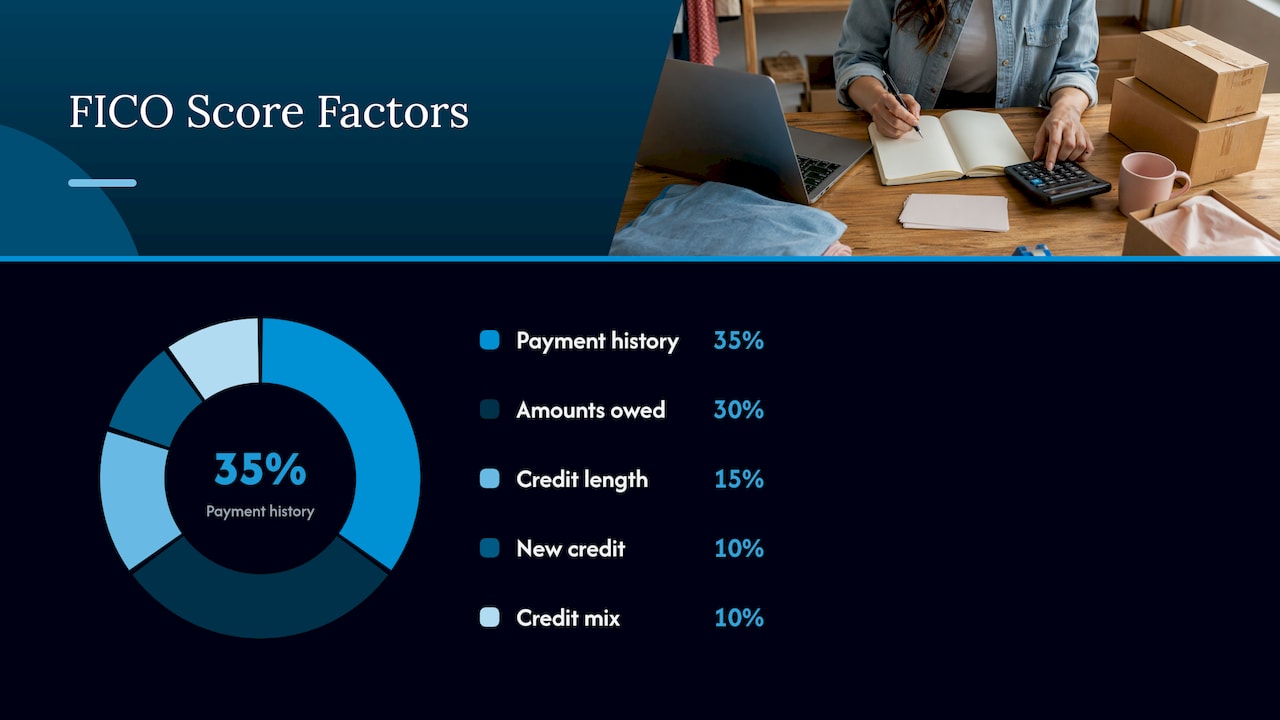
Both structures can help build credit, as long as the lender reports your payments and you make them on time. Lenders and scoring models look at the same basics. The FDIC lists the factors in a personal FICO score: payment history 35%, amounts owed 30%, length of credit history 15%, new credit 10% and credit mix 10%. The same guide notes that business credit reporting agencies include Dun & Bradstreet, Experian Business and Equifax Small Business, and that some models blend personal and business history.
Two things follow for a business owner.
The moment of applying matters too. Many lenders run a hard credit check, which can count as new credit. Our application does not impact your credit score, so you can see your options first. For the factors lenders weigh once you apply, read what lenders look for in loan approvals.
How fast you get funded depends less on whether the product is revolving or installment and more on the lender’s process. The Federal Reserve explains that lenders use credit scoring mainly to approve, deny or flag applications for further review, that smaller business loans are more likely to be decided on score alone, and that automated scoring can return decisions in minutes or hours rather than days or weeks. Larger, secured or SBA-backed loans take longer because there is more to review. See our timeline guide, small business loan timelines and five steps to speed it up, for what to prepare.
On requirements, collateral is the big difference. Long-term installment loans are usually secured. SBA guarantees exist to help here: the SBA promises to repay some or all of a borrower’s debt if the borrower defaults, which helps businesses with limited credit history or collateral get loans, often on better terms. Through Fordham, funding does not require collateral, and approvals can come within 24 hours.
Start with the need, not the product.
Choose revolving credit when:
Choose an installment loan when:
Use both when you have a long-term investment and day-to-day cash needs. A common pattern is an installment loan or SBA loan for the big purchase and a line of credit for working capital around it. Our comparison of a startup loan vs. a line of credit goes deeper for companies in their first years.
A lower score does not close every door. Alternative and non-bank lenders weigh factors such as revenue and cash flow, and a marketplace can match you with the lender whose criteria fit your profile. Read why businesses choose non-bank lenders for fast funding. Keep in mind that approval standards have shifted: the Federal Reserve’s 2022 Small Business Finance report found that 75% of online-lender applicants were at least partially approved in 2017 versus 52% in 2021. Reaching several lenders through one application improves your odds of finding the match.
Owners come to us with a deadline and a gap, not a definition. Payroll is Friday. A supplier wants a deposit. A big order needs inventory first.
In those moments, we think a line of credit is the strongest first tool for most small businesses. You are approved once, you draw only what you need, and you pay for the days you use it. Money that comes back to you is available again, which matches how a small business really runs.
An installment loan, including an SBA loan, is the right companion when you are buying something big and lasting. We offer both, along with working capital financing, because the right answer depends on the job the money has to do.
What we built is meant to remove the usual friction: a one-page application, access to a wide network of banks and lenders, no impact on your credit score, and no collateral required. Our job is to match your need to the structure that fits it.
Rob
Fordham Capital is an online marketplace that connects small and medium-sized businesses to a network of banks and alternative lenders. You complete one page, with no impact on your credit score and no collateral required, and approvals can come within 24 hours. Our offers include an SBA loan at 8% per year, a line of credit at 1-3% per month and working capital financing. Start at Fordham Capital and tell us what the money is for.
If you want to see how lenders in a network compare before you apply, our guide to comparing business lenders for fast approval lays out what to look at, and the lender network benefits explain why one application reaching many lenders helps.
Most business lines of credit are revolving: you borrow up to a limit, repay, and borrow again. Some are non-revolving, where you draw a flat amount and repay it over a set period, much like an installment loan. Confirm which type you are being offered before you accept.
Term loans, equipment loans and SBA 7(a) loans are installment credit, repaid on a schedule until the balance is zero. Lines of credit and business credit cards are revolving. Working capital financing can be structured either way, depending on the lender.
It can, in both directions. On-time payments help your payment history, and a low balance compared with your limit looks healthy under the “amounts owed” factor. A hard inquiry at application may count as new credit. Our application does not impact your credit score.
Yes, and many businesses do. An installment or SBA loan covers a large, one-time investment, while a line of credit handles recurring cash flow needs. Lenders see a mix of credit types as part of a healthy profile, as long as payments are on time.
At Fordham Capital, we've made the application process straightforward and reassuring. Dive in and explore your financial options with confidence, knowing there's no impact on your credit score and no obligations. We review your details and offer customized solutions based on what you're looking for.